Bird App
Bird of the day
Canada goose
Branta canadensis
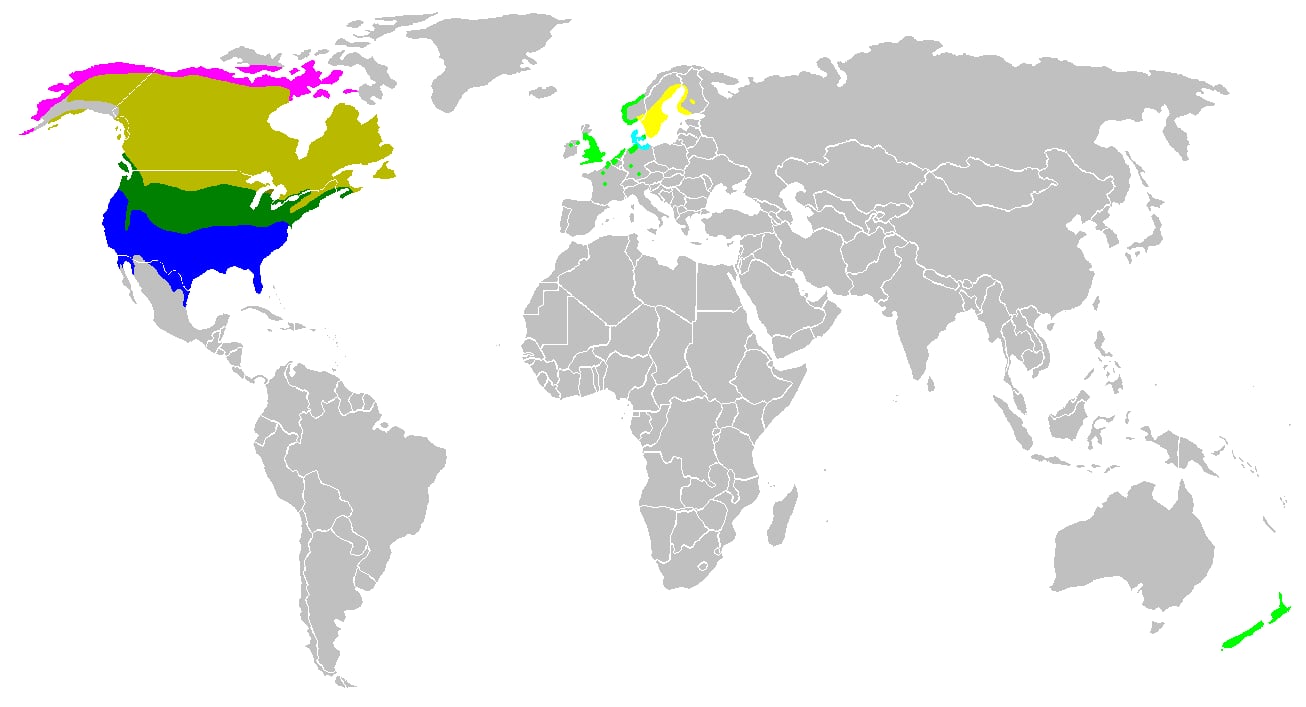
The Canada goose (Branta canadensis) is a large species of goose with a black head and neck, white cheeks, white under its chin, and a brown body. It is native to the arctic and temperate regions of North America, and it is occasionally found during migration across the Atlantic in northern Europe. It has been introduced to France, the United Kingdom, Ireland, Scandinavia, New Zealand, Japan, Chile, Argentina, and the Falkland Islands. Like most geese, the Canada goose is primarily herbivorous and normally migratory; often found on or close to fresh water, the Canada goose is also common in brackish marshes, estuaries, and lagoons.
Extremely adept at living in human-altered areas, Canada geese have established breeding colonies in urban and cultivated habitats, which provide food and few natural predators. The success of this common park species has led to it often being considered a pest species because of its excrement, its depredation of crops, its noise, its aggressive territorial behavior toward both humans and other animals, and its habit of stalking and begging for food, the latter a result of humans disobeying artificial feeding policies toward wild animals.
The black head and neck with a white "chinstrap" distinguish the Canada goose from all other goose species except the cackling goose and barnacle goose (the latter, however, has a black breast and gray rather than brownish body plumage). Some Canada geese come with a pepper-spotted or brown neck with brown plumage, and these are assumed to be a leucistic variety.
The seven subspecies of this bird vary widely in size and plumage details, but all are recognizable as Canada geese. Some of the smaller races can be hard to distinguish from the cackling goose, which slightly overlap in mass. However, most subspecies of the cackling goose (exclusive of Richardson's cackling goose, B. h. hutchinsii) are considerably smaller. The smallest cackling goose, B. h. minima, is scarcely larger than a mallard. In addition to the size difference, cackling geese also have a shorter neck and smaller bill, which can be useful when small Canada geese comingle with relatively large cackling geese. Of the "true geese" (i.e., the genera Anser and Branta), the Canada goose is on average the largest living species, although some other species that are geese in name, if not of close relation to these genera, are on average heavier, such as the spur-winged goose and Cape Barren goose.
Canada geese range from 75 to 110 cm (30 to 43 in) in length and have a 127–185 cm (50–73 in) wingspan. Among standard measurements, the wing chord can range from 39 to 55 cm (15+1⁄2 to 21+1⁄2 in), the tarsus can range from 6.9 to 10.6 cm (2+11⁄16 to 4+3⁄16 in) and the bill can range from 4.1 to 6.8 cm (1+5⁄8 to 2+11⁄16 in). The largest subspecies is B. c. maxima, or the giant Canada goose, and the smallest (with the separation of the cackling goose group) is B. c. parvipes, or the lesser Canada goose. An exceptionally large male of race B. c. maxima, which rarely exceed 8 kg (18 lb), weighed 10.9 kg (24 lb) and had a wingspan of 2.24 m (7 ft 4 in). This specimen is the largest wild goose ever recorded of any species.
The male Canada goose usually weighs 2.6–6.5 kg (5+3⁄4–14+1⁄4 lb), averaging amongst all subspecies 3.9 kg (8+1⁄2 lb). The female looks virtually identical, but is slightly lighter at 2.4–5.5 kg (5+1⁄4–12+1⁄4 lb), averaging amongst all subspecies 3.6 kg (8 lb), and generally 10% smaller in linear dimensions than the male counterparts. The honk refers to the call of the male Canada goose, while the hrink call refers to the female goose. The calls are similar, however, the hrink is shorter and more high-pitched than the honk of males. When agitated or aggressively defending territory, Canada geese will typically initiate an encounter with a high-pitched hiss. Canada geese communicate with ten different vocalizations, each in response to a different situation confronting them.
Aliases
Branta canadensis, Lesser Canada Goose, Greater Canada Goose, Canadian Geese, Canada goose
Range