Bird App
Bird of the day
Sharp-tailed ibis
Cercibis oxycerca
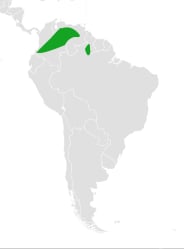
The sharp-tailed ibis (Cercibis oxycerca) is a species of ibis native to open wet savannas in parts of northern South America.
This large ibis measures 75–86 cm in length, with males being slightly larger than females. In adult males, the flat wing measures 390–415mm lengthways, and the culmen measures 156–168mm from the base of the bill. In adult females, the wing is 376–413mm long and the culmen 144–197mm.
The species is distinguished by its notably long tail, the longest among all extant ibis species; measuring 250–301mm in males and 256–272mm in females. The tail projects beyond the tips of the folded wings when the ibis stands; and beyond the trailing legs in flight. The plumage is predominantly black with greenish glossing; and with purplish tinges on the upper back, hindneck, wings and tail. The forehead and cheek region are occasionally greyish brown. Juveniles appear similar to adults, but their plumage lacks a metallic sheen.
The bill, legs, toes, and bare facial skin are orangey-red; the throat is yellowish-orange, and a feathered grey strip extends below the eye from the lower mandible. An inconspicuous fuzzy crest extends down the back of its head and upper neck. The iris is greyish red, but is sometimes scarlet red, which may be associated with breeding. Nothing is however known of changes in soft part colourations as part of courtship. Overall, the sharp-tailed ibis is superficially similar to many sympatric ibises such as the glossy ibis and the bare-faced ibis; but clearly differs through its longer tail and larger body size.
This ibis is particularly vocal. The call is a loud, distinct single or double cuk or turuck; or kut and kut-kaaaoh. These calls resemble the sound of a saxophone or toy trumpet. Flight calls have been transcribed as a long drawn-out tuuut, as a cuk cuk cuk cuk and as a loud nasal TUUR-DEE. The male is believed to utter the TUUR element, and the female utters the following DEEE in response. The timbre of the TUUR-DEE call has earned it the local Spanish name Tarotaro.
The sharp-tailed ibis has a slow, laboured flight; with individuals flying low above the ground and often only covering short distances such as between neighbouring trees. However, they have been observed to fly across wide-open expanses of grassland toward roosting or feeding sites. Due to its noisy wing beating, it is often heard before coming into view.
Aliases
Cercibis oxycerca
Range