Bird App
Bird of the day
Russet sparrow
Passer cinnamomeus
The russet sparrow (Passer cinnamomeus), also called the cinnamon or cinnamon tree sparrow, is a passerine bird of the sparrow family Passeridae. A chunky little seed-eating bird with a thick bill, it has a body length of 14 to 15 cm (5.5–5.9 in). Its plumage is mainly warm rufous above and grey below. It exhibits sexual dimorphism, with the plumage of both sexes patterned similarly to that of the corresponding sex of house sparrow. Its vocalisations are sweet and musical chirps, which when strung together form a song.
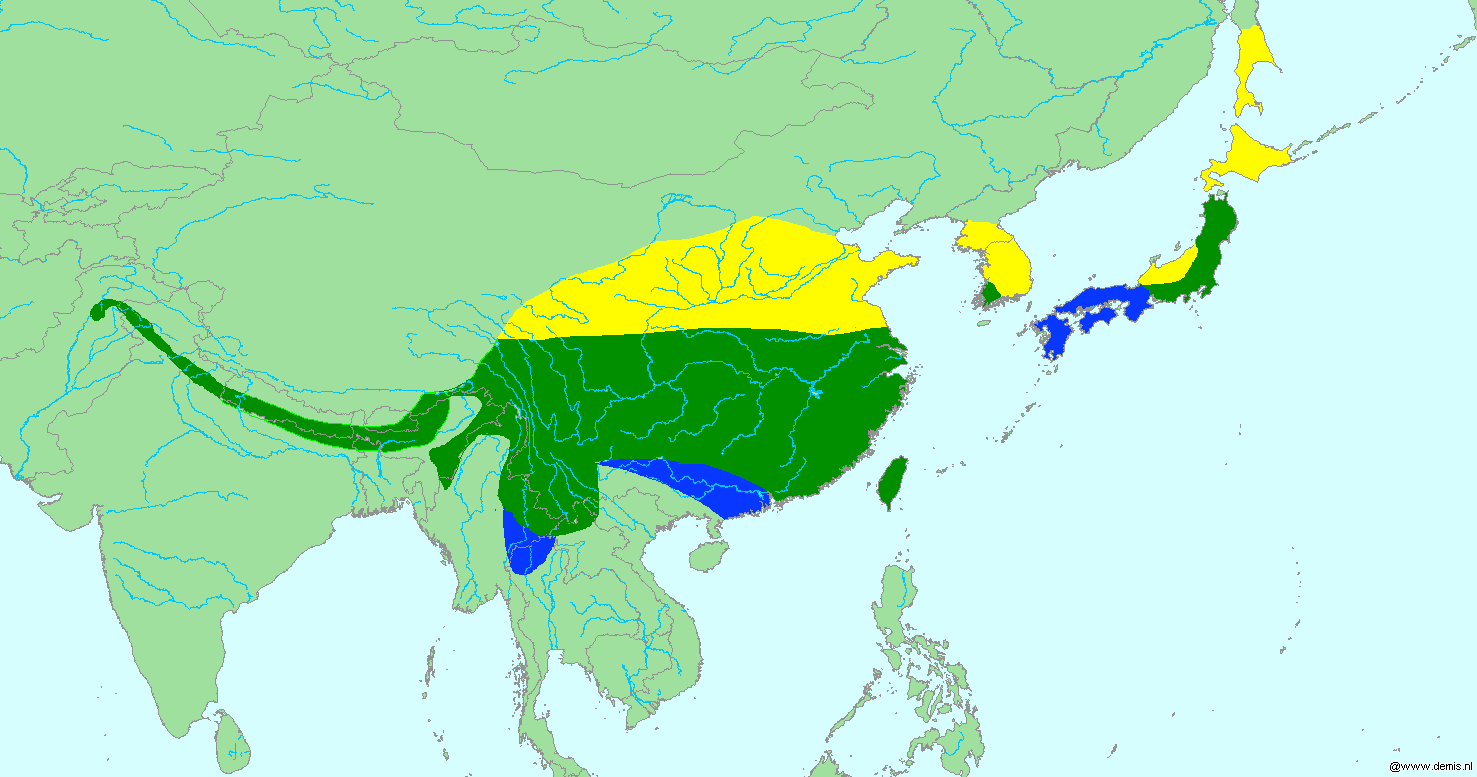
Three subspecies are recognised, differing chiefly in the yellowness of their underparts. The subspecies rutilans and intensior breed in parts of eastern Asia, where they are usually found in light woodland, and the subspecies cinnamomeus breeds in the Himalayas, where it is usually associated with terrace cultivation. The russet sparrow is the typical sparrow of human habitations in towns where the house and Eurasian tree sparrows are absent. In the southern part of its range, the russet sparrow prefers higher altitudes, but in the north it breeds by the sea. The russet sparrow is known well enough in the Himalayas to have a distinct name in some languages, and is depicted in Japanese art.
This sparrow feeds mainly on the seeds of herbs and grains, but it also eats berries and insects, particularly during the breeding season. This diet makes it a minor pest in agricultural areas, but also a predator of insect pests. While breeding, it is not social, as its nests are dispersed. It forms flocks when not breeding, although it associates with other bird species infrequently. In some parts of its range, the russet sparrow migrates, at least to lower altitudes. Its nest is located in a tree cavity, or a hole in a cliff or building. The male chooses the nest site before finding a mate and uses the nest for courtship display. The typical clutch contains five or six whitish eggs. Both sexes incubate and feed the young.
The russet sparrow is a small chunky bird, with plumage warm rufous in overall colour. It is a medium-sized sparrow at 14 to 15 cm (5.5–5.9 in) and 18 to 22.5 grams (0.63–0.79 oz). It has a thick bill suited to eating seeds, which is black on the breeding male, horn-coloured on the non-breeding male, and yellowish with a dark tip on the female. Wingspans for males range between 6.8 to 8.2 cm (2.7–3.2 in) and those for females from 6.7 to 7.7 cm (2.6–3.0 in). Tail, bill, and tarsus lengths are 4.3 to 5.1 cm (1.7–2.0 in), 1.1 to 1.3 cm (0.43–0.51 in), and 1.6 to 1.8 cm (0.63–0.71 in), respectively.
Measurements for the russet sparrow vary geographically, between the three subspecies, and also within the Himalayan subspecies cinnamomeus. The subspecies cinnamomeus is generally larger than the others, and within this form there is a tendency for birds at higher altitudes to be larger, and a clinal variation in size with the smallest birds in the west of the range and the largest in the east.
The iris is chestnut in colour. The legs of both sexes are pale brown to pinkish-brown. The flight of all sparrows is swift, and that of the russet sparrow is described as swifter and more direct than that of the Eurasian tree sparrow.
The sexes differ, or are dimorphic, in their plumage, and have a similar pattern to that in the corresponding sex of house sparrow. There is some variation between the three subspecies, especially in the colouration of the underparts. Birds of the subspecies rutilans are off-white on their cheeks and the sides of their necks, and have pale grey underparts. Birds of the subspecies intensior have a pale yellow wash on their underparts and cheeks, as well as darker upperparts, while those of the subspecies cinnamomeus have a heavy yellow tinge to their underparts.
Moult is poorly recorded, the only records coming from Sakhalin and Himachal Pradesh. In Sakhalin, moult occurs in August and September, between the breeding season and migration. In Himachal Pradesh, aviculturalist G. A. Perreau observed captive and wild birds and reported that they were yellow from December to spring and whitish during the remainder of the year, a pattern which may be atypical.
The breeding male is bright russet or cinnamon red on its upperparts from its crown to its rump, with a black streaking on its mantle. It has a small black bib and black around its eye, separated from the russet of its crown by a very thin white supercilium, a stripe running from the bill to the rear of the head. The side of its neck and cheek are off-white, and its underparts are pale grey or washed with yellow, varying geographically. Shoulders and greater coverts are chestnut, and its median coverts are black at the base with white at the tips. The rest of the wing is light brown with black tinges. Its tail is blackish brown, edged with ashy brown. The non-breeding male differs little from the breeding male, being paler with more orange upperparts. The only species with which the male is easily confused is the Eurasian tree sparrow, which differs in its black cheek spot and brown back.
The female has mostly pale brown upperparts, and pale grey underparts, so it resembles the female house sparrow. It differs from the house sparrow in its slightly darker, russet-tinged plumage. It has a conspicuous cream supercilium from above its eye nearly around its head, and a bold dark brown stripe through its eye. It has mostly greyish brown wings and a back streaked with black and buff. The juvenile is similar to the female, though more pale and sandy. As the male reaches its first winter, it resembles the adult, differing in less bold chestnut and a dusky bib.
The russet sparrow's vocalisations are described by most sources as "the sweetest and most musical" of any sparrow. Its basic call is a cheep or chilp, similar to that of other sparrows. This call is monosyllabic, unlike the house sparrow's chirrup call, and is softer than that of the other sparrows. This call is given as a flight call, or by displaying males. Recorded variations include a chweep given by males at the nest and a trilled cheeep. Sometimes the male strings calls together and sings them in a strident tone, to create a sort of short song, transcribed as cheep chirrup cheeweep or chreet-chreet-chreet. The song is interspersed with sibilant chu-swik notes similar to those of the white wagtail. A thin swee swee vocalisation not unlike that of an Indian robin has been reported, but the context of this call is unrecorded. During territorial disputes, males give a rapid chit-chit-chit call.
Aliases
Passer cinnamomeus
Range