Bird App
Bird of the day
Whistling warbler
Catharopeza bishopi
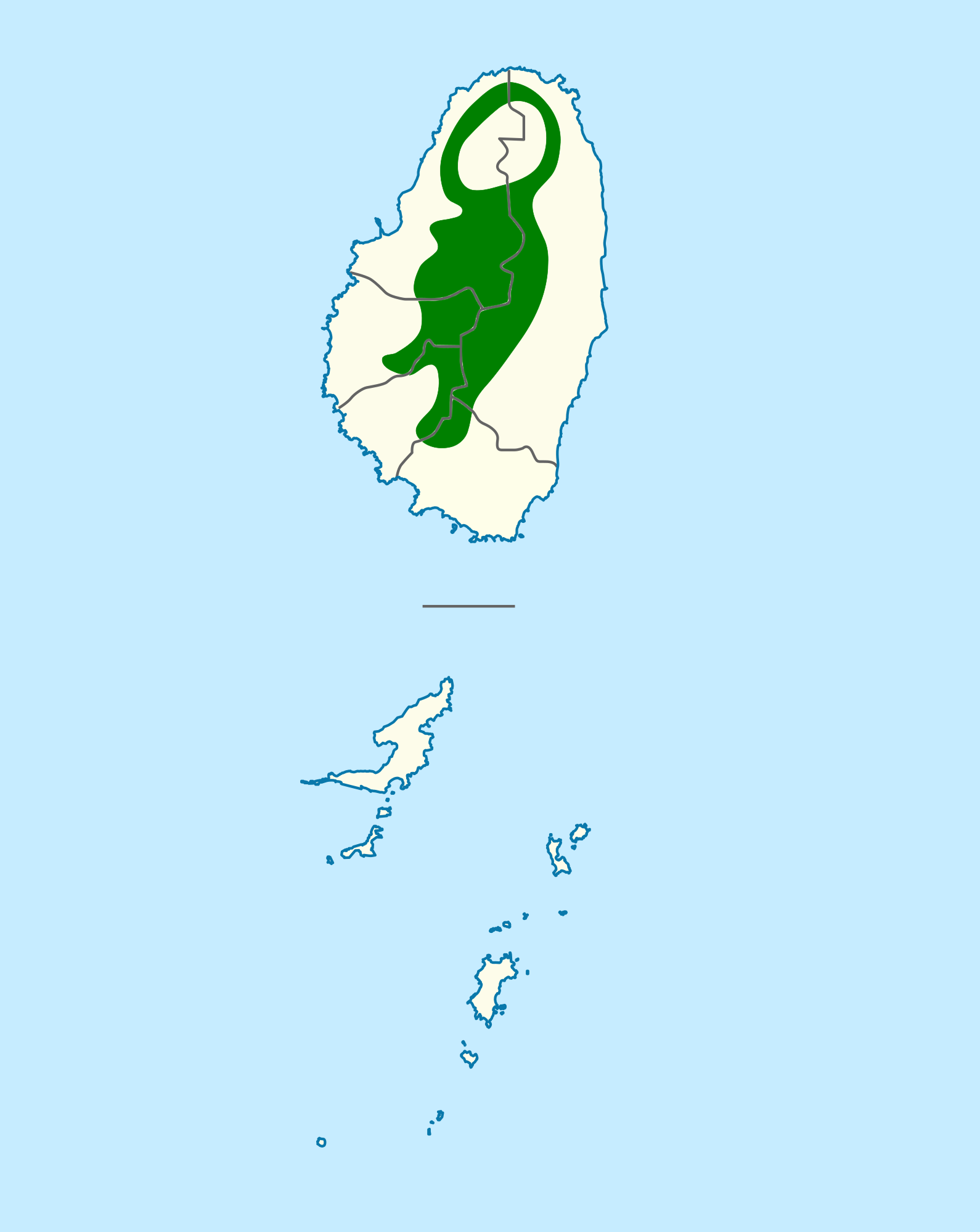
The whistling warbler (Catharopeza bishopi) is a species of bird in the New World warbler family. It is monotypic within the genus Catharopeza. It has a dark back that fades into a lighter gradient going towards the chest. It also has a dark head, a dark strip on the breast, and a light orbital. Both male and female have the same plumage. It is endemic to the island of Saint Vincent in the Lesser Antilles. Its natural habitats are subtropical or tropical moist lowland forest and subtropical or tropical moist montane forest. It is threatened by habitat loss. This habitat loss is due to volcanic activity and deforestation. Whistling warblers have cup-shaped nests, and spotted eggs. Their diet primarily consists of insects.
The whistling warbler is often compared to a wren in appearance. It has a dusty-black plumage, with a dark head and bill. Some interpretations of the whistling warbler have stated that they have a medium-brown plumage. A bright white ring surrounds the eye, with a hazel iris. There is also an off-white color on a minor portion of the chin and on the ends of feathers on the upper throat. The breast has a black and white striped-like pattern, with the black between two white bands. The underside of the tail goes from a blackish ash gray to an off-white. The tail's two distal feathers have a white triangle at the end of them. The tarsus and toes are a light orange color, and they also have a small manubrium-sternum bridge. Females have the same plumage.
The whistling warbler's length ranges from 5 ½ inches to 5 ¾ inches. Their wings are around 2 ¾" long, the tail is about 2 ½ in", the tarsus is ~7/8 inches, and their wingspan is approximately 8 ½ inches in length.
The immature whistling warbler has black feathers emerging on the crown and has the same appearance of the tail's feather tips as the adult, with the overall tail feather color being black. There is a dark greenish brown color on the top, and lighter color on the bottom. In place of the white marks in an adult, a light reddish-brown is present. The quills are brown.
The whistling warbler's song has a rapid rhythm, with an increasing intensity that is comparable to the Troglodytes rufescen, with less variation. The call is compared to a weaker olive-backed thrush song. In Andrle and Andrle's study in 1986, they found that the average of the most common songs were about 4 to 6 second. They also found that the Whistling Warbler's songs could be heard from morning to late afternoon, unless it was heavily raining.
Aliases
Catharopeza bishopi
Range