Bird App
Bird of the day
Carolina wren
Thryothorus ludovicianus
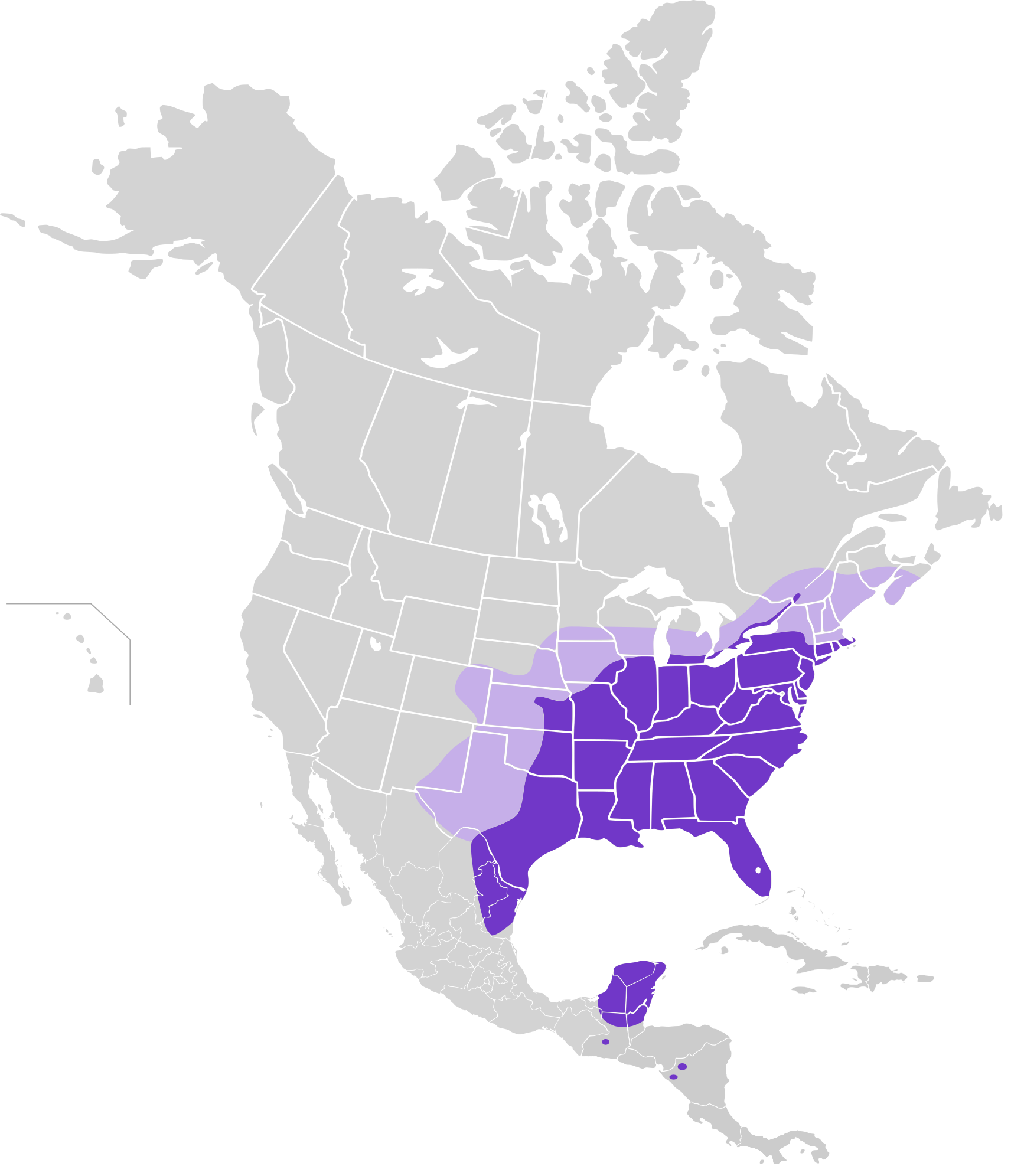
The Carolina wren (Thryothorus ludovicianus) is a species of wren that is common in the Eastern United States, the extreme south of Ontario, Canada, and the extreme northeast of Mexico. Severe winters restrict the northern limits of their range, while favorable weather conditions lead to a northward extension of their breeding range. Their preferred habitat is in dense cover in forest, farm edges, and suburban areas. This wren is the state bird of South Carolina.
Seven recognized subspecies occur across the range of these wrens and they differ slightly in song and appearance. The birds are generally inconspicuous, avoiding the open for extended periods of time. When out in the open, they energetically investigate their surroundings and are rarely stationary. After finding a mate, pairs maintain a territory and stay together for several years. Both males and females give out alarm calls, but only males sing to advertise territory. Carolina wrens raise multiple broods during the summer breeding season, but can fall victim to brood parasitism by brown-headed cowbirds, among other species. Some populations have been affected by mercury contamination.
At 12.5 to 14 cm (4.9 to 5.5 in) long, with a 29 cm (11 in) wingspan and a weight of about 18 to 23 g (0.63 to 0.81 oz), the Carolina wren is a fairly large wren; the second largest in the United States species after the cactus wren. Among standard measurements, the wing chord is 5.4 to 6.4 cm (2.1 to 2.5 in), the tail is 4.5 to 5.6 cm (1.8 to 2.2 in), the culmen is 1.4 to 1.8 cm (0.55 to 0.71 in) and the tarsus is 2 to 2.3 cm (0.79 to 0.91 in). Sexual dimorphism is slight with males being larger than their mates. A study indicated that of 42 mated pairs, every male but one was larger than the female of the pair. The males were on average 11 percent heavier along with having longer wing chords.
Several differences are seen among the subspecies. For T. l. ludovicianus, the crown is rich brown that appears more chestnut-colored on its rump and upper tail coverts. Shoulders and greater coverts are a rich brown, with a series of small white dots on the lesser primary coverts. The secondary coverts are rich brown with a darker brown barring on both webs; the bars on the primaries are on the outerwebs only, but darker and more noticeable. The rectrices are brown with 18 to 20 bars that span across the tail. The white supercilious streak borders thinly with a black above and below, and extends above and beyond its shoulders. The ear coverts are speckled gray and grayish-black. Its chin and throat are grey that becomes buff on its chest, flank and belly, though the latter two are of a warmer color. The underwing coverts sport a grayish buff color. Its iris is reddish-brown, the upper mandible is lemon-colored and paler at the base and lower mandible. The legs are flesh-colored.
As for the other subspecies in contrast to T. l. ludovicianus, T. l. berlandieri is of a slightly smaller build, but possesses a larger bill, the upperparts are duller brown with deeper colored underparts, T. l. lomitensis is of a duller color (than either ludovicianus or berlandieri) with its underparts either pale or almost white, T. l. miamensis contains darker rusty chestnut upperparts and deeper colored below. T. l. burleighi is duller and sootier with less distinct tail markings, T. l. mesophilus has paler underparts and a whiter supercilium, and T. l. tropicalis is darker than all races, and contains heavier bars than T. l. berlandieri.
The juvenile T.l. ludovicianus is similar in appearance, but the plumage is generally paler; a softer texture, buff-tipped wing coverts, and a paler superciliary streak. In August and September, the partial plumage molt for the post-juvenile wrens is darker in color and affects the contour plumage, wing coverts, tail and develops a whiter superciliary stripe. The post-nuptial molt for adults in the same time period is more pronounced in color than the spring molt, with both sexes similar in appearance.
Survival rates differ by region. A male captured in Arkansas lived to be at least 73 months old, and in Alabama, the oldest female and male captured were six and ten years old, respectively. In a survival probability mark-and-recapture study conducted within the Southeastern United States from 1992 to 2003, roughly 90 percent of the banded wrens died within 10 years.
The easiest species to confuse with the Carolina wren is Bewick's wren, which differs in being smaller but with a longer tail, grayer-brown above and whiter below. The Carolina and white-browed wrens differ from the house wren in being larger, with a decidedly longer bill and hind toe; their culmen has a notch behind the tip.
Aliases
Thryothorus ludovicianus
Range