Bird App
Bird of the day
Amazonian umbrellabird
Cephalopterus ornatus
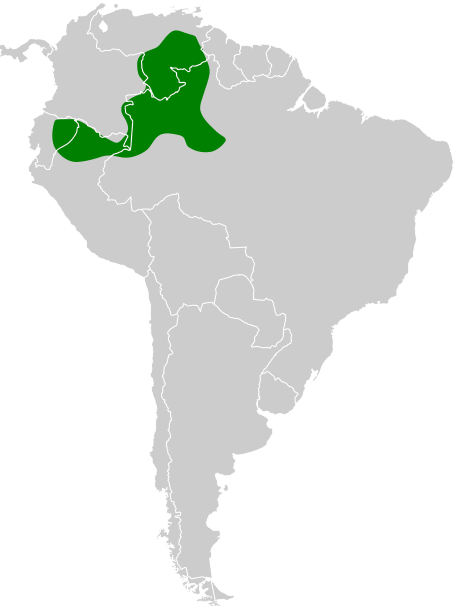
The Amazonian umbrellabird (Cephalopterus ornatus) is a species of bird in the family Cotingidae native to the Amazon basin with a separate population on the eastern slopes of the Andes. The male bird is entirely black, with a black crest and inflatable wattle on the throat, and at 48 to 55 cm (19 to 22 in), may be the largest passerine bird in South America. The female is slightly smaller. Both have an undulating flight, described as woodpecker-like, and the male has a loud, booming call.
The Amazonian umbrellabird feeds on fruit and berries, and may opportunistically take insects and spiders. It forages singly, in pairs or in small groups, in the forest canopy, hopping from branch to branch, but is a secretive species and is more often heard than seen.
Much larger than the female, the male Amazonian umbrellabird is likely the largest passerine in South America as well as the largest suboscine passerine in the world. The male Amazonian umbrellabird grows to a weight of 480–571 grams (1.06–1.26 lb) and a length of 48–55 centimetres (18.9–21.7 in). The female typically stands 41–44 centimetres (16.1–17.3 in) tall and weighs up to 380 grams (0.84 lb). As in the other umbrellabirds, the Amazonian umbrellabird is almost entirely black, has a conspicuous crest on the top of their head, and an inflatable wattle on the neck, which serves to amplify their loud, booming calls. This species has pale eyes, whereas in other umbrellabirds, the eye is black. The undulating flying method of this species is considered quite woodpecker-like, with the lack of white on the umbrellabird's plumage distinguishing it from large woodpeckers with which it co-exists. The Amazonian umbrellabird is usually seen flying only across openings in the forest, such as over rivers, and usually boldly hops branch to branch while in trees.
Aliases
Cephalopterus ornatus
Range