Bird App
Bird of the day
Aleutian tern
Onychoprion aleuticus
The Aleutian tern (Onychoprion aleuticus) is a migratory bird living in the subarctic region of the globe most of the year. It is frequently associated with the Arctic tern, which it closely resembles. While both species have a black cap, the Aleutian tern may be distinguished by its white forehead (although juvenile Arctic terns also have white foreheads). During breeding season, the Arctic terns have bright red bills, feet, and legs while those of the Aleutian terns are black.
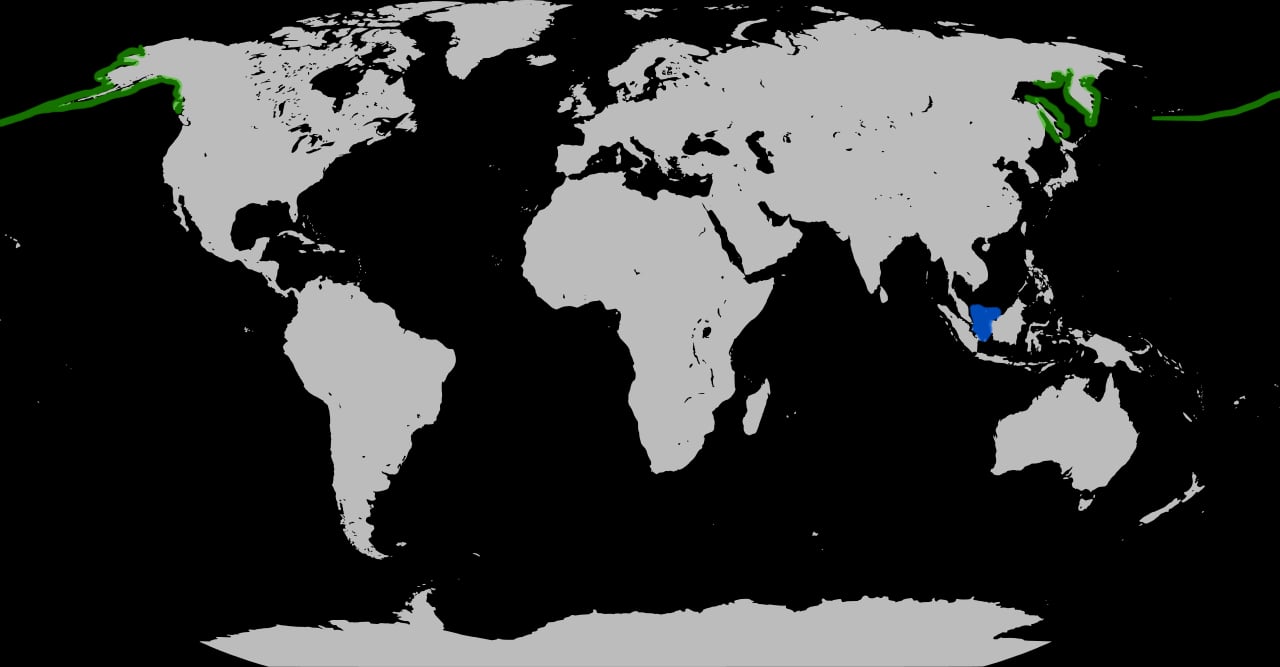
Onychoprion aleuticus has not been thoroughly studied yet. If its winter migratory range was completely unknown until the late 1980s; it is now known that many Aleutian terns spend the winter near the Equator in the western Pacific. The Aleutian tern breeds in wide-ranging coastal colonies only in Alaska and eastern Siberia. Although Alaskan and Siberian populations are not well monitored, both are thought to be in significant decline.
The Aleutian tern is medium-sized tern (32–39 cm (13–15 in) long), with a 75–80 cm (30–31 in) wingspan, a short pointed bill and a long, deeply forked tail. It weighs 84–140 g (2.9–5.0 oz).
Breeding adult and juvenile are the only plumages likely to be encountered in North America. Breeding adult (definitive alternate plumage) has a white forehead, a black cap, a mid-grey mantle with darkish grey underparts, and white rump and tail. Its underwing is whitish, with dark-tipped primaries and a diagnostic dark bar on the secondaries. The Aleutian tern has a black bill as well as black legs. There are no significant differences between the male and the female.
The plumage of the non-breeding adult (definitive basic plumage) is poorly known. It is thought to be similar to plumage of the breeding adult. It has white underparts, a white speckled crown, and a gray tail with white sides. Whereas the forehead bar disappears in winter, the dark secondary bar remains.
Lee described juveniles with a white collar, extensive white forehead, white underparts, and gray tail with white outer web of outer tail-feather. They usually do not have clear dark bar on their secondaries.
Molt strategies are very poorly known in the Aleutian tern but are presumably similar to those of other medium-sized, northern-breeding, migratory terns, such as the much better-studied common tern. The Aleutian tern exhibits a Complex Alternate Strategy:
The Aleutian tern is associated with different calls reported in the literature. Their call can be distinguished from the Common tern ones, since it has a higher pitch and is characterized by a soft and rolling whistled tone.
The most distinctive sound is the choppy "chif-chif-chu-ak" described by Olsen and Larsson in 1995, less harsh than the sustained note of the Arctic tern. Another distinctive sound of the Aleutian tern is a prolonged "whee-hee-hee-hee" stressed on the first syllable. Aleutian terns also have a call that is similar to call of Red-necked Phalarope (Phalaropus lobatus), which is a short, sharp "chit" , possibly uttered during social contact.
The Aleutian tern is generally silent while incubating.
Aliases
Onychoprion aleuticus, Sterna aleutica
Range