Bird App
Bird of the day
Short-toed treecreeper
Certhia brachydactyla
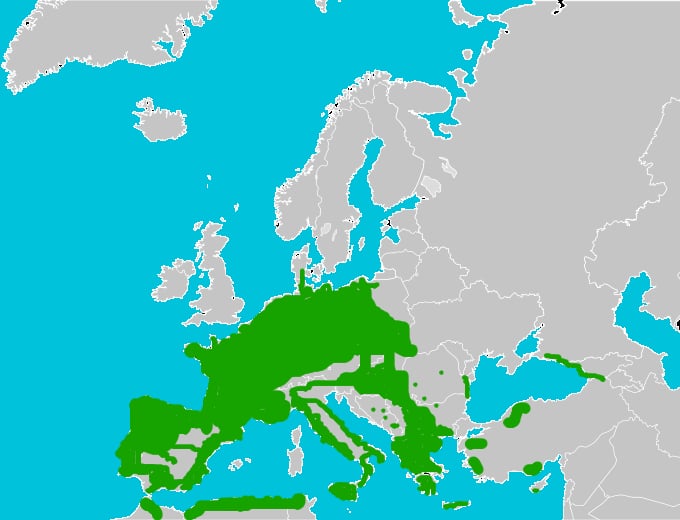
The short-toed treecreeper (Certhia brachydactyla) is a small passerine bird found in woodlands through much of the warmer regions of Europe and into north Africa. It has a generally more southerly distribution than the other European treecreeper species, the common treecreeper, with which it is easily confused where they both occur. The short-toed treecreeper tends to prefer deciduous trees and lower altitudes than its relative in these overlap areas. Although mainly sedentary, vagrants have occurred outside the breeding range.
The short-toed treecreeper is one of a group of four very similar Holarctic treecreepers, including the closely related North American brown creepers, and has five subspecies differing in appearance and song. Like other treecreepers, the short-toed is inconspicuously plumaged brown above and whitish below, and has a curved bill and stiff tail feathers. It is a resident in woodlands throughout its range, and nests in tree crevices or behind bark flakes, laying about six eggs. This common, unwary, but inconspicuous species feeds mainly on insects which are picked from the tree trunk as the treecreeper ascends with short hops.
All the treecreepers are similar in appearance, being small birds with streaked and spotted brown upperparts, rufous rumps and whitish underparts. They have long decurved bills, and long stiff tail feathers which provide support as they creep up tree trunks looking for insects.
The short-toed treecreeper is 12.5 centimetres (4.9 inches) long and weighs 7.5–11 g (0.26–0.39 oz). It has dull grey-brown upperparts intricately patterned with black, buff and white, a weak off-white supercilium and dingy underparts contrasting with the white throat. The sexes are similar, but juveniles have whitish underparts, sometimes with a buff belly.
The call of this species is a repeated shrill tyt...tyt tyt-tyt and the song of the nominate subspecies is an evenly spaced sequence of notes teet-teet-teet-e-roi-tiit. There is some geographical variation; the song of Danish birds is shorter, that of the Cyprus subspecies is very short and simple, and the North African version is lower pitched. European birds do not respond to latter two song variants.
This species shares much of its range with the common treecreeper. Compared to the short-toed, that bird is whiter below, warmer and more spotted above, and has a whiter supercilium and slightly shorter bill. However, identification by sight may be impossible for poorly-marked birds. Vocal birds are usually identifiable, since Common has a distinctive song composed of twitters, ripples and a final whistle and a shree call rarely given by the short-toed; however, both species have been known to sing the other's song. Even in the hand, although the short-toed usually has a longer bill and shorter toes, 5% of birds are not safely identifiable.
The brown treecreeper has never been recorded in Europe, but would be difficult to separate from the short-toed treecreeper, which it much resembles in appearance. Its call is more like the common treecreeper's, but a vagrant brown treecreeper might still not be possible to identify with certainty given the similarities between the three species.
Aliases
Certhia brachydactyla
Range