Bird App
Bird of the day
Great cormorant
Phalacrocorax carbo
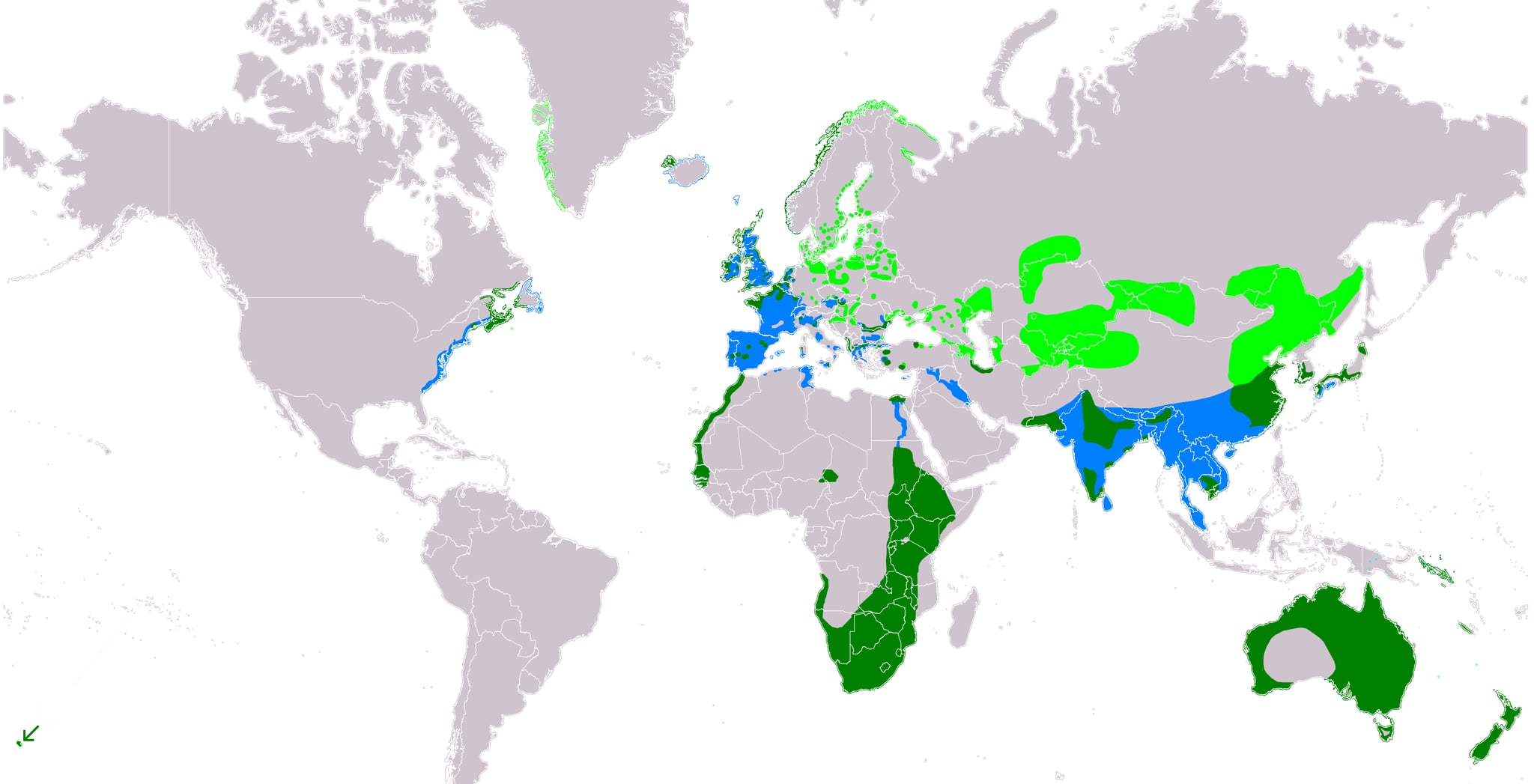
The great cormorant (Phalacrocorax carbo), also known as just cormorant in Britain, as black shag or kawau in New Zealand, formerly also known as the great black cormorant across the Northern Hemisphere, the black cormorant in Australia, and the large cormorant in India, is a widespread member of the cormorant family of seabirds. It breeds in much of the Old World, Australasia, and the Atlantic coast of North America.
The great cormorant is a large bird, but there is a wide variation in size in the species' wide range. Weight is reported to vary from 1.5 kg (3 lb 5 oz) to 5.3 kg (11 lb 11 oz). Males are typically larger and heavier than females, with the nominate race P. c. carbo averaging about 10% larger in linear measurements than the smaller subspecies P. c. sinensis. The lightest average weights cited are in Germany (P. c. sinensis), where 36 males averaged 2.28 kg (5 lb 1⁄2 oz) and 17 females averaged 1.94 kg (4 lb 4+1⁄2 oz). The highest come from Prince Edward Island in Canada (P. c. carbo), where 11 males averaged 3.68 kg (8 lb 2 oz) and 11 females averaged 2.94 kg (6 lb 7+1⁄2 oz). Length can vary from 70 to 102 cm (27+1⁄2 to 40 in) and wingspan from 121 to 160 cm (47+1⁄2 to 63 in). They are tied as the second largest extant species of cormorant after the flightless cormorant, with the Japanese cormorant averaging at a similar size. In bulk if not in linear dimensions, the blue-eyed shag species complex of the Southern Oceans is only marginally smaller on average.
The plumage is largely black, but with bronze to greenish iridescence on the wings and tail, and purple iridescence on the body. The eyes are a striking deep sea-green in adults, duller dark grey in juveniles. The tail is fairly long, with 14 feathers. The bill is stout, and strongly hooked at the tip, dark grey at the tip, grading to paler at the base; it also has a yellow, or sometimes red, patch of bare gular skin on the throat at the base of the bill. The legs are short but stout, and dark grey; the feet large, and fully webbed between all four toes (totipalmate). In the breeding season, adults have white filoplume patches on the thighs and on the head and upper neck. The two African subspecies P. c. maroccanus and P. c. lucidus also have more extensive white plumage on the foreneck and breast. In winter, the plumage is more uniformly black, slightly duller and less glossy, and the white filoplumes are shed. Juveniles and immatures have pale to whitish underparts, becoming browner in their second year and reaching adult plumage when 3–4 years old. Great cormorants are mostly silent, but they make various guttural noises at their breeding colonies.
In European waters the great cormorant can be distinguished from the European shag by its larger size, heavier build, thicker bill, lack of a crest and body plumage with a purple, not green, tinge. In eastern North America, it is similarly larger and bulkier than the double-crested cormorant; the latter species also has more yellow on the throat and bill and lacks the white thigh patches seen on breeding plumage adult great cormorants. Both European shag and double-crested cormorant also differ in having 12, not 14, tail feathers. Identification between the great cormorant subspecies is difficult, and complicated by hybridisation between the subspecies; the most useful character is the shape of the gular skin patch, which forms an acute angle in nominate P. c. carbo, and an obtuse angle in P. c. sinensis; similar variation is used to distinguish P. c. hanedae and P. capillatus in eastern Asia. Differentiation between the two white-breasted African subspecies remains complex and uncertain.
The white filoplumes on the head in the breeding season vary with both the age of the bird, and the subspecies; older birds have more white filoplumes than younger birds, while nominate P. c. carbo tends to have fewer than P. c. sinensis, but there is much overlap. The extent of variation between individuals means it is not a very useful character for subspecies identification.
A very rare variation of the great cormorant is caused by albinism. Albinos suffer from poor eyesight and/or hearing, thus it rarely manages to survive in the wild.
Aliases
Phalacrocorax carbo, Cormorant, Great Black Cormorant, Black Cormorant, Large Cormorant, Black Shag
Range