Bird App
Bird of the day
Brolga
Grus rubicunda
The brolga (Antigone rubicunda), formerly known as the native companion, is a bird in the crane family. It has also been given the name Australian crane, a term coined in 1865 by well-known ornithologist John Gould in his Birds of Australia.
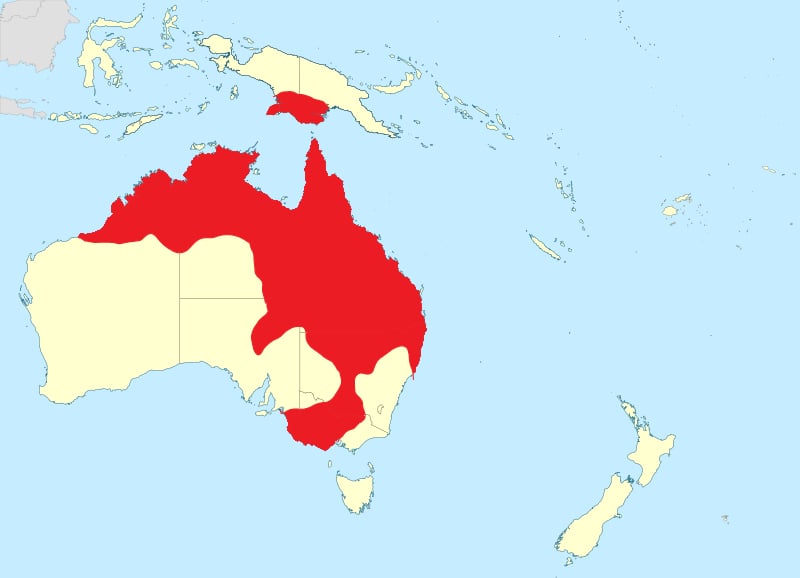
The brolga is a common, gregarious wetland bird species of tropical and south-eastern Australia and New Guinea. It is a tall, upright bird with a small head, long beak, slender neck, and long legs. Its plumage is mainly grey, with black wing tips, and it has an orange-red band on its head. The brolga's courting dance is similar to that of other cranes. The nest is built of wetland vegetation, either on an elevated piece of land or floating on shallow water in marshland, and usually two eggs are laid. Incubation takes 32 days, and the newly hatched young are precocial. The adult diet is omnivorous and includes plant matter, invertebrates, and small vertebrates.
Although the bird is not considered endangered over the majority of its range, populations are showing some decline, especially in southern Australia, and local action plans are being undertaken in some areas. It has featured on the Queensland coat of arms since 1977 and was formally declared as the bird emblem of the state in 1986.
The brolga is a tall bird with a large beak, a long and slender neck, and stilt-like legs. The sexes are indistinguishable in appearance, though females are usually a little smaller. The adult has a grey-green, skin-covered crown, and the face, cheeks, and throat pouch are also featherless and are coral red. Other parts of the head are olive green and clothed in dark bristles. The gular pouch, which is particularly pendulous in adult males, is covered with such dense bristles as to make it appear black. The beak is greyish-green in adult birds, long and slender, and the irises are yellowish-orange. The ear coverts appear as a grey patch of small feathers surrounded by red naked skin and the body plumage is silvery-grey. The feathers on the back and the wing coverts have pale margins. The primary wing feathers are black and the secondaries grey. The legs and feet are greyish-black. Juveniles lack the red band and have fully feathered heads with dark irises. A fully grown brolga can reach a height of 0.7 to 1.4 m (2 ft 4 in to 4 ft 7 in) and has a wingspan of 1.7 to 2.4 m (5 ft 7 in to 7 ft 10 in). Adult males have an average body mass of 6.8 kg (15 lb) with females averaging 5.66 kg (12.5 lb). The weight can range from 3.6 to 8.7 kg (7.9 to 19.2 lb). Heights up to 1.8 m (5 ft 11 in) in male brolga have been reported but presumably need confirmation. The brolga is the heaviest flying bird regularly found in mainland Australia, averaging slightly higher in body mass than other large resident species such as black swan, Australian pelican and the Australian race of sarus crane (Asian sarus cranes are heavier and significantly taller). Brolgas are as well as much heavier on average than the biggest flying land birds such as the very sexually-dimorphic Australian bustard and wedge-tailed eagle), although heavier birds such as wandering albatross may be seen as marine vagrants off the mainland. Brolgas probably rival black-necked storks and sarus cranes as the tallest flying birds in Australia.
The brolga can easily be confused with the sarus crane, but the latter's red head-colouring extends partly down the neck, while the brolga's is confined to the head. The brolga is more silvery-grey in colour than the sarus, the legs are blackish rather than pink, and the trumpeting and grating calls it makes are at a lower pitch. Additionally, in Australia, sarus crane distribution is limited to north-eastern areas, compared to the more widespread distribution of the brolga.
Aliases
Grus rubicunda
Range