Bird App
Bird of the day
Black sparrowhawk
Accipiter melanoleucus
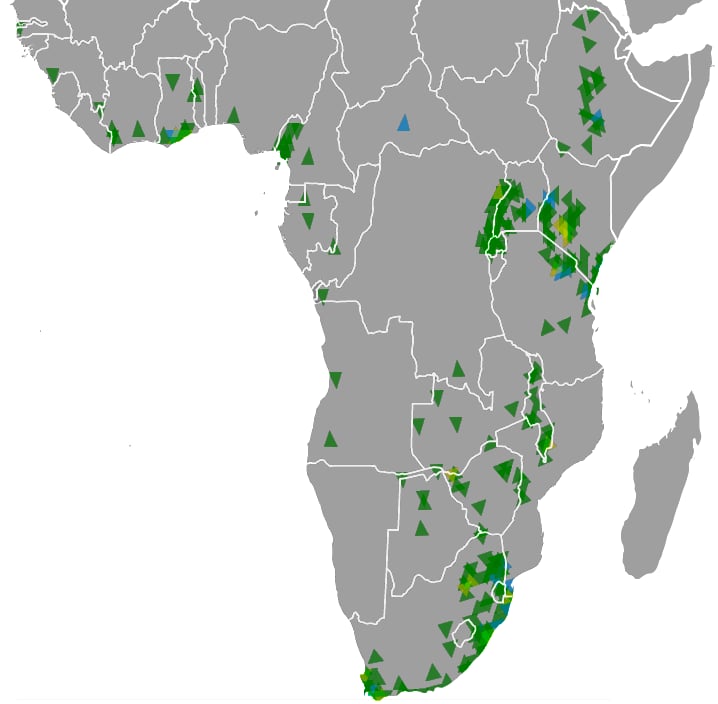
The black sparrowhawk (Astur melanoleucus), sometimes known as the black goshawk or great sparrowhawk, is a bird of prey belonging to the family Accipitridae. It was formerly placed in the genus Accipiter. It occurs mainly in forest and non-desert areas south of the Sahara, particularly where there are large trees suitable for nesting; favored habitat includes suburban and human-altered landscapes. It preys predominantly on birds of moderate size, such as pigeons and doves, in suburban areas.
Typically, both sexes of the black sparrowhawk have a predominantly black plumage with a white throat, breast and belly. These white-breasted individuals are known as "white morphs" which are in the majority over most of the birds' range. The "black morph" variety is generally rare, except along the coastal regions of South Africa, including the Cape Peninsula where they constitute 80% of the population. (Black sparrowhawks do not occur more than about 200–300 km north of Cape Town along the South African west coast, where there are almost no trees.) These "black (or dark) morphs", when seen perched, can be black all over, but more commonly have a few white spots on the breast or a white throat of variable size. In flight both morphs show white and black barring on the underside of the wings and tail (see picture). The black morphs are not melanistic, as commonly alleged, as their plumage is not completely black, nor are they black as chicks or juveniles. There is no noticeable difference between the plumage of mature females and males, which can only be distinguished by size. The tails are cross-barred with about three or four paler stripes, and the undersides of the wings with perhaps four or five. The legs are yellow, with large feet and talons.
Young chicks have mid-grey eyes and white down, but when the feathers erupt they are predominantly brown. The full plumage of juveniles is a range of browns and russets with dark streaks along the head and, more conspicuously, down the chest. Commonly there are white or light-colored spots and streaks as well, mainly on the wings. The brown plumage being a sign of immaturity, it does not attract as dangerously aggressively territorial behavior as a mature black-and-white bird would. As the young birds mature, their eyes change in color from mid-grey, through light brown, to dark red.
The black sparrowhawk is one of the world's largest hawks, only the Henst's, Meyer's and Eurasian goshawk can match or exceed its size. As is common in the genus Astur, male black sparrowhawks are smaller than females. Typically the weights of males lie between 450 and 650 g (0.99 and 1.43 lb) while that of females lies in the 750 to 1,020 g (1.65 to 2.25 lb) range. The typical total length is about 50 cm (20 in) and wingspan about 1 m (39 in). As in most hawks, the tails are long (about 25 cm (9.8 in)), as are the tarsi (about 8 cm (3.1 in). The features of the black sparrowhawk (and Astur species in general) are reflective of the necessity to fly through dense arboreal habitats, although this species does most of its hunting in open areas (usually from a concealed perch in a tree).
The two different colour morphs (light and dark) exhibited by black sparrowhawks are inherited in a typical Mendelian manner, that suggests a one-locus, two-allele system in which the allele coding for the light morph is dominant. The frequency of the morphs varies gradually throughout the South African range of black sparrowhawks, with the frequency of dark morphs declining from over 80% in the Cape Peninsula to under 20% in the northeast. However, there are no differences of the morph distribution in relation to levels of urbanization.
Dark morph black sparrowhawks might be more common on the Cape Peninsula due to pleiotropic properties of the genes that code for dark colouration, meaning that they code for an apparently unrelated trait. In the dark morph black sparrowhawk, those genes are also responsible for an improved blood parasite resistance compared to the light morph. The species breeds during the dry season in most parts of South Africa, but during the wet season on the Cape Peninsula, where blackflies and biting midges which transmit the haematozoan blood parasites (Leucocytozoon toddi and Haemoproteus nisi), may be more abundant. So, on the Cape Peninsula, black sparrowhawks gain a selective advantage from a dark colouration.
When it comes to breeding on the Cape Peninsula, the morph combination of the parents also influences their productivity. Mixed-pairs produce more offspring per year than pairs of the same morph, but this happens at the expense of the chicks' body condition.
It has also been observed that dark morph black sparrowhawks have a higher hunting success in lower light conditions, while white morphs catch more prey in brighter conditions. This suggests, that the different morphs have a better crypsis (so that prey cannot detect them) at different light levels.
Aliases
Accipiter melanoleucus, Black goshawk
Range