Bird App
Bird of the day
Red-headed myzomela
Myzomela erythrocephala
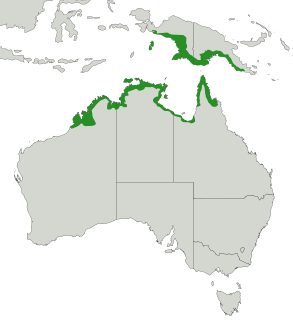
The red-headed myzomela or red-headed honeyeater (Myzomela erythrocephala) is a passerine bird of the honeyeater family Meliphagidae found in Australia, Indonesia, and Papua New Guinea. It was described by John Gould in 1840. Two subspecies are recognised, with the nominate race M. e. erythrocephala distributed around the tropical coastline of Australia, and M. e. infuscata in New Guinea. Though widely distributed, the species is not abundant within this range. While the IUCN lists the Australian population of M. e. infuscata as being near threatened, as a whole the widespread range means that its conservation is of least concern.
At 12 cm (4.7 in), it is a small honeyeater with a short tail and relatively long down-curved bill. It is sexually dimorphic; the male has a glossy red head and brown upperparts and paler grey-brown underparts while the female has predominantly grey-brown plumage. Its natural habitat is subtropical or tropical mangrove forests. It is very active when feeding in the tree canopy, darting from flower to flower and gleaning insects off foliage. It calls constantly as it feeds. While little has been documented on the red-headed myzomela's breeding behaviour, it is recorded as building a small cup-shaped nest in the mangroves and laying two or three oval, white eggs with small red blotches.
The red-headed myzomela is a distinctive small honeyeater with a compact body, short tail and relatively long down-curved bill. It averages 12 centimetres (4.7 in), with a wingspan of 17–19 cm (6.7–7.5 in) and a weight of 8 grams (0.28 oz). The birds exhibit sexual dimorphism, with males being slightly larger and much more brightly coloured than females.
The adult male of the nominate subspecies has a dark red head, neck, and rump; the red is glossy, reflecting bright light. The rest of the upper body is a blackish-brown, and the upper breast and under-body a light brownish-grey. The red of the head is sharply demarcated against the brown plumage, giving the bird the appearance of having a red hood. The bill is black or blackish-brown, and the gape is black or yellowish. There is a distinct black loral stripe that extends to become a narrow eye ring. The iris is dark brown. The adult female's head and neck are grey-brown with a pink-red tint to the forehead and chin. The rest of the female's upper body is grey-brown with darker shades on the wings and lighter shades on the breast and underparts. The gape is yellow. One study suggested a connection between the female's bill colour and breeding status, with birds that had a horn-coloured (grey) bill also having well-developed brood patches. Juveniles are similar to females though with an obvious pale yellow edge to the lower mandible. Initially lacking in red plumage, they begin to get red feathers on their faces after around a month of age. Males keep their juvenile plumage for up to three months, and take a similar period to come into full colour. M. e. infuscata is similar in appearance to the nominate race but has red extending from the rump onto the back, a darker grey belly, and is slightly larger overall.
The red-headed myzomela has a range of contact calls and songs that are primarily metallic or scratchy. Its song is an abrupt tchwip-tchwip-tchwip-tchwip with a slightly softer swip-swip-swip-swip contact call and a scolding charrk-charrk.
The red-headed myzomela closely resembles the scarlet myzomela, though there is only a small overlap in their respective ranges, in eastern Cape York Peninsula. The latter species lives in woodlands rather than mangroves. The dusky myzomela resembles the female red-headed myzomela, but is larger and darker brown, and lacks the red markings around the bill. The Sumba myzomela is similar but slightly smaller than the red-headed myzomela and has darker upper parts and a broad black pectoral band.
Aliases
Myzomela erythrocephala
Range