Bird App
Bird of the day
Blue-and-black tanager
Tangara vassorii
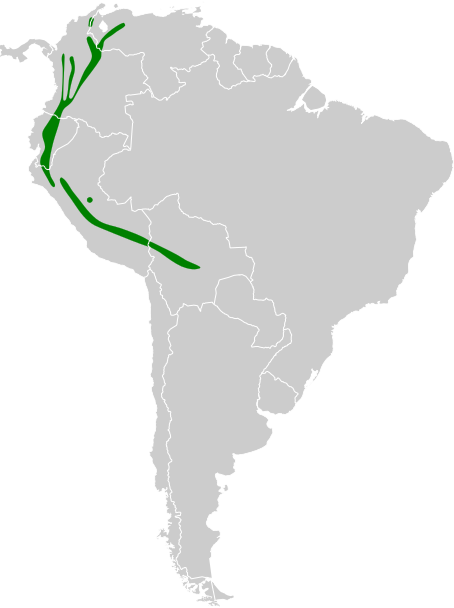
The blue-and-black tanager (Tangara vassorii) is a species of bird in the tanager family Thraupidae. It is found in the Andes of Bolivia, Colombia, Ecuador, Peru and Venezuela, where it inhabits montane evergreen forest, dwarf forest, and secondary forest at elevations of 1,500–3,500 m (4,900–11,500 ft). It inhabits the highest altitude of any Tangara species, and is the only species from the genus that is found near the tree line. Adults are 13 cm (5.1 in) long and weigh 18 g (0.63 oz) on average, and are mostly blue with black masks, wings, and tails. The species shows slight sexual dimorphism, with females being slightly duller than males.
The blue-and-black tanager feeds on fruit and arthropods, with the most favored fruit being Miconia. It forages in mixed-species flocks in pairs or groups of 3–6 individuals, especially with Iridosornis or Anisognathus. It breeds from February to August, making cup nests out of moss and rootlets. Begging young have been reported in January, while fledglings have been reported in May. The blue-and-black tanager is listed as being of least concern by the International Union for Conservation of Nature (IUCN) on the IUCN Red List due to its large range, relative commonness, and lack of significant population declines, but is threatened by habitat destruction.
The blue-and-black tanager is an average-sized species for its genus, with a mean length of 13 cm (5.1 in) and mass of 18 g (0.63 oz). It shows slight sexual dimorphism, with females being slightly duller than males. Adult males are mainly cobalt blue with a black mask. The wing and tail feathers are black with blue edges. Subadults are mostly gray, but have black wings, tails, and lores. The bill is very short compared to other species of Tangara. The iris is brown, the bill is black, and the feet are wine gray.
The blue-and black tanager may be confused with the masked flowerpiercer, but can be distinguished its brown eye, more extensive black on the wing, and shorter and thicker bill. Populations of the subspecies atrocoerulea may also be confused with the golden-naped tanager, but can be distinguished by their blacker back and lack of cinnamon underparts.
The blue-and-black tanager's calls include a thin, high-pitched tsit, a slightly lower swit, a repeated swit-swit-swit, and a hard SWIT-it. The song is 2–3 second long series of rhythmic, high-pitched notes that begin slow and then speed up into a zieeu-zie-zie-zizizizee trill, given every 15 seconds.
Aliases
Tangara vassorii
Range