Bird App
Bird of the day
Blue nuthatch
Sitta azurea
The blue nuthatch (Sitta azurea) is a bird species in the nuthatch family Sittidae. It is a medium-sized nuthatch, measuring 13.5 cm (5.3 in) in length. The species, which shows slight sexual dimorphism, has dramatic plumage pattern unlike any other member of its genus. Its head is black or blackish-blue dark blue upperparts close to purple with azure feathers. The wings are edged with black. The throat and chest are white or a washed buff, contrasting with the upperparts and the belly of a very dark blue; the covert feathers are generally clear, blue-grey or purplish.
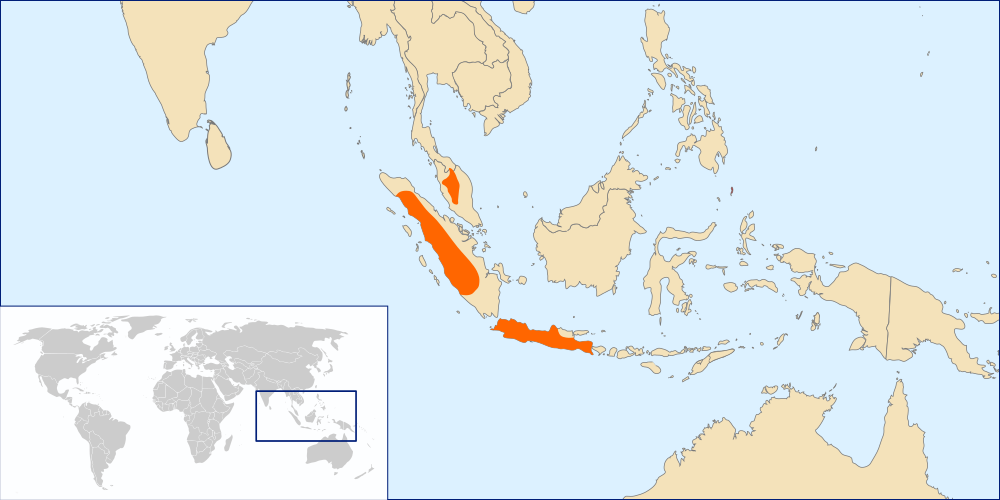
The blue nuthatch's ecology is poorly known, but it feeds on small invertebrates found on trees; reproduction takes place from April to June or July. It also forages in mixed-species flocks in larger groups. They can be found in the Malay Peninsula and on the islands of Sumatra and Java in Indonesia, where it inhabits subtropical or tropical moist lowland forest and subtropical or tropical moist montane forest above 900 m (3,000 ft) in altitude.
Three subspecies are accepted: S. a. expectata, S. a. nigriventer and S. a. azurea, which differ chiefly in the colour of their mantles, chests and bellies. The species' closest relatives are the velvet-fronted nuthatch (S. frontalis), the yellow-billed nuthatch (S. solangiae) and the sulphur-billed nuthatch (S. oenochlamys). The population of the species has not been determined but the species appears to be at low risk of extinction because of the extent of its distribution. It has been classified as of least concern by the International Union for Conservation of Nature.
The blue nuthatch is a medium-sized nuthatch that has an average length of 13.5 cm (5.3 in). The weight is not known. Its appearance differs significantly from all other nuthatches. All of its subspecies are broadly black and white (especially when viewed in low-light conditions in which their dark blue colour is not apparent) and have upper plumage shot through with dramatic notes of cobalt, azure and other lighter shades of blue, as well as greys and purples. The head is black, or blackish-blue with a broad, pale blue eye ring.
The three subspecies vary in the colour of their mantle, chest and belly. The upperparts are dark blue at the mantle or purplish in some subspecies. The rectrices are pale blue in the middle with a black border and contrast sharply with the dark areas of the coat. The throat and breast are white, or washed buff, especially in S. a. nigriventer. The belly and abdomen are blackish, contrasting with blue-grey or purplish coverts. The bill is lavender, slightly tinged with green, and black at the tip; the legs are a pale blue-grey and the claws are slate-grey or black.
The species displays no significant sexual dimorphism, but the Japanese ornithologist Nagamichi Kuroda describes the female as having slightly duller upperparts. Juveniles resemble adults, but have a duller crown and ear coverts, as well as a brown cast that does not cover their entire body. The belly is a dull black and the undertail coverts are variably edged creamy white. The juvenile's bill is blackish, with a pink base. Adults experience a partial moult before the breeding season (February–March for S. a. expectata; March–April for S. a. azurea) involving the throat, chest and mantle; a complete moult takes place after the breeding season (March–April and August in Java in Malaysia).
The species' calls include a melodious tup or tip, a sudden whit, a thin hissing sit, and a fuller, harder, and more forceful chit. When excited, sit and chit notes are frequently given quickly and repetitively as a chi-chit, chit-chit-chit or chir-ri-rit, which can be prolonged, accelerated into staccato trilling tititititititik, or even becoming a rattling tr-r-r-r-r-r-t. Other calls include a thin, squeaking zhe and zhe-zhe, a squeaky toy-like nasal snieu or kneu, and a buzzy chirr-u. The vocal repertoire of the blue nuthatch is quite varied and is reminiscent of the velvet-fronted nuthatch and, to a lesser extent, the sulphur-billed nuthatch.
Aliases
Blue nuthatch
Range