Bird App
Bird of the day
Great horned owl
Bubo virginianus
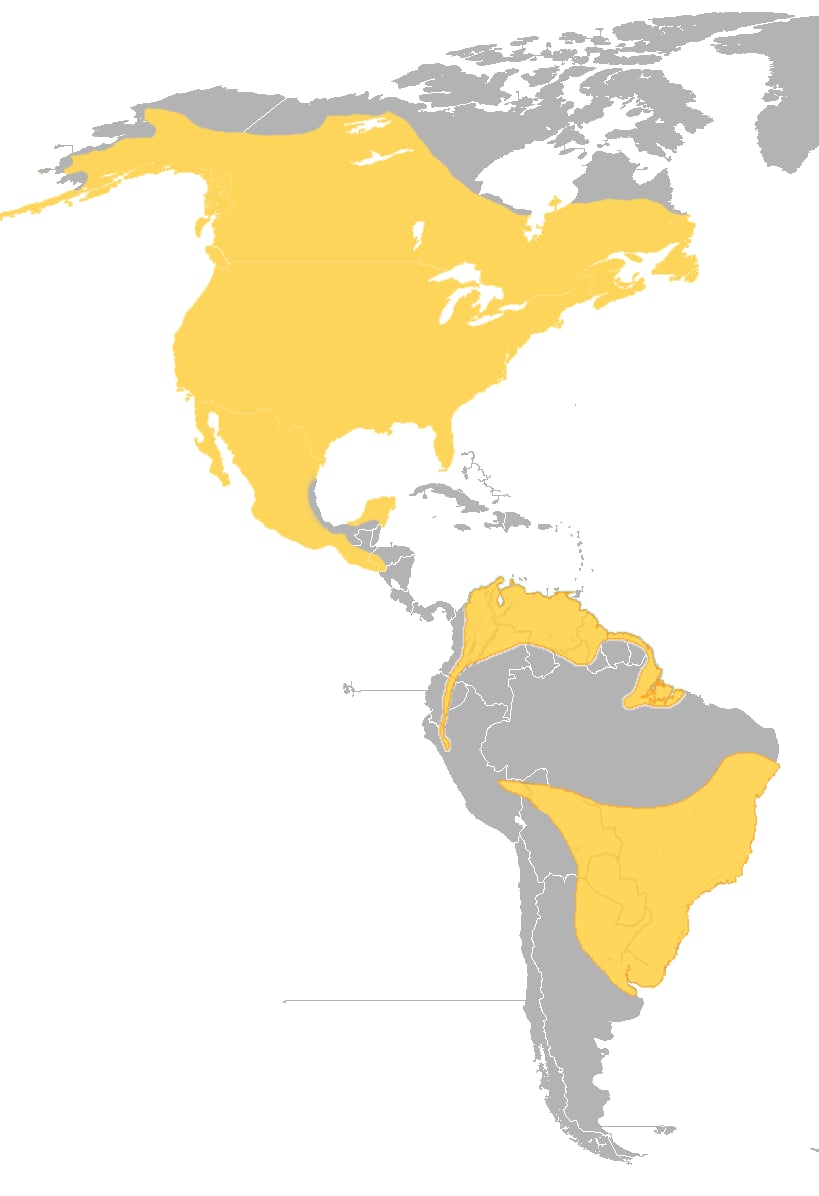
The great horned owl (Bubo virginianus), also known as the tiger owl (originally derived from early naturalists' description as the "winged tiger" or "tiger of the air") or the hoot owl, is a large owl native to the Americas. It is an extremely adaptable bird with a vast range and is the most widely distributed true owl in the Americas. Its primary diet is rabbits and hares, rats and mice, and voles; it remains one of the few regular predators of skunk. Hunting also includes rodents, larger mid-sized mammals, birds, reptiles, amphibians, and invertebrates.
In ornithological study, the great horned owl is often compared to the Eurasian eagle-owl (Bubo bubo), a closely related species, which occupies the same ecological niche in Eurasia despite its notably larger size. The great horned owl is also compared to the red-tailed hawk (Buteo jamaicensis), with which it often shares similar habitat, prey, and nesting habits by day; thus the red-tailed hawk is something of a diurnal ecological equivalent. The great horned owl is one of the earliest nesting birds in North America, often laying eggs weeks or even months before other raptorial birds.
The great horned owl is generally colored for camouflage. The underparts of the species are usually light with some brown horizontal barring; the upper parts and upper wings are generally a mottled brown usually bearing heavy, complex, darker markings. All subspecies are darkly barred to some extent along the sides.
A variable-sized white patch is seen on the throat. The white throat may continue as a streak running down the middle of the breast even when the birds are not displaying, which in particularly pale individuals can widen at the belly into a large white area. South American great horned owls typically have a smaller white throat patch, often unseen unless actively displaying, and rarely display the white area on the chest.
Individual and regional variations in overall color occur, with birds from the subarctic showing a washed-out, light-buff color, while those from the Pacific Coast of North America, Central America, and much of South America can be a dark brownish color overlaid with blackish blotching. The skin of the feet and legs, though almost entirely obscured by feathers, is black. Even tropical great horned owls have feathered legs and feet. The feathers on the feet of the great horned owl are the second-longest known in any owl (after the snowy owl). The bill is dark gunmetal-gray, as are the talons.
All great horned owls have a facial disc. This can be reddish, brown, or gray in color (depending on geographical and racial variation) and is demarked by a dark rim culminating in bold, blackish side brackets. This species' eyebrow-like "horns" are tufts of feathers, called plumicorns. The purpose of plumicorns is not fully understood, but the hypothesis that they serve as a visual cue in territorial and sociosexual interactions with other owls is generally accepted.
The great horned owl is the heaviest extant owl in Central and South America and is the second-heaviest owl in North America, after the closely related but very different-looking snowy owl. It is heavily built, with a barrel-shaped body, a large head, and broad wings. Its size can vary considerably across its range, with populations in interior Alaska and Ontario being largest and populations in California and Texas being smallest, though those from the Yucatán Peninsula and Baja California appear to be even smaller. Adult great horned owls range in length from 43 to 64 cm (17 to 25 in), with an average of 55 cm (22 in), and possess a wingspan of 91 to 153 cm (3 ft 0 in to 5 ft 0 in), with an average of 122 cm (48 in). Females are somewhat larger than males. Mean body weight is 1,608 g (3.545 lb) for females and 1,224 g (2.698 lb) for males. Depending on subspecies, maximum weight can reach 2,503 g (5.518 lb).
The wing chord length is 297–400 mm (11.7–15.7 in). The wing loading, the measured wing area compared to weight, is high, meaning the wings are relatively small in surface area for the bird's weight; the species' wing loading has been described as proportionately the highest among raptors. The tail, being relatively short as is typical of most owls, is 175 to 252 mm (6.9 to 9.9 in) long. Like other owl species, the great horned owl is capable of "silent flight", which is the way owls fly while making almost no discernable noise, despite their large size.
This is made possible thanks to three main components of the owl's wing structure. The leading edge of their feathers have serrations that help to disrupt the turbulence generated by wing flapping, then the softer feathers help deaden the sound, and finally the trailing fringe of the feathers works to finish cutting the sounds made by flight. The structure of the great horned owl wing also allows it to fly at a very low speed for the size of the species, as slow as 2 miles per hour when they are gliding on breezes.
The legs, feet, and talons are large and powerful. Tarsal length is 54–80 mm (2.1–3.1 in). The average foot span of a fully spread foot, from talon to talon, is around 20 cm (7.9 in), as compared to 8 cm (3.1 in) in long-eared owls, 13 to 15 cm (5.1 to 5.9 in) in barn owls, and 18 cm (7.1 in) in the great grey owl. Great horned owls can apply at least 300 psi (2,100 kPa) of crushing power in their talons, a pressure considerably greater than the human hand is capable of exerting. In some big females, the gripping power of the great horned owl may be comparable to much larger raptor species such as the golden eagle.
The hard, inflexible bill of the great horned owl is 3.3–5.2 cm (1.3–2.0 in) long, although the culmen, the exposed bill portion as measured along the top of the beak, is only 2.1 to 3.3 cm (0.83 to 1.30 in).
The outer ear openings, which are concealed by feathers on the sides of the head, are relatively smaller than those of the Eurasian eagle owl, being 2.3 cm (0.91 in) in vertical axis, with the left ear slightly larger than the right. Like most exclusively (or near exclusively) nocturnal species, the great horned owl has asymmetrical ear holes that allow for the triangulation of sounds when hunting in the dark. The different-height holes, while still close together, are differentiated enough that the owl is able to use the timing and direction of the sound waves hitting each hole to precisely locate prey even if the prey is located under cover such as snow. The disc-like shape of their faces also helps to direct the sounds they hear toward their ears. While the true nature/purpose of the ear tufts that are present on the great horned owl is unknown, researchers agree that the tufts do not play any role in the hearing ability of the owl. It is estimated that their hearing is up to ten times that of a human being.
The great horned owl's eyes, just slightly smaller than the eyes of a human being, are large even for an owl and rank proportionately among the largest eyes of all terrestrial vertebrates. The great horned owl has cylindrical eyes which creates more distance from the lens of the eye to the retina, which allows it to act more like a telephoto lens for farther distance sight compared to that possible from round eyes. They are visually highly adapted for nocturnal hunting and provide a wide, almost completely binocular field of view, a large corneal surface and a predominantly rod retina.
The great horned owl's eye contains both rods and cones like most species that see in color, but the vision of a great horned owl closely resembles that of many other nocturnal species. The peak wavelengths that are observed by the cones is 555 nm and the research suggests that the great horned owl has relatively weak color vision, especially compared to other bird species. Despite (or perhaps as a result of) the poorer sense of color vision, the owl manages to have excellent night vision. Instead of turning its eyes, an owl must turn its whole head, and the great horned owl can rotate its neck 270°. The iris is yellow, except in the amber-eyed South American great horned owl (B. v. nacurutu).
The great horned owl's song is normally a low-pitched but loud ho-ho-hoo hoo hoo (or also transcribed as bu-bubu booh, who-hoo-ho-oo or who-ho-o-o, whoo-hoo-o-o, whoo) and can last for four or five syllables. The call is resonant and has warranted descriptions as varied as "solemn" and "terrifying". The female's call is higher and rises in pitch at the end of the call. Female vocalizations are higher in pitch because of a smaller syrinx in the larger sex. Calling seems to peak after rather than before midnight. Usually, territorial hooting decreases in February or March at the onset of egg laying.
On occasion, this species exhibits "an indescribable assemblage of hoots, chuckles, screeches, and squawks, given so rapidly and disconnectedly that the effect is both startling and amusing". Descriptions of some of these odd sounds including a growling krrooo-ooo note pair, a laughing whar, whah, wha-a-a-a-ah, a high-pitched ank, ank, ank; a weak, soft erk, erk, a cat-like meee-owwwwww, a hawk-like note of ke-yah, ke-yah, and a nighthawk-like peent. These vocalizations may be variously uttered when the birds are disturbed and angered at the nest (frequently preceding an attack on an interloping human or other animal), represent the vocal development of young owls, or are given during courtship and during territorial disputes with other owls. Young owls still in the care of their parents make loud, persistent hissing or loud, piercing screeching sounds that are often confused with the calls of the barn owl.
Common/eastern great horned owl (Bubo virginianus virginianus)
Eastern United States eastwards from at least as far west as Minnesota to Texas; northeastwards in distribution to southern Quebec, southern Ontario, Nova Scotia and Prince Edward Island. Resident all-year. The race B. v. mesembrinus from Central America south of the Isthmus of Tehuantepec, may be merely a southerly leg of this race, as its coloring is almost exactly the same as virginianus, although with rather smaller body size. However, mesembrinus type owls are discontinuous in range, with only paler owls from pallescens and mayensis found in the in-between range before the northern virginianus reappears back up in South Texas.
The "nominate race" is a medium-hued form, neither darkly saturated nor strikingly pale. Darker gray or somewhat paler individuals are known. It tends to be richly tinged with rufous and barred distinctly blackish-brown below with rather soft contrast. The feet can range from tawny to buff to creamy and are the legs are typically barred dark to a moderate extent. The facial disc is often a solid cinnamon-red color. This is mid-to-large race, with a wing chord length of 319–371 mm (12.6–14.6 in), averaging 339 mm (13.3 in), in males and 343–388 mm (13.5–15.3 in), averaging 362.8 mm (14.28 in), in females. Unexpectedly, although it is not the longest-winged, the nominate is the heaviest known race as males weigh from 985 to 1,588 g (2.172 to 3.501 lb), averaging 1,318 g (2.906 lb), and females weigh from 1,417 to 2,503 g (3.124 to 5.518 lb), averaging 1,768.5 g (3.899 lb); the prior figures originally from a huge sample around Michigan. In comparison, B. v. subarcticus, though averaging longer in wing length averages somewhat less heavy. On the contrary, in Costa Rica, within the range of the possibly synonymous mesembrinus, great horned owls average approximately 1,000 g (2.2 lb), the lightest average mass reported anywhere for this species. Other standard measurements of this race are a tail length of 190 to 235 mm (7.5 to 9.3 in), a tarsus length of about 56 to 58 mm (2.2 to 2.3 in) and a bill length of 35 to 50 mm (1.4 to 2.0 in). B. v. virginianus also tends to have relatively the longest ear tufts on any race.
South American great horned owl (Bubo virginianus nacurutu)
Originally named as a separate species Strix nacurutu, A lowland form occurring in disjunct populations from eastern Colombia to the Guyanas; also from Brazil and Uruguay south of the Amazon Basin to Bolivia, the Buenos Aires Province in northern Argentina and western Paraguay; resident all-year. Includes the proposed subspecies scotinus, elutus, and deserti. The status of this form, especially the relationships between the scattered subpopulations and with ssp. nigrescens and the Magellanic horned owl, deserves more study.
Dull, earthy brownish color is typical; birds from the semiarid interior of Brazil often have much white on uppertail- and ear-coverts against a dull gray background (sometimes separated as deserti). This race is less fuscous than nigrescens. It is the only subspecies where the iris is amber, not yellow. The Magellanic horned owl, while somewhat similar in coloring, has yellow eyes like other horned owls, not amber eyes. B. v. nacurutu is a medium-sized race, smaller than most in North America but not as small as some of the Mexican races. The wing chord length is 330–354 mm (13.0–13.9 in) in males and 340–376 mm (13.4–14.8 in) in females. The tail in both sexes can range from 184 to 217 mm (7.2 to 8.5 in). Only three birds have had published weights, two males scaling 1,011 and 1,132 g (2.229 and 2.496 lb) and one female weighing 1,050 g (2.31 lb). The most notable feature of this race is its large bill, at 43 to 52 mm (1.7 to 2.0 in), which is the biggest of any horned owl race despite the otherwise moderate size of B. v. nacurutu.
Northern/sub-Arctic great horned owl (Bubo virginianus subarcticus)
Breeding range from Mackenzie, British Columbia region east to the southern Hudson Bay; southern limit unclear but at least reaches to Montana and North Dakota. Non-breeding birds are regularly found south to latitude 45°S, i.e. Wyoming or South Dakota, occasionally ranging beyond this limit especially in years with low prey in the north. This race includes the birds described as occidentalis (based on a wintering individual, as was the original subarcticus) and sclariventris. The older name wapacuthu was occasionally used for this subspecies, but it cannot with certainty be assigned to a recognizable taxon and is thus considered a nomen dubium. The population described as algistus is probably based on wandering individuals and/or various intergrades of subarcticus with other races.
This is the palest form of horned owl, with the ground color essentially whitish with a faint buff tinge above; black underside barring variable from indistinct to pronounced, being most often prominent on the upper chest amongst otherwise pale plumage. This race shows little to no reddish coloration. B. v. subarcticus shows a very high degree of clinal variation, ranging from in the Contiguous United States where owls are often medium-grayish and more heavily marked to the subarctic zone in Canada where very pale birds with almost non-existent markings are prominent. Very pale birds are similar to a young female snowy owl from a distance. In this race, the feet range from immaculate white to buff, with little or no mottling. In the west of Canada, subarcticus may hybridize with the dark saturatus and may do the same with this similarly dark heterocnemis in the east. In both cases, they may produce intermediate looking hybrids of reddish tone, like a virginianus but with sharper contrasting of colors. This is one of the largest-bodied subspecies. The wing chord length is 323–372 mm (12.7–14.6 in), averaging 346.7 mm (13.65 in), in males and 339–390 mm (13.3–15.4 in), averaging 362.5 mm (14.27 in), in females. Body mass ranges from 865 to 1,460 g (1.907 to 3.219 lb), averaging 1,196.5 g (2.638 lb), in males and from 1,112 to 2,046 g (2.452 to 4.511 lb), averaging 1,556 g (3.430 lb), in females. Tail length is 200 to 225 mm (7.9 to 8.9 in) and 220 to 240 mm (8.7 to 9.4 in) in males and females, respectively. Bill length is 35 to 43 mm (1.4 to 1.7 in) in both and one bird had a tarsus of 66 mm (2.6 in).
California great horned owl (Bubo virginianus pacificus)
Central and southern California west of the Sierra Nevada except for the San Joaquin Valley, south to Northwestern Baja California, Mexico. Intergrades with pallescens in San Diego County, California (see also below). Resident all-year.
Very rich brown, dark underside barring distinct, less pronounced than in saturatus but more pronounced than in pallescens. Humeral area is black. Feet are mottled dark. The facial disc is often even darkly mottled. This is a fairly small-bodied race, in fact including the lightest wild great horned owl adult ever weighed. The wing chord length is 305–362 mm (12.0–14.3 in), averaging 332.5 mm (13.09 in), in males and 335–375 mm (13.2–14.8 in), averaging 351.4 mm (13.83 in), in females. Body mass ranges from 680 to 1,272 g (1.499 to 2.804 lb), averaging 991.7 g (2.186 lb), in males and from 825 to 1,668 g (1.819 to 3.677 lb), averaging 1,312.7 g (2.894 lb), in females. Tail length is 175 to 218 mm (6.9 to 8.6 in) and 203 to 230 mm (8.0 to 9.1 in) in males and females, respectively. Bill length is 34 to 41 mm (1.3 to 1.6 in) and one bird had a tarsus of 57 mm (2.2 in).
Coastal great horned owl (Bubo virginianus saturatus)
Pacific coast from southeastern Alaska to northern California. Includes the previously described form of B. v. leucomelas. The often-recognized race B. v. lagophonus is often now considered a mere clinal variation of the same race from interior Alaska to Oregon, the Snake River, and northwestern Montana. These forms may be reported in winter as far south as Colorado and Texas, but these are in times of irruption.
A dark and overall brownish form with heavily barred and mottled underside, with a dull tawny base. Inland birds (lagophonus) tend to have a more grayish base, the coastal owls being more richly brown. Otherwise, inland and coastal owls are practically the same. The facial disc can range from gray to reddish-gray to dark rufous. The feet are fairly dusky gray typically, although some buff-footed individuals are known, and legs are more prominently barred with black than in other North American races. This is a large race going on linear measurements, which in Alaskan owls outmatch those of all other races but for heterocnemis in Ontario (which may itself be a discontinuous eastern wing of this race). The wing chord length is 330–370 mm (13–15 in), averaging 348.3 mm (13.71 in), in males and 339–400 mm (13.3–15.7 in), averaging 374.7 mm (14.75 in), in females. Tail length is 191 to 245 mm (7.5 to 9.6 in) and 196 to 252 mm (7.7 to 9.9 in) in males and females. In both sexes, known bill and tarsal lengths are 35 to 44 mm (1.4 to 1.7 in) and 62 to 70 mm (2.4 to 2.8 in). No weights are known to have been published.
North Andean great horned owl (Bubo virginianus nigrescens)
Andes; arid temperate and puna zones from Colombia to northwestern Peru. Resident all-year round. Presumably synonymous with the described columbianus.
A dark, cold gray-brown form with heavy fuscous blotching. Arguably this is the darkest colored race on average, though it could be rivaled by individuals from saturatus and elachistus. This race has only minimally the rufous tinge seen in other darkish races, although some nigrescens may have a cinnamon facial disc. The largest winged race of owl in South America, this owl has a wing chord length of 345–365 mm (13.6–14.4 in) in males and 350–382 mm (13.8–15.0 in) in females. The tail in both sexes can range from 185 to 217 mm (7.3 to 8.5 in). Bill length is 40 to 50 mm (1.6 to 2.0 in), again relatively long as in nacurutu and one bird had a tarsal length of 80 mm (3.1 in), indicating relatively long legs in the race. No published weights are known. Apparently, despite its sizeable wing area, nigrescens is notably smaller overall when specimens are compared side-by-side with those from saturatus.
Desert great horned owl (Bubo virginianus pallescens)
San Joaquin Valley southeastwards through arid regions of southeastern California and southern Utah eastwards to western Kansas and southwards to Guerrero and western Veracruz in Mexico; intergrades with pacificus in San Diego County, if not elsewhere; vagrant individuals of saturatus and the Rocky Mountains population, which look similar to intergrades, also seem to occur in its range. Resident all-year. This race is likely synonymous with melanocercus.
A pale dusky buff form with indistinct barring, especially on the underside. Darker individuals tend to have a deeper fulvous base to their upper sides. Humeral area is umber in color and the feathers of the feet are white and usually unmarked. A small race, it averages slightly larger in wing length than pacificus but weighs less on average. The wing chord length is 318–367 mm (12.5–14.4 in), averaging 337.2 mm (13.28 in), in males and 332–381 mm (13.1–15.0 in), averaging 348.9 mm (13.74 in), in females. Body mass ranges from 724 to 1,257 g (1.596 to 2.771 lb), averaging 914.2 g (2.015 lb), in males and from 801 to 1,550 g (1.766 to 3.417 lb), averaging 1,142.2 g (2.518 lb), in females. In both sexes, tail length is 190 to 235 mm (7.5 to 9.3 in) and bill length is 33 to 43 mm (1.3 to 1.7 in).
Yucatán great horned owl (Bubo virginianus mayensis)
Endemic to the southern two-thirds of the Yucatán Peninsula. Resident all-year.
A medium-pale form, fairly similar to pallescens in both hue and ventral markings. Going on linear measurements, B. v. mayensis is smaller than all North American horned owls, even the smallish pallescens, and is only slightly larger at median than the following race. This race has wing chord and tail lengths of 297–340 mm (11.7–13.4 in) and 180 to 198 mm (7.1 to 7.8 in) in males and 303–357 mm (11.9–14.1 in) and 199 to 210 mm (7.8 to 8.3 in) in females. In both sexes, the bill length is 39 to 41 mm (1.5 to 1.6 in) and tarsal length is 54 to 65 mm (2.1 to 2.6 in).
Baja California great horned owl (Bubo virginianus elachistus)
Southern Baja California, Mexico. Resident all-year.
Similar in color to pacificus but even darker and more heavily barred, like a miniaturized saturatus. It is considerably (5–10%) smaller than pacificus linearly; some size overlap does occur though. On average, it is the smallest known subspecies. Males have a wing chord length of 305 to 335 mm (12.0 to 13.2 in), tail length of 175 to 206 mm (6.9 to 8.1 in) and bill length of 33 to 38 mm (1.3 to 1.5 in). A single female had a wing chord of 330 mm (13 in) and tail of 211 mm (8.3 in).
Northeastern great horned owl (Bubo virginianus heterocnemis)
Breeds in eastern Canada (northern Quebec, Labrador, Newfoundland). Its southern breeding range seems to be delineated by the Saint Lawrence River. In winter, this race may disperses southwards throughout Ontario to as far as the Northeastern United States. This subspecies may be synonymous with saturatus, although it is distributed far to the east of that race. B. v. heterocnemis is surrounded by the much paler subarcticus to its west and quite differently marked virginianus to its south, the latter two overlap and possibly hybridize in some of the northeast.
A fairly dark and grey, heavily barred form. Feet pale with dusky mottling. Going on median reported linear measurements (since body mass is unknown), this is the largest bodied subspecies on average. Males have a wing chord length of 350 to 365 mm (13.8 to 14.4 in) and females range from 370 to 390 mm (15 to 15 in). In both sexes, the tail is 220 to 250 mm (8.7 to 9.8 in) and the bill is 38 to 48 mm (1.5 to 1.9 in).
Rocky Mountains great horned owl (Bubo virginianus pinorum)
The Rocky Mountains population breeds south of the Snake River in Idaho south to Arizona, New Mexico, and the Guadalupe Mountains of Texas. Westwards, it is presumed to occur to the Modoc Plateau and Mono Lake of California. This race was included in the presumed subspecies occidentalis, but was recently first described and named as a distinct subspecies and makes up the missing piece in the once-muddled distribution of great horned owls in the West and Rockies. Downslope movements into valleys occupied by pallescens might occur, but this needs study.
A medium gray form, intermediate in coloring between saturatus and pallescens. Moderately barred and tinged buff or ochraceous on the underside. Feet mottled. This is a largish race, wing chord lengths being inexplicably greater in males, at 350 to 397 mm (13.8 to 15.6 in), than in females, at 327 to 367 mm (12.9 to 14.4 in). Tail length can range from 190 to 233 mm (7.5 to 9.2 in) and a female weighed 1,246 g (2.747 lb).
The combination of the species' bulk, prominent ear tufts and barred plumage distinguishes it through much of the range, but it may be easily confused with the lesser horned owl (B. magellanicus), which may overlap in range. The Magellanic horned owl was once considered a subspecies of the great horned, but is now almost universally considered a distinct species, as is supported by genetic materials, with the great horned being the paraspecies. Overall coloration is similar, but the Magellanic is markedly smaller with smaller feet and a smaller head, with finer, but more numerous brownish bars on the underside, rather than the blotchy, irregular barring typical of great horned owls. Other eagle-owls may superficially be somewhat similar, but the species is generically allopatric with the exception of wintering snowy owls. More tropical species with ear tufts, the stygian owl (A. stygius) and striped owl (A. clamator), are much smaller. Other large owls lack ear tufts.
Aliases
Bubo virginianus, Tiger Owl
Range