Bird App
Bird of the day
Ringed kingfisher
Megaceryle torquata
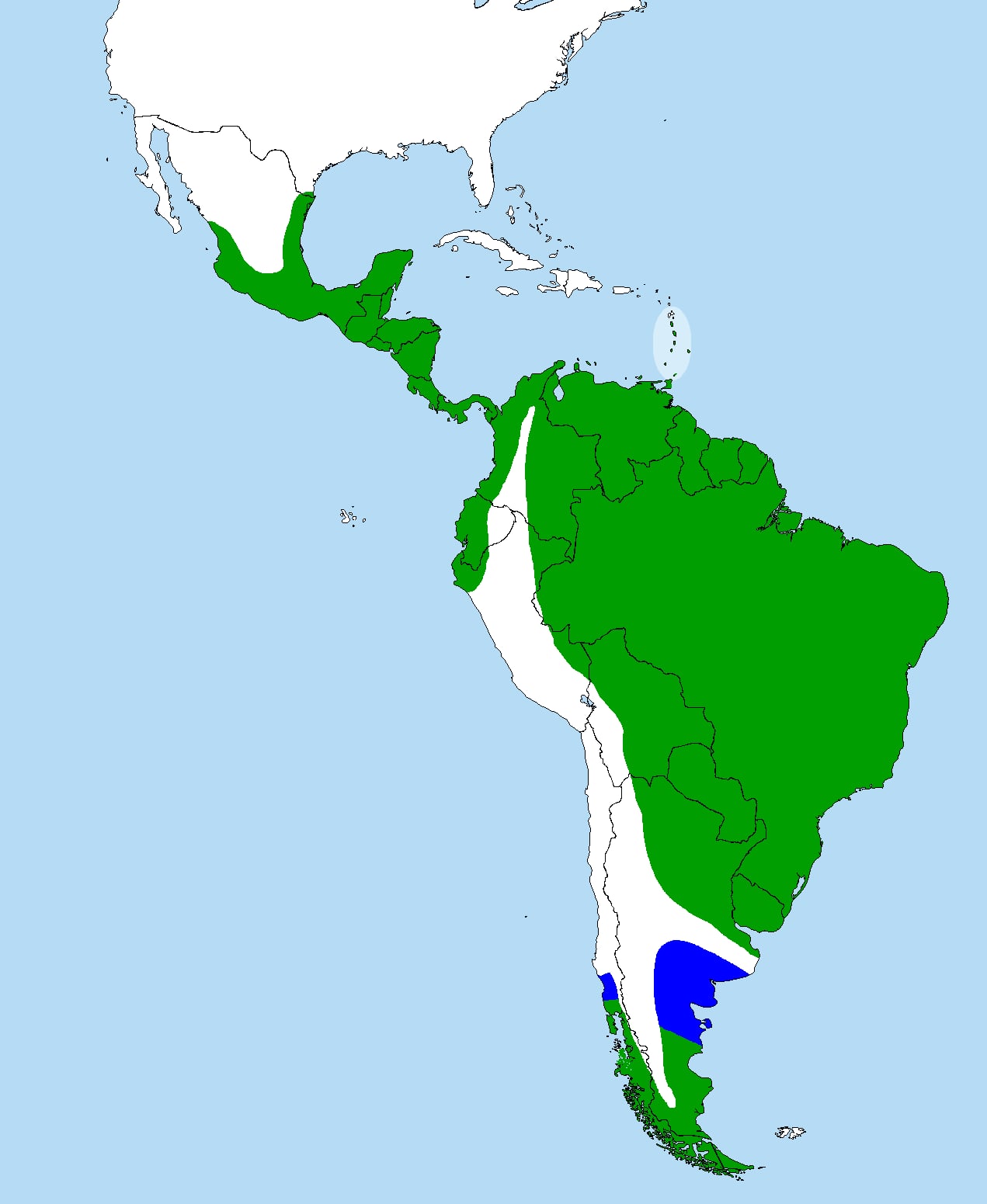
The ringed kingfisher (Megaceryle torquata) is a large, conspicuous, and noisy kingfisher bird commonly found along the lower Rio Grande Valley in southeasternmost Texas in the United States through Central America to Tierra del Fuego in South America.
Megaceryle torquata is a Neotropical kingfisher that lives in habitats ranging between the US and Mexico. In 1888, the species was first discovered in the US, while the first ringed kingfisher nest was found in 1970. They are commonly seen along the Rio Grande and in water bodies in southern Texas. Their distribution is increasing and expanding northwards.
The wings of adult males range between 184.9 and 211.1 mm (7.28 and 8.31 in), with an average of 196.3 mm (7.73 in). Their tails range from 110.0–129.0 mm (4.33–5.08 in), and their bills measure 74.9–94 mm (2.95–3.70 in). Female wings are from 185.0-210.1 mm, and their tails measure 111.5–132.1 mm (4.39–5.20 in) and possess bills measuring 75.9–90.9 mm (2.99–3.58 in). Individuals can weigh between 305 and 341 g (10.8 and 12.0 oz). Such measurements prove that the species do not differ sexually in terms of size.
Ringed kingfishers have dark-brown irises that are consistent among all age groups. They have straight bills that are longer than their heads, along with curved culmens and tomial serrations. The lower mandible appears to have some yellowish colorations. They possess syndactyl feet with olive-green or yellowish toes and black claws. A large crest appears between the base of their bills and necks. Several individuals have a white collar located around the neck.
Each ringed kingfisher possesses 10 primary wings, 15 secondaries, three tertials, and 12 rectrices. They are rounded, and the tail is squared. Subspecies can be found in Texas, Mexico, Central America, and South America, due to slight plumage differences. Individuals themselves vary slightly as a result of variable environmental constraints and day-length regimes.
Ringed kingfishers can be identified by sex due to differences in coloration. The males possess rusty-brown underparts with white undertail coverts and a white throat. Females have a bluish-gray band seen on the upper breast and a whitish band.
A ringed kingfisher's clutch size is typically three to six eggs, which are incubated for about 22 days.
Aliases
Megaceryle torquata
Range