Bird App
Bird of the day
Black woodpecker
Dryocopus martius
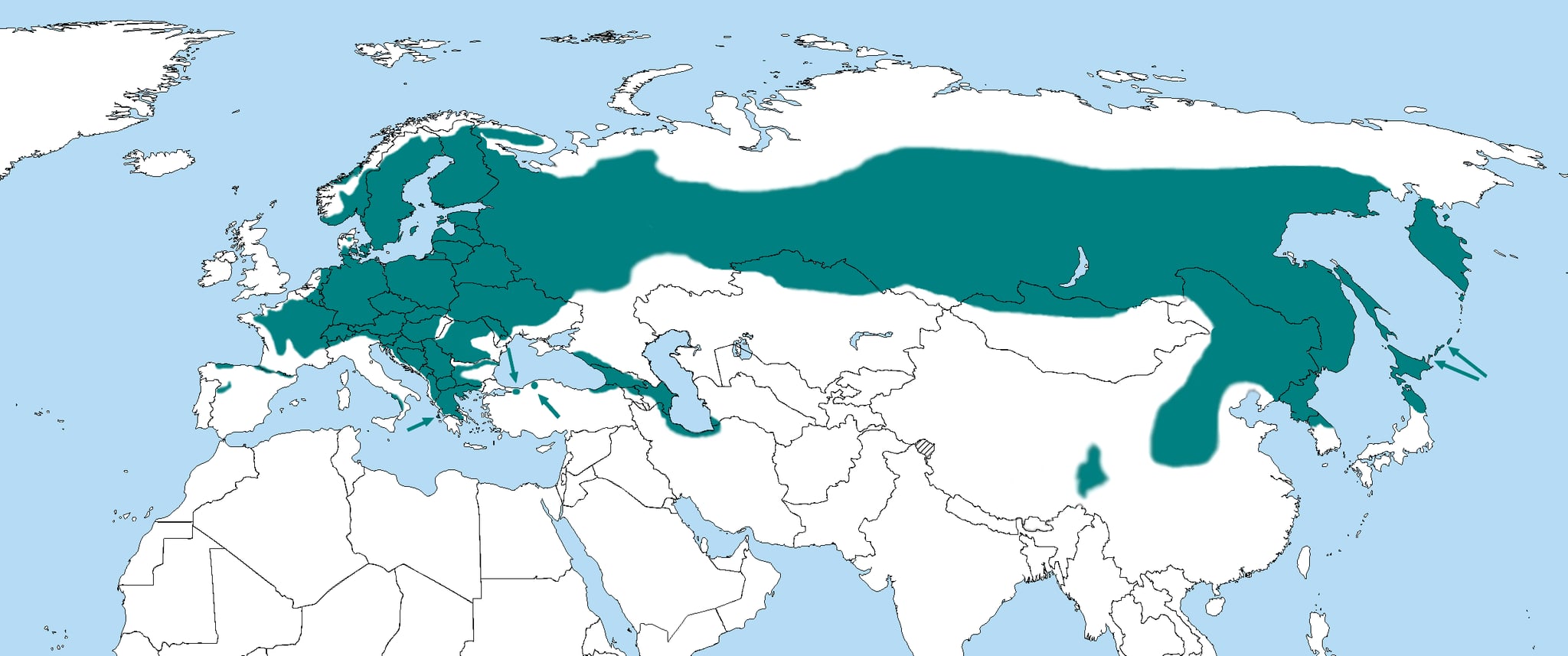
The black woodpecker (Dryocopus martius) is a large woodpecker that lives in mature forests across the northern Palearctic. It is the sole representative of its genus in that region, and its range is expanding. The black woodpecker is easily the largest woodpecker species in Europe as well as in the portion of Asia where it lives and is one of the largest species worldwide. This non-migratory species tends to make its home in old-growth forest or large forest stands and excavates a large tree hole to reside in. In turn, several species rely on black woodpeckers to secondarily reside in the holes made in trees by them. This woodpecker's diet consists mostly of carpenter ants. This species is closely related to, and fills the same ecological niche in Europe as, the pileated woodpecker of North America and the lineated woodpecker of South America, also being similar to the white-bellied woodpecker which is distributed to the south somewhat of the black woodpecker in Asia.
The black woodpecker measures 45 to 55 cm (18 to 22 in) long with a 64 to 84 cm (25 to 33 in) wingspan. Body weight is approximately 250 to 400 g (8.8 to 14.1 oz) on average. Among standard measurements, the wing chord is 22.7 to 26 cm (8.9 to 10.2 in), the tail is 15.9 to 17.3 cm (6.3 to 6.8 in), the very long bill is 5 to 6.7 cm (2.0 to 2.6 in) and the tarsus is 3.6 to 4 cm (1.4 to 1.6 in). It is easily the largest woodpecker in its range and is second in size only to the great slaty woodpecker amongst the woodpecker species certain to exist (with the likely extinction of the largest and second largest woodpeckers), although its average mass is similar to that of the Magellanic woodpecker of South America. The closely related pileated and white-bellied woodpeckers also broadly overlap in size with the black woodpecker, but both are somewhat smaller in average and maximal size and mass. The plumage of this crow-sized woodpecker is entirely black apart from a red crown. In males, the entire crown is red, but in females only the top hindcrown is red, with the rest of the body all black. The juvenile black woodpecker is similar but is less glossy, with a duller red crown and a paler grey throat and bill . The piercing yellow eyes and manic, high-pitched calls of the black woodpecker have made it the villain of fairy tales throughout its range. Their voice is remarkable in that it has two different calls. One is a short single high-pitched note, a loud, whistling kree-kree-kree, done only twice in a row. The other is a screech-like shrill while in flight. Unlike other woodpecker species, the black woodpecker does not have a dipping, bounding flight, but instead flies with slow, unsteady-seeming wing beats with its head raised.
Aliases
Dryocopus martius
Range