Bird App
Bird of the day
Water pipit
Anthus spinoletta
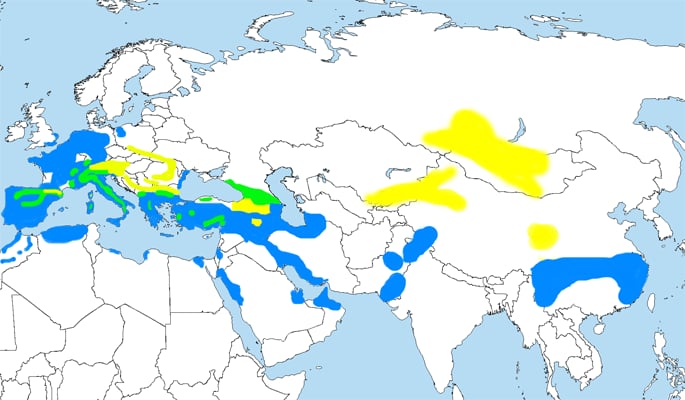
The water pipit (Anthus spinoletta) is a small passerine bird which breeds in the mountains of Southern Europe and the Palearctic eastwards to China. It is a short-distance migrant; many birds move to lower altitudes or wet open lowlands in winter.
The water pipit in breeding plumage has greyish-brown upperparts, weakly streaked with darker brown, and pale pink-buff underparts fading to whitish on the lower belly. The head is grey with a broad white supercilium ("eyebrow"), and the outer tail feathers are white. In winter, the head is grey-brown, the supercilium is duller, the upperparts are more streaked, and the underparts are white, streaked lightly with brown on the breast and flanks. There are only minor differences among the three subspecies, the sexes are almost identical, and young birds resemble adults. The water pipit's song is delivered from a perch or in flight, and consists of four or five blocks, each consisting of about six repetitions of a different short note.
Water pipits construct a cup-like nest on the ground under vegetation or in cliff crevices and lay four to six speckled grey-ish white eggs, which hatch in about two weeks with a further 14–15 days to fledging. Although pipits occasionally catch insects in flight, they feed mainly on small invertebrates picked off the ground or vegetation, and also some plant material.
The water pipit may be hunted by birds of prey, infested by parasites such as fleas, or act as an involuntary host to the common cuckoo, but overall its population is large and stable, and it is therefore evaluated as a species of least concern by the International Union for Conservation of Nature (IUCN).
The water pipit is 15–17 centimetres (5.9–6.7 in) long and weighs 18.7–23 grams (0.66–0.81 oz). The adult of the nominate race in spring plumage has greyish-brown upperparts, weakly streaked with darker brown, and pale pink-buff underparts fading to whitish on the lower belly. There may be some faint streaking on the breast and flanks. The head is grey with a broad white supercilium. The outer tail feathers are white, and the legs, bill and iris are dark brown or blackish. In non-breeding plumage, the head is grey-brown and the supercilium is less distinct. The upperparts are more streaked, and the underparts are white, marked lightly with brown on the breast and flanks.
The sexes are similar although the female has, on average, a greyer head. Young birds resembles the non-breeding adult, but are browner and more streaked above with prominent streaking on the underparts. A. s. coutellii is smaller than the nominate subspecies and the white of the outer tail feathers has a hint of grey. It is paler and more heavily streaked above, and in summer plumage the underparts' colour covers a larger area and has a rusty tint. A. s. blakistoni is large, pale and less strongly streaked.
The water pipit has a complete moult between July and September, although there is considerable individual variation in timing. There is a partial pre-breeding moult, mainly between January and March, but with much variability in timing. This moult typically involves replacing the head, body and some wing feathers, but the extent is again variable. Very occasionally, females may moult into what looks like non-breeding plumage, rather than the expected brighter garb. The chicks start to gain juvenile plumage as soon as a month after hatching, and most have completed the transition to near-adult appearance by September. The first pre-breeding moult is similar to that of the adult, but may be less complete or even absent.
The water pipit is closely related to the Eurasian rock pipit and the meadow pipit, and is rather similar to both in appearance. Compared to the meadow pipit, the water pipit is longer-winged and longer-tailed than its relative, and has much paler underparts. It has dark, rather than pinkish-red, legs. The water pipit in winter plumage is also confusable with the Eurasian rock pipit, but has a strong supercilium, greyer upperparts, and white, not grey, outer tail feathers; it is also typically much warier. The habitats used by European rock and water pipits are completely separate in the breeding season, and there is little overlap even when birds are not nesting. There is also little mixing with breeding meadow pipits, although since 1960 some overlapping territories have been found where the species coexist.
The European rock pipit's subspecies Anthus petrosus littoralis in summer plumage is particularly close in outward appearance to the water pipit. The rock pipit normally has a bluer tint to the head, streaking on the breast and flanks, and buff outer tail feathers, and the songs are also different. The species mostly occupy different habitat types even when they occur in the same general area.
The water pipit's song is delivered from a perch or in flight, and consists of four or five blocks, each consisting of about half a dozen repetitions of a different short note. In comparison, the European rock pipit's song is a sequence of about twenty tinkling cheepa notes followed by a rising series of thin gee calls, and finishing with a short trill. The call of the water pipit is a single or double sharp "dzip" or similar, slightly harsher than soft sip sip sip of the meadow pipit or the shrill pseep of the European rock pipit. The short, thin fist flight call is intermediate between the sip of the meadow pipit and the rock pipit's feest. The differences between the calls of the pipit species are very subtle, and not diagnostic in the absence of other evidence. The flight call of the subspecies A. s. coutellii is shorter and more buzzing than that of the nominate race.
Aliases
Anthus spinoletta
Range