Bird App
Bird of the day
Bohemian waxwing
Bombycilla garrulus
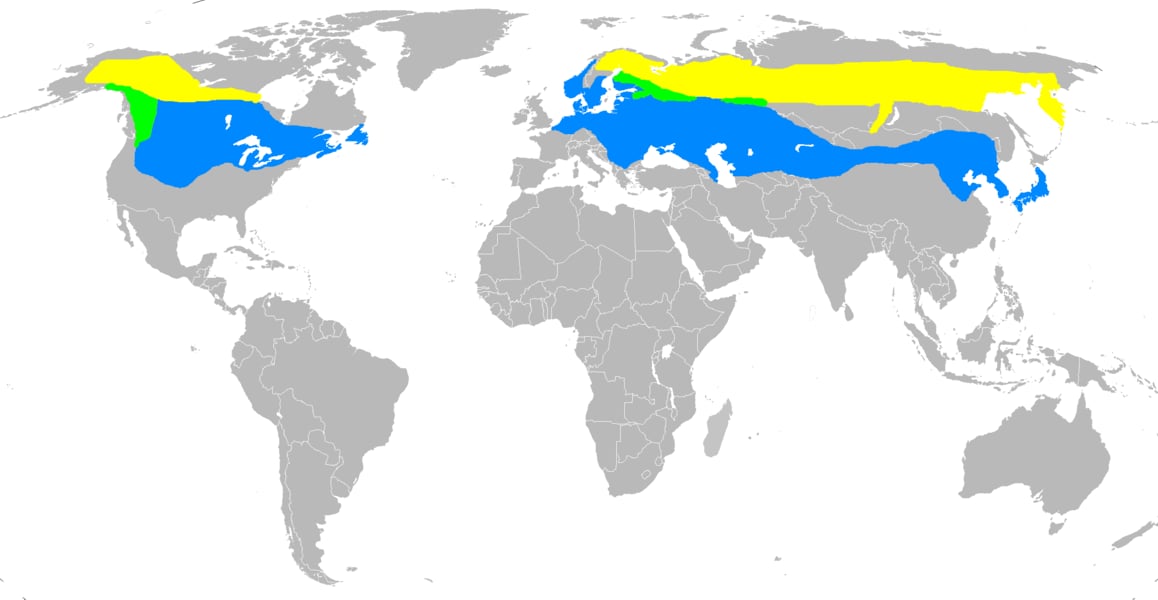
The Bohemian waxwing (Bombycilla garrulus) is a starling-sized passerine bird that breeds in the northern forests of the Palearctic and North America. It has mainly buff-grey plumage, black face markings and a pointed crest. Its wings are patterned with white and bright yellow, and some of the wing feathers have red tips, the resemblance of which to sealing wax gives these birds their common name. The two or three subspecies show only minor differences in appearance. Females are similar to males, although young birds are less well-marked and have few or no waxy wingtips. Although the Bohemian waxwing's range overlaps those of the cedar and Japanese waxwings, it is easily distinguished from them by size and plumage differences.
The breeding habitat is coniferous forests, usually near water. The pair build a lined cup-shaped nest in a tree or bush, often close to the trunk. The clutch of 3–7 eggs is incubated by the female alone for 13–14 days to hatching. The chicks are altricial and naked, and are fed by both parents, initially mostly with insects, but thereafter mainly fruit. They fledge about 14–16 days after leaving the egg. Many birds desert their nesting range in winter and migrate farther south. In some years, large numbers of Bohemian waxwings irrupt well beyond their normal winter range in search of the fruit that makes up most of their diet.
Waxwings can be very tame in winter, entering towns and gardens in search of food, rowan berries being a particular favourite. They can metabolise alcohol produced in fermenting fruit, but can still become intoxicated, sometimes fatally. Other hazards include predation by birds of prey, infestation by parasites, and collisions with cars or windows. The large numbers and very large breeding area mean that it is classified as being of least concern by the International Union for Conservation of Nature.
The Bohemian waxwing is a starling-sized bird 19–23 cm (7.5–9.1 in) in length with a 32–35.5 cm (12.6–14.0 in) wingspan, and an average weight of 55 g (1.9 oz). It is short-tailed, mainly brownish-grey, and has a conspicuous crest on its head. The male of the nominate subspecies has a black mask through the eye and a black throat. There is a white streak behind the bill and a white curve below the eye. The lower belly is a rich chestnut colour and there are cinnamon-coloured areas around the mask. The rump is grey and the tail ends in a bright yellow band with a broad black border above it. The wings are very distinctive; the flight feathers are black and the primaries in adults have markings that produce a yellow stripe and white "fishhooks" on the closed wing. The adult's secondaries end in long red appendages with the sealing wax appearance that gives the bird its English name. The eyes are dark brown, the bill is mainly black, and the legs are dark grey or black. In flight, the waxwing's large flocks, long wings and short tail give some resemblance to the common starling, and its flight is similarly fast and direct. It clambers easily through bushes and trees but only shuffles on the ground.
In adults, the primary feathers have a bright yellow leading edge near the tip, and a white 'tick mark' on the tip of the trailing edge. In males, the yellow tail tip is 6–11 mm broad, the black throat is sharply defined, and there are 6–8 red waxy tips on the secondaries. Females are very similar to males, but have a narrower (4–8 mm) yellow terminal band to the tail, a less defined lower edge to the black throat and slightly fewer red tips, 5–7, on the secondaries. First-winter birds are easily distinguished from adults by the tips of the primaries, which have a white or only very pale yellow leading edge, and no white 'tick mark' on the trailing edge; they also have a slightly narrower yellow tail tip (5–10 mm in males, 2–6 mm in females), and fewer red wax tips on the secondaries, 4–6(–8) in males and (0–)1–5 in females. The juvenile plumage, only seen on the far northern breeding grounds, is markedly duller than adult plumage, with streaky, whiter underparts, no black on the throat, and a smaller black face mask; juveniles moult into first-winter plumage soon after fledging, before the end of the summer.
Compared to the nominate subspecies, eastern B. g. centralasiae is paler, greyer and has little reddish-brown behind the bill. The American subspecies B. g. pallidiceps has more colouring on the cheeks and forehead than the nominate form and is otherwise generally duller in appearance.
The soft, dense feathers are kept in good condition by preening. The red waxy tips are the extended and flattened ends of feather shafts, pigmented with astaxanthin and enclosed in a transparent sheath. A study of the cedar waxwings showed that the red tips are few or absent until the third year of life for that related species. All adult waxwings have a complete moult annually between August and January. Juveniles moult at the same time but retain their flight and some other wing feathers.
The range of the Bohemian waxwing overlaps those of both the other members of the genus. The cedar waxwing is smaller than the Bohemian; it has browner upperparts, a white undertail and a white line above the black eye patch, and lacks the white and yellow marks on the wings. Adult cedar waxwings have a yellowish belly, and all ages have less strongly patterned wings than the Bohemian waxwing. The Japanese waxwing is easily distinguished from its relatives; it has a red terminal band to the tail, the black mask extends up the rear of the crest, and there is no yellow stripe and few or no red tips on the wings.
The Bohemian waxwing's call is a high trill sirrrr. It is less wavering and lower-pitched than that of the cedar waxwing, and longer and lower-pitched than the call of the Japanese waxwing. Other calls are just variants of the main vocalisation; a quieter version is used by chicks to call parents, and courtship calls, also given during nest construction, have a particularly large frequency range. Although not a call as such, when a flock takes off or lands, the wings make a distinctive rattling sound that can be heard 30 m (98 ft) away.
Aliases
Bombycilla garrulus, Waxwing
Range