Bird App
Bird of the day
Ruby-throated hummingbird
Archilochus colubris
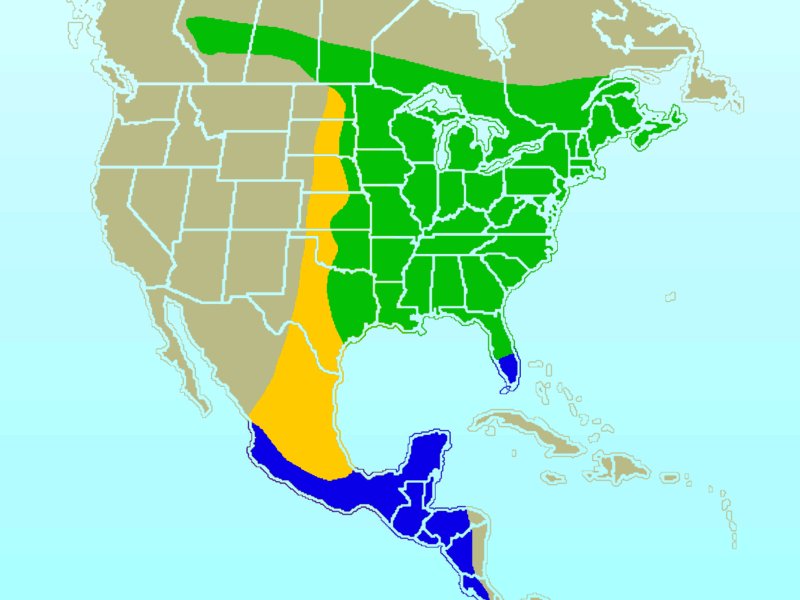
The ruby-throated hummingbird (Archilochus colubris) is a species of hummingbird that generally spends the winter in Central America, Mexico, and Florida, and migrates to Canada and other parts of Eastern North America for the summer to breed. It is the most common hummingbird in eastern North America, having population estimates of about 35 million in 2021.
This hummingbird is from 7 to 9 cm (2.8 to 3.5 in) long and has an 8 to 11 cm (3.1 to 4.3 in) wingspan. Weight can range from 2 to 6 g (0.071 to 0.212 oz), with males averaging 3.4 g (0.12 oz) against the slightly larger female which averages 3.8 g (0.13 oz). Adults are metallic green above and grayish white below, with near-black wings. Their bill, at up to 2 cm (0.79 in), is long, straight, and slender.
Hummingbird legs are short and have feet with three toes pointing forward and one backward – the hallux. The toes are formed as claws (image) with ridged inner surfaces to aid gripping onto flower stems or petals.
The middle toe is around 0.6 cm (0.24 in). The ruby-throated hummingbird can only shuffle to move along a branch, although it can scratch-preen with its feet.
The species is sexually dimorphic. The adult male has a gorget (throat patch) of iridescent ruby red bordered narrowly with velvety black on the upper margin and a forked black tail with a faint violet sheen. The red iridescence is highly directional and appears dull black from many angles. The female has a notched tail with outer feathers banded in green, black, and white and a white throat that may be plain or lightly marked with dusky streaks or stipples. Males are smaller than females and have slightly shorter bills. Juvenile males resemble adult females, though usually with heavier throat markings. The plumage is molted once a year on the wintering grounds, beginning in early fall and ending by late winter.
As of 2021, there were 34–36 million ruby-throated hummingbirds over their eastern North American breeding range, making this species the most populous of North American hummingbirds. Despite substantial population growth from 1970 through the early 21st century, numbers of ruby-throated birds declined by 17% over the census reported in 2021. According to the International Union for Conservation of Nature Red List of Threatened Species in 2023, ruby-throated hummingbirds are listed as least-concern for risk of extinction, while numerous other common North American hummingbirds are in significant decline.
The vocalizations of ruby-throated hummingbirds are rapid, squeaky chirps, which are used primarily for threats. For example, males may vocalize to warn another male that has entered his territory.
During the courtship displays, the male makes a rapid tik-tik tik-tik tik-tik sound with his wings. The sound is produced both during the shuttle display, at each end of the side-to-side flight. Also, the sound is made during dive displays. A second, rather faint, repeated whining sound is sometimes produced with the outer tail-feathers during the dive, as the male flies over the female, spreading and shutting the tail as he does so.
Aliases
Archilochus colubris
Range