Bird App
Bird of the day
New Zealand bellbird
Anthornis melanura
The New Zealand bellbird (Anthornis melanura), also known by its Māori language names korimako, makomako and kōmako, is a medium-sized species of honeyeater endemic to New Zealand. It has been the only living member of the genus Anthornis since the Chatham bellbird went extinct in the early 20th century. The bellbird's closest living relative is the only other New Zealand honeyeater, the tūī (Prosthemadera novaeseelandiae). The bellbird forms a significant component of the famed New Zealand dawn chorus of birdsong, which was much noted by early European settlers. Exceptional singing abilities were already observed by Captain James Cook, who described its song as "like small bells most exquisitely tuned".
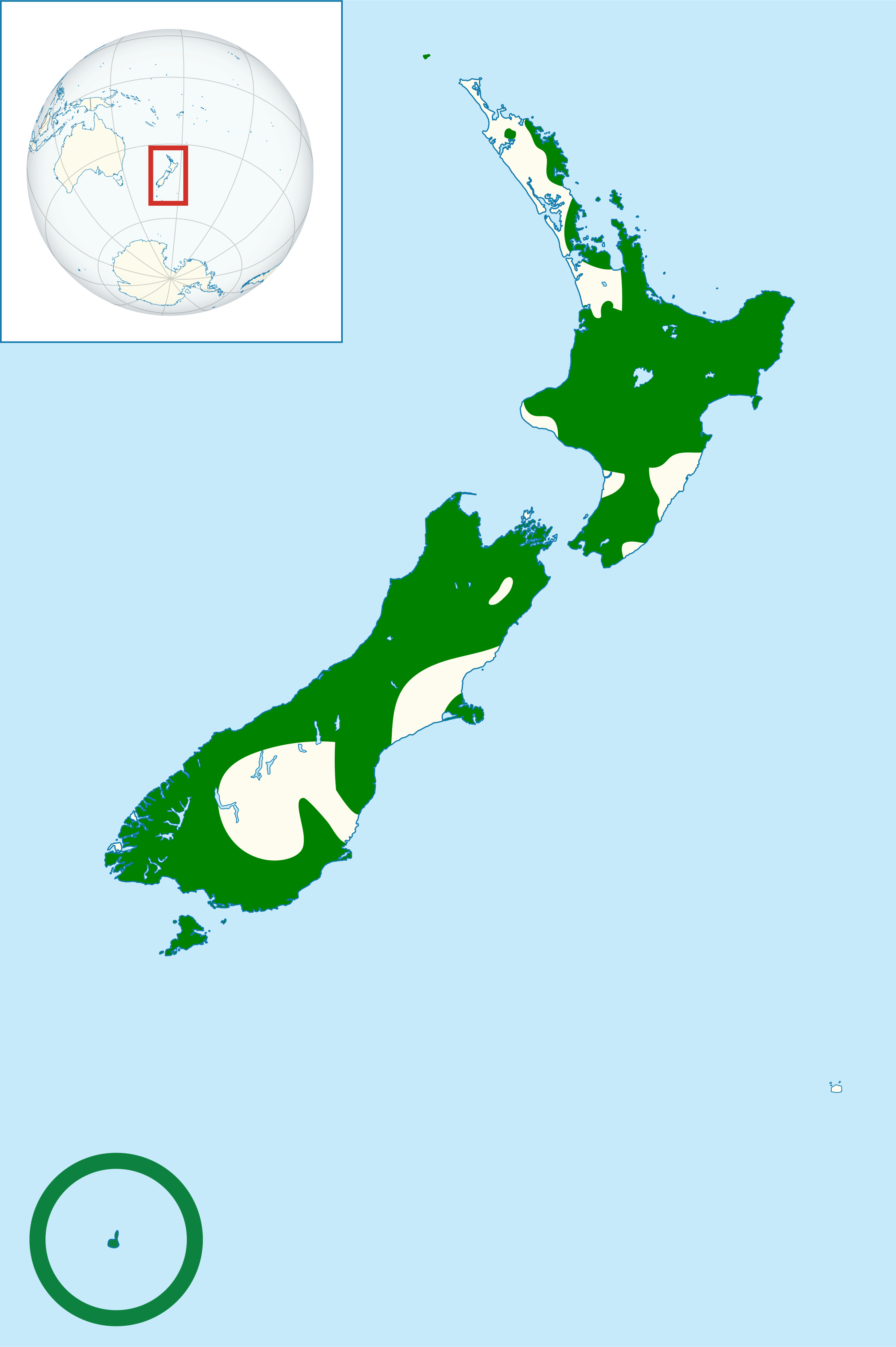
Bellbirds measure about 17–20 cm (6.7–7.9 in) in length, with females weighing approximately 25 g (0.88 oz) and males 33 g (1.2 oz). Males are mostly olive-green with paler underparts, and bluish-black wings and tail. Females are paler and browner. Like other honeyeaters, the bellbird has a brush-like tongue that enables effective feeding on nectar from deep flowers. The species is common across much of New Zealand, its offshore islands, and the Auckland Islands, but it is scarce north of Waikato and across the Canterbury Plains and Central Otago. Its habitat includes both native and exotic forests and scrublands, and it is commonly found in parks and gardens.
Bellbirds feed on nectar, fruit, honeydew, and insects. During the breeding season, they become highly territorial and aggressively defend their territory against intruders. Bellbirds form monogamous pairs with long-lasting bonds that can span many years. Females typically lay around 3–4 eggs and incubate them for about 13–15 days. Fledging occurs approximately 19 days after hatching. Bellbirds have modified their ninth primary flight feathers, allowing them to produce specific whirring sounds in flight that they utilise during courtship and territorial defence. The bellbird is regarded as taonga (cultural or spiritual treasure) by the Māori, who traditionally valued it for both its meat and its melodious singing abilities.
Bellbirds are medium-sized honeyeaters, about 17–20 cm in length from the tip of their beak to the end of their tail. Females weigh about 25 g and males 33 g. Males have an olive-green body with a dark purplish sheen on their head. Their belly and flanks are lighter. The uppertail is black-brown with a narrow iridescent blue-black edge on most feathers. The upperwing coverts are mostly dark olive-green, with blackish inner webs. The vent and undertail-coverts are pale yellow to off-white, and the thighs are grey. The underwing is mainly grey with a dark olive leading edge, pale-yellow secondary coverts, and a brown tint to the remiges. There is a yellow patch at the bend of a folded wing. The iris of the male is red.
Females are slightly smaller than males. Their plumage is duller and much browner than adult males. The gloss on the head is bluish, and there is a narrow white stripe starting at the gape and continuing below the eye. Upperparts are dark olive-brown with dark brown uppertail and olive-edged outer webs. The upperwing is mostly dark olive-brown with dark brown inner webs and olive outer edges. Underparts are mostly olive-brown with a patch of pale yellow feathers on the flanks, less prominent than in adult males, and pale olive to off-white vent and undertail-coverts. The undertail is brownish grey, and the underwing resembles that of an adult male. The iris of a female is brown.
Bare parts of males and females are the same. The bill is black and slightly curved downwards. Legs are grey-black, claws brown. Similar to other honeyeaters, bellbirds have a brush-like tongue that is used to collect nectar deeply from flowers. The tongue is longitudinally grooved, and its tip is divided into four segments. The end of each segment is equipped with fine hair-like structures that form the final brush. In both sexes, the ninth primary feather is notched. Sometimes, the eighth or tenth or all three mentioned primaries are notched too.
Both subspecies oneho and obscura are very similar in appearance to the nominate species described above. Male subsp. oneho has more blue sheen on its head, and feathers on some upper parts (nape, forehead, crown, ear coverts, chin, and throat) have a violet sheen. Female subspecies oneho differs from the nominate female by having a greener sheen on the head and neck, and a green-blue sheen on the crown, forehead, nape, and ear coverts. Compared to mainland birds, males of the subsp. oneho are relatively larger in proportion to females. The male subsp. obscura has slightly darker plumage than the nominate male, and its sheen on the upper body parts is violet. The female subsp. obscura has slightly paler underparts compared to the nominate female.
A juvenile male is similar to an adult male but is duller with very little to no iridescence. A juvenile female is even paler and greyer than a juvenile male. Unlike adults, juvenile bellbirds don't have their primaries notched. Nestlings are initially born without feathers but quickly develop a covering of grey down.
Aliases
Anthornis melanura, Mocker, Korimako, Makomako, Moki-mok, Moko-moko, bellbird
Range