Bird App
Bird of the day
Ocellated turkey
Meleagris ocellata
The ocellated turkey (Meleagris ocellata) is a species of turkey residing primarily in the Yucatán Peninsula, Mexico, as well as in parts of Belize and Guatemala. A relative of the North American wild turkey (Meleagris gallopavo), it was sometimes previously considered in a genus of its own (Agriocharis), but the differences between the two turkeys are currently considered too small to justify generic segregation. It is a relatively large bird, at around 70–122 cm (28–48 in) long and an average weight of 3 kg (6.6 lb) in females and 5 kg (11 lb) in males.
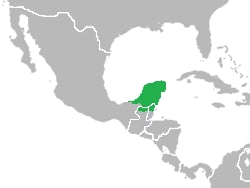
The ocellated turkey lives only in a 130,000 km2 (50,000 sq mi) range in the Yucatán Peninsula in Mexico—which includes all or part of the states of Quintana Roo, Campeche, Yucatán, Tabasco, and Chiapas—as well as the northern and western parts of Belize and northern Guatemala.
The ocellated turkey was considered endangered by Mexican authorities as recently as 2002 and has been considered Near Threatened by the IUCN since 2004.
The body feathers of both sexes are a mixture of bronze and green iridescent color. Although females can be duller with more green, the breast feathers do not generally differ and cannot be used to determine sex. Neither sex possesses the "beard" typically found in wild turkeys. Tail feathers of both sexes are bluish-grey with an eye-shaped, blue-bronze spot near the end with a bright gold tip. The spots, or ocelli (located on the tail), for which the ocellated turkey is named, have been likened to the patterning typically found on peafowl. The upper, major secondary wing coverts are rich iridescent copper. The primary and secondary wing feathers have similar barring to that of North American turkeys, but the secondaries have more white, especially around the edges.
Both sexes have blue heads with some orange or red nodules, which are more pronounced on males. The males also have a fleshy blue crown covered with nodules, similar to those on the neck, behind the snood. During breeding season this crown swells up and becomes brighter and more pronounced in its yellow-orange color. The eye is surrounded by a ring of bright red skin, which is most visible on males during breeding season. The legs are deep red and are shorter and thinner than on North American turkeys. Males over one year old have spurs on the legs that average 4 cm (1+1⁄2 in), with lengths of over 6 cm (2.4 in) being recorded. These spurs are much longer and thinner than on North American turkeys.
Ocellated turkeys are much smaller than any of the subspecies of North American wild turkey, with adult hens weighing about 4 kg (8.8 lb) before laying eggs and 3 kg (6–7 pounds) the rest of the year, and adult males weighing about 5–6 kg (11–13 lb) during breeding season.
Vocalizations of the hen ocellated turkeys are similar to those of their northern relatives, however the male vocalization known as a "gobble" is quite different in comparison. The gobble begins with several low frequency "thumps", much like the sound of a small gasoline motor starting. As the tempo of thumps increases, the typical gobble is produced. Branton and Berryhill (2007) have observed that the male ocellated turkey does not gobble per se like the wild turkey. Rather, his song is distinct and includes some six to seven bongo-like bass tones which quicken in both cadence and volume until a crescendo is reached whereupon the bird's head is fully erect while he issues forth a rather high-pitched but melodious series of chops. The ocellated turkey will typically begin his singing 20 to 25 minutes before sunrise—similar to the wild turkey.
Aliases
Meleagris ocellata
Range