 Bird App
Bird of the day
Snowy plover
Charadrius nivosus
The snowy plover (Anarhynchus nivosus) is a small shorebird found in the Americas. It is a member of the bird family Charadriidae, which includes the plovers, dotterels, and lapwings. The snowy plover was originally described by John Cassin in 1858, but was classified as a subspecies of the Kentish plover in 1922. Since 2011, the snowy plover has been recognized as a distinct species based on genetic and anatomical differences from the Kentish plover. Two or three subspecies are recognized, distributed along the Pacific coast of North America, Ecuador, Peru, and Chile, in several inland areas of the US and Mexico, along the Gulf Coast, and on Caribbean islands. The coastal populations consist of both residential and migratory birds, whereas the inland populations are mostly migratory. It is one of the best studied endemic shorebirds of the Americas, and one of the rarest.
Snowy plovers are pale brown above and white below, with a white band on the hind neck. During the breeding season, males have black patches behind the eye and on the side of the neck; the neck patches are separated from each other and do not form a continuous breast band as in many other plovers. Snowy plovers can also be distinguished from other plovers in having an all-black and slender bill, and gray to black legs. The typical call is a repeated "tu-wheet".
This plover inhabits open areas in which vegetation is absent or sparse, in particular coastal sand beaches and shores of salt or soda lakes, where it feeds on invertebrates such as crustaceans, worms, beetles, and flies. At the beginning of the breeding season, males excavate multiple nest scrapes that are advertised to females; one of these scrapes is later selected for breeding. Some females will desert their brood soon after the chicks hatch to re-mate with another male, while their first mate will continue to rear the chicks. Such polygamy is uncommon in birds, and is possibly a strategy to maximize breeding success. There are more males than females – 1.4 times as many in California – and the more pronounced this sex ratio imbalance is, the more females engage in polyandrous behavior.
The snowy plover is listed as near threatened by the International Union for Conservation of Nature. The main threats are habitat destruction due to invasive beach grasses, urban development, as well as frequent disturbance due to recreational uses of beaches. Conservation measures on the US Pacific coast include roping-off beach areas that are used for breeding, the removal of invasive beach grasses, and protection against egg predators. While such measures have been successful locally, the global population is thought to be in decline.
The snowy plover is a plump shorebird with a large head, a short and slender bill, and short neck and tail. It is a small plover, with adults ranging from 15 to 17 cm (5.9 to 6.7 in) in length, from 34 to 43.2 cm (13.4 to 17.0 in) in wingspan, and from 40 to 43 g (1.4 to 1.5 oz) in weight. Its body is typically held horizontally. Compared to other plovers, its legs are relatively long and its wings short. The bill is black, the iris dark brown, and the legs gray to black.
Snowy plovers are pale brown above and white below, with a white band on the hind neck and a smudgy eyestripe (absent in the South American subspecies). Breeding males have black patches behind the eye ("ear patch"), on the sides of the neck, and on the forehead. In males, the crown may be reddish at the start of the breeding season. The breeding female is slightly duller, and typically one or more of the patches are partly or completely brown. The neck patches on each side are well separated and rarely joined at the front, giving the appearance of a "broken" breast band in contrast to the continuous breast band in many other plovers. Outside the breeding season, the neck and ear patches are pale and the forehead patch is absent, and plumages of males and females cannot be distinguished. Newly hatched chicks have pale upper sides with brown to black spots and are white below.
Similar species within its range include the piping plover, the collared plover, the semipalmated plover, and Wilson's plover. Amongst other features, the snowy plover differs from these species in its slender and entirely black bill (shorter and thicker in piping plover and longer and thicker in Wilson's plover, and with orange base in piping and breeding semipalmated plover), in its gray to black legs (orange or yellow in piping, collared, and semipalmated plover), and the "broken" breast band (usually complete in semipalmated, Wilson's, and breeding collared plovers).
The typical call is a repeated "tu-wheet" given in a wide range of contexts. In males, these include advertisement while standing in territories and courtship. In both sexes, the call may be given in situations of threat, aggression, distress, and alarm. This call differs between sexes, being shorter, quieter, and hoarser in the female. Other calls include a repeated "purrt" that is given during breeding season, for example while flying from nest sites or when other plovers intrude their territory. A single "churr" is mostly given by males while defending territory or offspring from other plovers. Outside the breeding season, a repeated "ti" is given when disturbed while resting, and is often followed by flight. Chicks make a "peep" call from up to two days before hatching while still in the egg, and until their first flight.
Aliases
Charadrius nivosus
Range
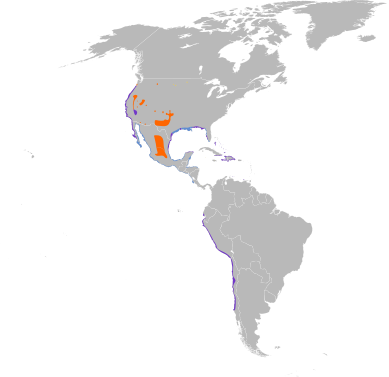
Data retrieved on October 15, 2025 at 6:20 AM