 Bird App
Bird of the day
Hooded visorbearer
Augastes lumachella
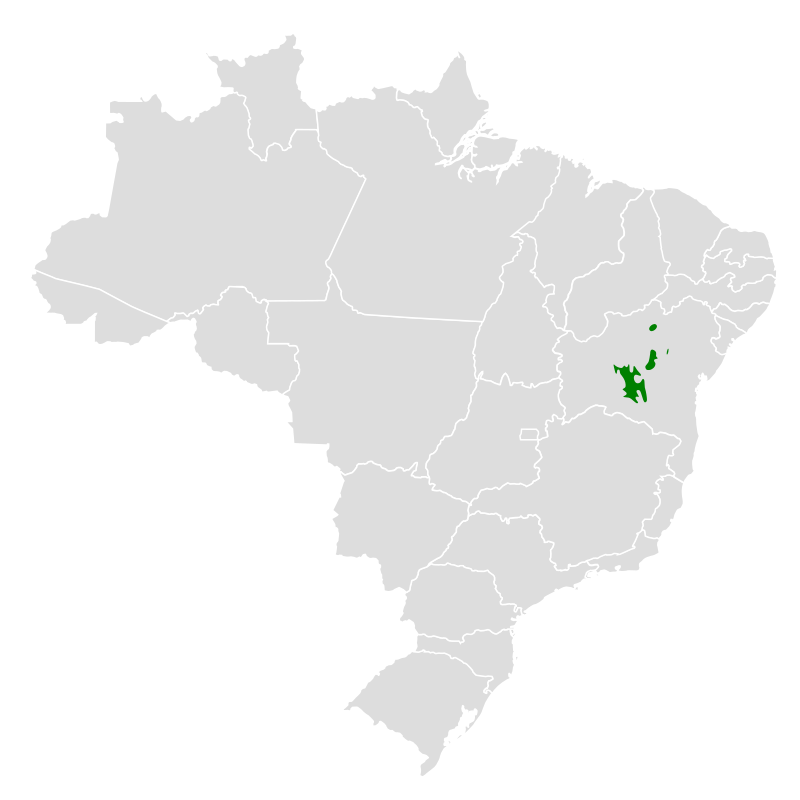
The hooded visorbearer (Augastes lumachella) is a small species of hummingbird in the family Trochilidae. Endemic to the east Brazilian state of Bahia, it is found only at higher altitudes in the Chapada Diamantina region. The species is sexually dimorphic.
It resides in the campo rupestre, an arid, high-elevation area characterized by rocky outcrops, poor soils, open habitats, and harsh climatic conditions. There, it feeds primarily on nectar, though it also takes insects. Its breeding ecology remains largely undescribed, though it is known to build its nest from cactus spines. The International Union for Conservation of Nature rates it as a near-threatened species, primarily because of the relatively small size of its range. It is threatened by habitat loss, brought about primarily by unregulated mining and the conversion of the campo to pastureland and human habitation. Climate change is projected to cause a major contraction of its range – perhaps by as much as 90%.
The hooded visorbearer is a small hummingbird, measuring 8.3–10 cm (3.3–3.9 in) in length and weighing 4–4.8 g (0.14–0.17 oz). Its short, straight bill is black. The species is moderately sexually dimorphic. The male is an iridescent bronzy-green color on the upperparts and underparts. His forehead and throat are an iridescent golden-green with a narrow border of bluish-green at the lower edge of the throat. The sides and crown of his head are black, and a thin line of black borders his gorget. He has a narrow white breast band with a golden-orange spot in the center and purplish-brown wings. His tail is a deep bronzy-crimson. The female's coloring is more subdued. She is more bronzy on her upperparts and underparts, and her head is green instead of black. She has a gray face and the sides of her head are brown, rather than black. The green on her throat is less colorful and iridescent than that of the male's, with a stronger border of bluish-green at the lower edge; the color does not extend to her forehead. Immature birds are bronzy-green above and brown below, with a white throat speckled with green. Their tails are a coppery-bronze above and crimson below, less brilliantly-colored than those of adults. The combination of head pattern and tail color is said to make this species "unmistakable" within its small natural range.
The song of the hooded visorbearer is described as "nasal" and "dry". Transcribed as tru tweé tru zee, its short phrases are typically repeated more than three times in a row.
Aliases
Hooded visor-bearer, Hooded Visorbearer
Range
Data retrieved on September 27, 2026 at 3:56 PM