 Bird App
Bird of the day
Wattled curassow
Crax globulosa
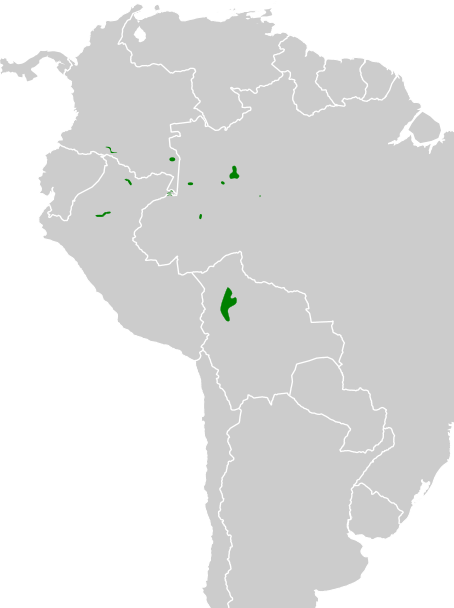
The wattled curassow (Crax globulosa) is a threatened member of the family Cracidae, the curassows, guans, and chachalacas. It is found in remote rainforests in the western Amazon basin in South America. Males have black plumage, except for a white crissum (the area around the cloaca), with curly feathers on the head and red bill ornaments and wattles. Females and juveniles are similar but lack the bill ornamentation and have a reddish-buff crissum area. The wattled curassow is the most ancient lineage of the southern Crax curassows. In captivity, it sometimes hybridises with the blue-billed curassow.
The habitat of the wattled curassow is gallery forests and seasonally-flooded forests where it feeds in small groups on the ground. The diet is largely fruit, but invertebrates and some small vertebrates are opportunistically taken. Little is known of its breeding habits, but it is known that the nest is built of sticks and leaves and two eggs are usually laid. The population of this species is declining. It is threatened by loss of habitat, as the rainforest is progressively cleared, and by hunting, and the International Union for Conservation of Nature has rated its conservation status as "endangered".
The wattled curassow is about 82–89 cm (32–35 in) long, and weighs around 2,500 g (88 oz). It is a large curassow lacking the white tail-tips found in many of these birds; the feathers along the crest of its head are curled forwards. Males have black plumage all over except for the white crissum. The irides are dark brown; legs, feet and bill are blackish. It has conspicuous crimson bill ornaments—a round red knob with bony core adorns the maxilla base, while the cere extends apically at least halfway under this knob and below the mandible base forms a small fleshy wattle.
Females have black plumage just like the male, but their crissal area is reddish buff. In some, the remiges and sometimes the wing coverts have faint brownish marbling. Their bills and irides are also blackish, but their feet and legs are a greyish flesh color. They lack the bill knob and wattles, and their cere is bright orange-red. Young males have less well-developed facial ornaments, usually with a more yellowish hue like females do.
The hatchlings are covered in brown down above and whitish down below.
Adults look very much like those of the red-billed curassow (C. blumenbachii), whose males have only an indistinct maxilla knob. Its females have a blackish cere, rather pale legs and feet, and their wings—particularly the remiges—usually have distinct chestnut brown marbling. The black curassow subspecies C. alector erythrognatha, found north of the Solimões, has a cere like the wattled curassow female, but its bill is lighter and the crissum is white in both sexes. Young C. globulosa males are easily confused with those of the yellow-knobbed curassows (C. daubentoni), but the latter has a white tail-margin and yellow (not orange) bill wattle. All these similar species are allopatric however, with only C. a. erythrognatha occurring adjacent to the range of C. globulosa.
Aliases
Crax globulosa
Range
Data retrieved on October 15, 2025 at 6:17 AM