 Bird App
Bird of the day
Common raven
Corvus corax
The common raven or northern raven (Corvus corax) is a large all-black passerine bird. It is the most widely distributed of all corvids, found across the Northern Hemisphere. There are 11 accepted subspecies with little variation in appearance, although recent research has demonstrated significant genetic differences among populations from various regions. It is one of the two largest corvids, alongside the thick-billed raven, and is the heaviest passerine bird; at maturity, the common raven averages 63 centimetres (25 inches) in length and 1.47 kilograms (3.2 pounds) in weight, though up to 2 kg (4.4 lb) in the heaviest individuals. Although their typical lifespan is considerably shorter, common ravens can live more than 23 years in the wild. Young birds may travel in flocks but later mate for life, with each mated pair defending a territory.
Common ravens have coexisted with humans for thousands of years and in some areas have been so numerous that people have regarded them as pests. Part of their success as a species is due to their omnivorous diet; they are extremely versatile and opportunistic in finding sources of nutrition, feeding on carrion, insects, cereal grains, berries, fruit, small animals, nesting birds, and food waste. Some notable feats of problem-solving provide evidence that the common raven is unusually intelligent.
Over the centuries, the raven has been the subject of mythology, folklore, art, and literature. In many cultures, including the indigenous cultures of Scandinavia, ancient Ireland and Wales, Bhutan, the northwest coast of North America, and Siberia and northeast Asia, the common raven has been revered as a spiritual figure or godlike creature.
A mature common raven ranges between 54 and 71 cm (21 and 28 in) and has a wingspan of 116 to 153 cm (46 to 60 in). Recorded weights range from 0.69 to 2.250 kg (1.52 to 4.96 lb), thus making the common raven one of the heaviest passerines. Birds from colder regions such as the Himalayas and Greenland are generally larger with slightly larger bills, while those from warmer regions are smaller with proportionally smaller bills. Representative of the size variation in the species, ravens from California weighed an average of 0.784 kg (1.73 lb), those from Alaska weighed an average of 1.135 kg (2.50 lb) and those from Nova Scotia weighed an average of 1.230 kg (2.71 lb). The bill is large and slightly curved, with a culmen length of 5.7 to 8.5 cm (2.2 to 3.3 in), one of the largest bills amongst passerines (only the thick-billed raven and white-necked raven have larger bills). It has a longish, strongly graduated tail, at 20 to 26.3 cm (7.9 to 10.4 in), and mostly iridescent black plumage, and a dark brown iris. The throat feathers are elongated and pointed and the bases of the neck feathers are pale brownish-grey. The legs and feet are stout and strong, with a tarsus length of 6 to 7.2 cm (2.4 to 2.8 in). The juvenile plumage is similar but duller, with a blue-grey iris, and pinkish gape at first.
Apart from its greater size, the common raven differs from related crows by having a larger and heavier black beak, shaggy feathers around the throat, longer bristles above the beak, and a longer, wedge-shaped tail. Flying ravens are distinguished from crows by their tail shape, larger wing area, and more stable soaring style, which generally involves less wing flapping. Despite their bulk, ravens are easily as agile in flight as their smaller cousins. In flight the feathers produce a creaking sound that has been likened to the rustle of silk. The voice of ravens is also quite distinct, its usual call being a deep croak of a much more sonorous quality than a crow's call, though the calls of other ravens like the fan-tailed raven and brown-necked raven can be confused where they occur together with common ravens in parts of southwest Asia and northern Africa; of these two, the fan-tailed raven is more similar in calls but has a very different shape with its broad wings and very short tail, while the brown-necked raven can be very hard to distinguish on plumage, but has somewhat more crow-like calls. In North America, the Chihuahuan raven (C. cryptoleucus) is fairly similar to the relatively small common ravens of the American southwest and is best distinguished by the still relatively smaller size of its bill, beard and body and relatively longer tail. The all-black carrion crow (C. corone) and rook (C. frugilegus) in Europe may suggest a raven due to their largish bill but are still distinctly smaller and have the wing and tail shapes typical of crows.
In the Faroe Islands, a now-extinct pied colour morph of this species existed, known as the pied raven; the ordinary black-coloured common ravens remain widespread in the archipelago. White ravens are occasionally found in the wild. Some in British Columbia lacked the pink eyes of an albino, and were instead leucistic, a condition where an animal lacks any of several different types of pigment, not simply melanin.
Common ravens have a wide range of vocalizations which are of interest to ornithologists. Gwinner carried out important studies in the early 1960s, recording and photographing his findings in great detail. Fifteen to 30 categories of calls have been recorded for this species, most of which are used for social interaction. Calls recorded include alarm calls, chase calls, and flight calls. The species has a distinctive, deep, resonant prruk-prruk-prruk call, which to experienced listeners is unlike that of any other corvid. Its very wide and complex vocabulary includes a high, knocking toc-toc-toc, a dry, grating kraa, a low guttural rattle and some calls of an almost musical nature.
Like other corvids, the common raven can mimic sounds from their environment, including human speech. Non-vocal sounds produced by the common raven include wing whistles and bill snapping. Clapping or clicking has been observed more often in females than in males. If a member of a pair is lost, its mate reproduces the calls of its lost partner to encourage its return.
Aliases
raven, Corvus corax, Common Raven, western raven
Range
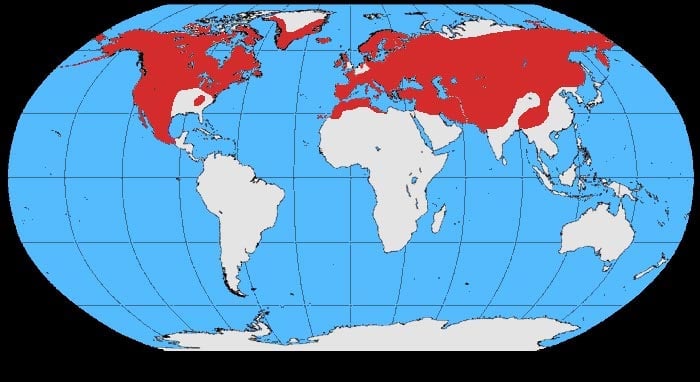
Data retrieved on October 15, 2025 at 6:14 AM