 Bird App
Bird of the day
Sarus crane
Antigone antigone
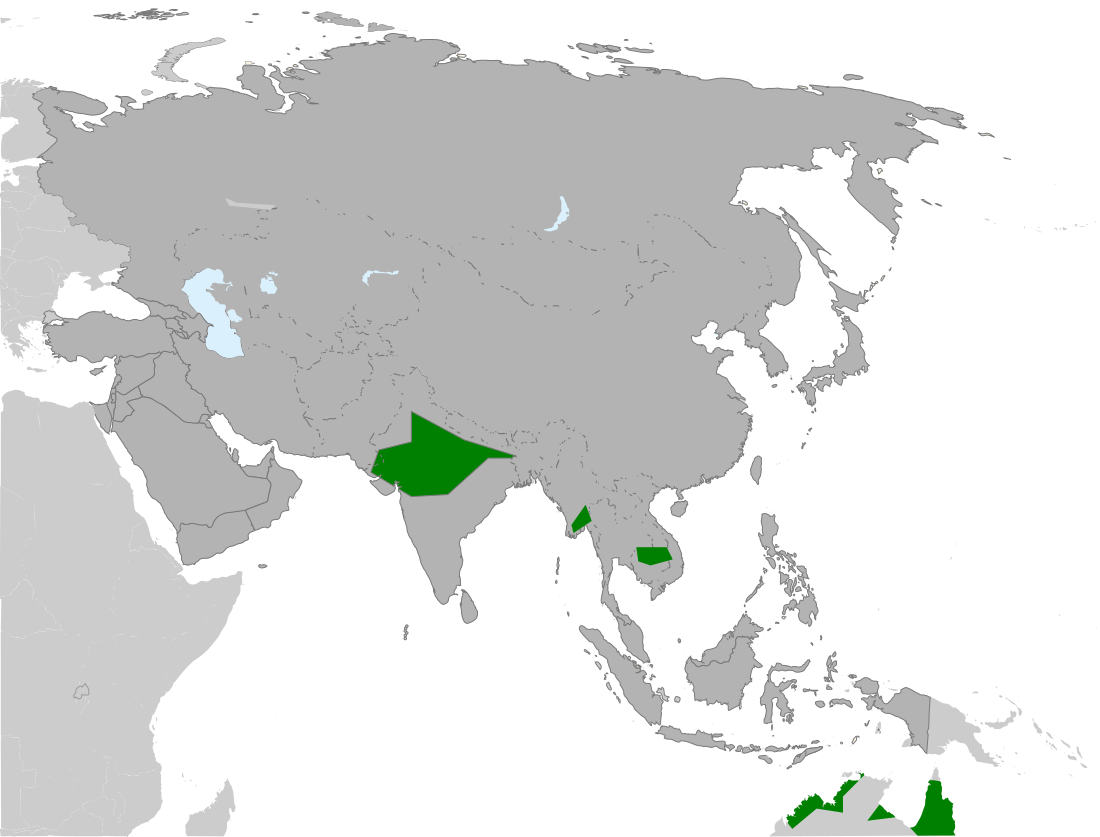
The sarus crane (Antigone antigone) is a large nonmigratory crane found in parts of the Indian subcontinent, Southeast Asia, and northern Australia. The tallest of the flying birds, standing at a height of up to 1.8 m (5 ft 11 in), they are a conspicuous species of open wetlands in South Asia, seasonally flooded Dipterocarpus forests in Southeast Asia, and Eucalyptus-dominated woodlands and grasslands in Australia.
The sarus crane is easily distinguished from other cranes in the region by its overall grey colour and the contrasting red head and upper neck. They forage on marshes and shallow wetlands for roots, tubers, insects, crustaceans, and small vertebrate prey. Like other cranes, they form long-lasting pair bonds and maintain territories within which they perform territorial and courtship displays that include loud trumpeting, leaps, and dance-like movements. In India, they are considered symbols of marital fidelity, believed to mate for life and pine the loss of their mates, even to the point of starving to death.
The main breeding season is during the wet season, when the pair builds an enormous nest "island," a circular platform of reeds and grasses nearly two meters in diameter and high enough to stay above the shallow water surrounding it. Increased agricultural intensity is often thought to have led to declines in sarus crane numbers, but they also benefit from wetland crops and the construction of canals and reservoirs. The stronghold of the species is in India, where it is traditionally revered and lives in agricultural lands in close proximity to humans. Elsewhere, the species has been extirpated in many parts of its former range.
The adult sarus crane is very large, with grey wings and body, a bare red head, collar and nape, a greyish crown, and a long, greenish-grey, pointed bill. In flight, the long neck is held straight, unlike that of a heron (which folds it back), and the black wing tips can be seen; the crane's long, pink legs trail behind them. This bird has a grey ear covert patch, orange-red irises, and a greenish-grey bill. Juveniles have a yellowish base to the bill and the brown-grey head is fully feathered.
The bare red skin of the adult's head and neck is brighter during the breeding season. This skin is rough and covered by feather follicles, and a narrow area around and behind the head is covered by black, bristly feathers. The sexes do not differ in plumage, although males are on average larger than females; males of the Indian population can attain a maximum height around 180 cm (5.9 ft), making them the world's tallest extant flying bird. The weight of nominate race individuals is 6.8–7.8 kg (15–17 lb), while five adults of A. a. sharpii averaged 8.4 kg (19 lb). Across the distribution range, their weight can vary from 5 to 12 kg (11 to 26 lb), height typically from 115 to 167 cm (45 to 66 in), and wingspan from 220 to 250 cm (87 to 98 in).
While individuals from northern populations are among the heaviest cranes, alongside the red-crowned and wattled cranes, and the largest in their range, birds from Australia tend to be smaller. In Australia, the sarus can easily be mistaken for the more widespread brolga. The brolga has the red colouring confined to the head and not extending onto the neck. Body mass in Australian sarus cranes was found to average 6.68 kg (14.7 lb) in males and 5.25 kg (11.6 lb) in females, with a range for both sexes of 5.0 to 6.9 kg (11.0 to 15.2 lb). Thus, Australian sarus cranes average about 25% lighter than the northern counterparts and are marginally lighter on average than brolgas.
Aliases
Antigone antigone
Range
Data retrieved on October 15, 2025 at 6:10 AM