 Bird App
Bird of the day
Australasian gannet
Morus serrator
The Australasian gannet (Morus serrator), also known as the Australian gannet or tākapu, is a large seabird of the booby and gannet family, Sulidae. Adults are mostly white, with black flight feathers at the wingtips and lining the trailing edge of the wing. The central tail feathers are also black. The head is tinged buff-yellow, with a pearly grey bill edged in dark grey or black, and blue-rimmed eyes. Young birds have mottled plumage in their first year, dark above and light below. The head is an intermediate mottled grey, with a dark bill. The birds gradually acquire more white in subsequent seasons until they reach maturity after five years.
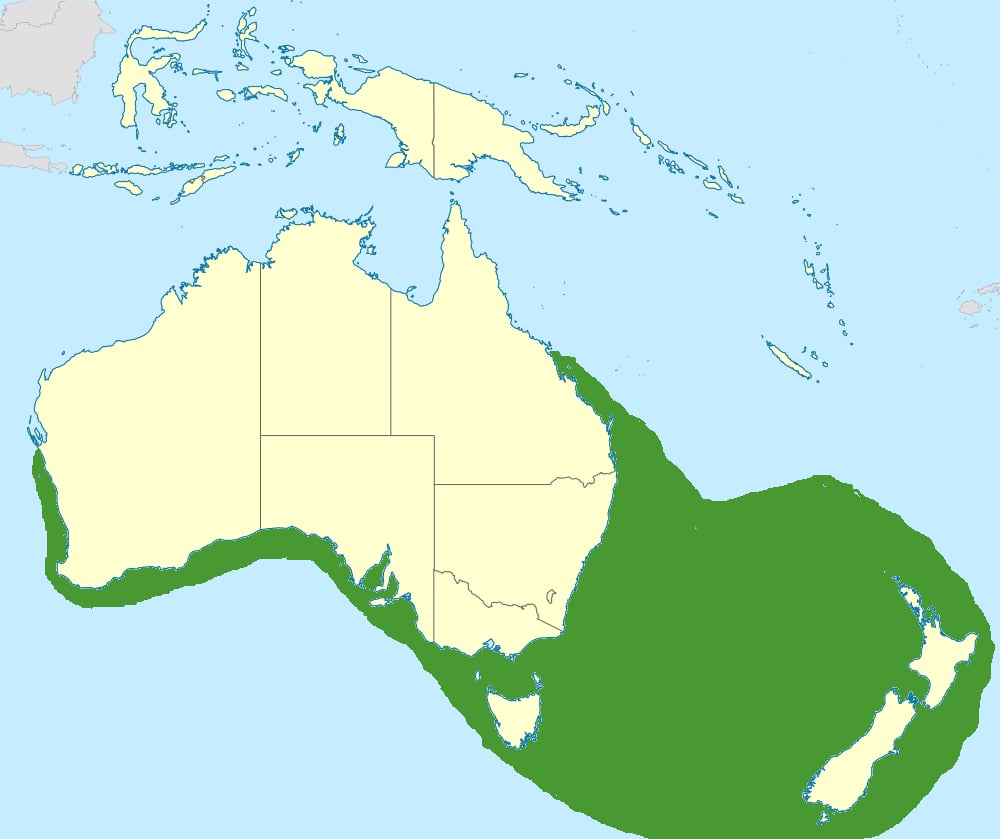
The species range over water above the continental shelf along the southern and eastern Australian coastline, from Steep Point in Western Australia to Rockhampton, Queensland, as well as the North and South Islands of New Zealand, Lord Howe and Norfolk Islands. Nesting takes place in colonies along the coastlines of New Zealand, Victoria and Tasmania—mostly on offshore islands, although there are several mainland colonies in both countries. Highly territorial when breeding, the Australasian gannet performs agonistic displays to defend its nest. Potential and mated pairs engage in courtship and greeting displays. The nest is a cup-shaped mound composed of seaweed, earth, and other debris, built by the female from material mainly gathered by the male. A single pale blue egg is laid yearly, though lost eggs may be replaced. The chick is born featherless but is soon covered in white down. Fed regurgitated fish by its parents, it grows rapidly and outweighs the average adult when it fledges.
These birds are plunge divers and spectacular fishers, plunging into the ocean at high speed. They eat mainly squid and forage fish that school near the surface. The species faces few natural or man-made threats, and since its population is growing it is considered to be a least-concern species by the International Union for Conservation of Nature (IUCN).
An adult Australasian gannet is 84–91 cm (33–36 in) long, weighs 2.3 kg (5.1 lb), and has a 170–200 cm (67–79 in) wingspan. The two sexes are generally of a similar size and appearance, though a 2015 field study at Pope's Eye and Point Danger colonies found females to be 3.1% and 7.3% heavier respectively. Females also had a slightly larger ulna and smaller bill. The plumage is white with black flight feathers on the wings, and central rectrices of the tail. Some individuals have more extensive black plumage of their tail feathers. There is a sharp demarcation between light and dark plumage. Black primary feathers are more resilient to wear, which may explain the dark plumage of the wings. The head and hindneck are tinged buff-yellow. The colour is more pronounced on the head and during breeding season. The eyes have a light grey iris surrounded by a pale blue eye ring, and bare black skin on the face which merges into the bill. In adults, the bill is pearly grey with dark grey or black edges, and a black groove running down the length of the upper mandible. The four-toed feet are dark grey and joined by a membrane of similar colour. There are light green lines running along the ridges of the toes that continue along up the front of the legs.
Fledglings are brownish-grey speckled with white overall. They have dark brown bills, bare facial skin and eyes, and dark grey legs and feet. Australasian gannets take 2–5 years to gain adult plumage. Over this period, the upperparts and underparts gradually whiten and the crown and nape become buff-coloured, but there is great variation in the age that mature plumage is seen.
This species is distinctive and only likely to be confused with species that do not generally share its range. The Cape gannet is a rare vagrant to Australasian waters and has an all-black tail, while the masked and red-footed boobies are generally restricted to tropical waters. Although both have mostly white plumage, they lack the buff colouring of the head and have white tails. The masked booby has a blue-black face and less black on the wing, while the red-footed booby has red feet.
The Australasian gannet is generally silent at sea and loud and vocal at the colony in the day and at times overnight during the breeding season. Its typical call is a harsh arrah-arrah or urrah-urrah, which is emitted upon approaching or arriving at the colony or as a threat. The calls can vary between individuals, and the female's call is lower pitched than the male's.
Aliases
Morus serrator
Range
Data retrieved on October 15, 2025 at 6:10 AM