 Bird App
Bird of the day
Curve-billed thrasher
Toxostoma curvirostre
The curve-billed thrasher (Toxostoma curvirostre) is a medium-sized mimid native to most of Mexico and to the deserts of southwestern United States. It is a non-migratory species, and throughout most of its range it is the most common desert thrasher. Several subspecies have been classified since 1827, though there is no consensus on the number. Allopatric speciation is believed to have played a major role in the variations of the curve-billed. It is grey-brown overall with a slightly curved bill, and is similar in appearance to the related Bendire's thrasher. It generally resides in desert regions of the United States and Mexico, but can inhabit areas predominately populated by humans.
The demeanor of the curve-billed has been described as "shy and rather wild", but it allows humans to view it closely. It is very aggressive in driving out potential threats, whether competitors for food or predators of its chicks. The curve-billed thrasher sometimes mimics several other species, though not to the extent of other mimics. It has a variety of distinctive songs, and this extensive repertoire of melodies has led it to be known as cuicacoche (songbird) in Mexico.
The curve-billed thrasher is immediately recognized as a thrasher by its long tail and short wings. It is also recognized for its sickle-shaped bill, almost as long as its head width and brownish black in color. The body is compact with a large head, short wings and long tail. However, the tail is short relative to other thrasher species. The chest is grayish brown with circular brown-gray spots. The eyes are generally orange, shading to golden in adulthood. Juveniles are lacking in pale tips, rectrices, abdominal feathers are unkempt and upper parts and chest are washed rufously.
Variations are markedly different with each subspecies. The eastern subspecies has more distinct spots on its chest, more white along the tips and rectrices and obvious wing bars. T.c. palmeri has less spotting on chest and tips and less obvious wing bars. Other examples include T.c. curvirostre possessing longer wings and a tail than T.c. oberholseri; T.c. insularum is paler with more grey than T.c. palmeri and has more visible spotting on its breast.
One study published in 2003 suggested that curve-billed speciation was due to climate, which could be explained by molt and feather wear. The same study suggested that the Sierra Madre Occidental acts as a barrier to initiate differentiation within the species.
Measurements:
Length: 10.6–11.0 in (27–28 cm)
Weight: 2.1–3.3 oz (60–94 g)
Wingspan: 13.4–13.6 in (34–35 cm)
The most distinctive voice of the curve-billed is an abrupt and brash whit-wheet, which sounds akin to a person whistling to get one's attention. It is usually uttered from high perches. The songs are similar to that of the northern mockingbird but notes do not end as abruptly; its voice is regarded as more pleasant. The curve-billed can utter songs consecutively two or three times, the length spanning from 2 to 15 seconds. Some phrases are nasal and buzzy; its large vocabulary enables it to conjure successive songs that are usually different from one another.
As a mimid it is capable of mimicking several species, including scissor-tailed flycatcher, northern cardinal, pyrrhuloxia and, in one instance, a black-headed grosbeak.
Because its coloration is similar to Bendire's thrasher, the two birds are easily mistaken for one another. The bill of the curve-billed is all black, while that of Bendire's is paler down to the lower mandible, showing a dark grey with a basal area that does not feature a stark contrast. The upper and lower mandibles of the curve-billed are curved, while the upper is curved and lower is essentially straight for the Bendires'. Although geographic variances for the curve-billed can make discerning breast patterns difficult, the curve-billed has a tendency to display larger and rounder spots overall on its breast, in contrast to the Bendires' smaller, more pronounced markings shaped like arrowheads. However, curve-billed thrashers can also present this feature. Bendires' typically have yellow eyes while curve-billed eyes are typically orange, but Bendires' can have variations that appear yellow-orange while some curve-billed eyes are red-orange, yellow-orange, or yellow. The curve-billed is heavier and is more likely to inhabit suburban regions; Bendires' are likely to avoid dense vegetation such as mesquite and prefers open grassland with scattered yucca or around hedgerows in agricultural areas. The song call of Bendire's is said to be more melodic and continuous with a chuck, while the curve-billed is known for its whit-wheet calls.
Some of the aforementioned differences, such as streaks on the breast, bill shape and eye color are even more prominent in juveniles of the two species.
Aliases
Toxostoma curvirostre
Range
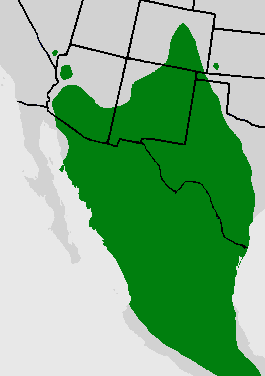
Data retrieved on October 15, 2025 at 6:09 AM