 Bird App
Bird of the day
Marsh tit
Poecile palustris
The marsh tit (Poecile palustris) is a Eurasian passerine bird in the tit family Paridae and genus Poecile, closely related to the willow tit, Père David's and Songar tits. It is a small bird, around 12 cm (4.7 in) long and weighing 12 g (0.42 oz), with a black crown and nape, pale cheeks, brown back and greyish-brown wings and tail. Between 8 and 11 subspecies are recognised. Its close resemblance to the willow tit can cause identification problems, especially in the United Kingdom where the local subspecies of the two are very similar: they were not recognised as separate species until 1897.
Globally, the marsh tit is classified as Least Concern, although there is evidence of a decline in numbers (in the UK, numbers have dropped by more than 50% since the 1970s, for example). It can be found throughout temperate Europe and northern Asia and, despite its name, it occurs in a range of habitats including dry woodland. The marsh tit is omnivorous; its food includes caterpillars, spiders and seeds. It nests in tree holes, choosing existing hollows to enlarge, rather than excavating its own. A clutch of 5–9 eggs is laid.
The nominate race has a black cap and nape with a blue sheen visible at close quarters. The black 'bib' below the bill is rather small; the cheeks are white, turning dusky brown on the ear coverts. The upperparts, tail and wings are greyish-brown, with slightly paler fringes to the tertials. The underparts are off-white with a buff or brown tinge strongest on the flanks and undertail coverts. The bill is black and the legs dark grey. Juveniles are very similar to adults, but with a duller black cap and bib, more greyish upperparts and paler underparts; they moult into adult plumage by September.
The marsh tit weighs 12 g (0.42 oz), has a length of 11.5 to 12 cm (4.5 to 4.7 in) (from bill to tail) and a wingspan of 19 cm (7.5 in). The wing length ranges from 60–70 mm (2.4–2.8 in). The oldest recorded marsh tit in Europe reached the age of 11 years, 11 months.
Like other tits it has a large range of call notes; most typical is the explosive "pitchou" note, given when agitated, often leading into "pitchou-bee-bee-bee", which can sound like willow tit when not heard clearly. Unlike many other tits, however, the marsh tit has a well-defined song and a wide song repertoire. Individual birds can have more than five songs, which they use interchangeably. Some of the more common songs include a typical tit-like, ringing, "schip-schip-schip-schip-ship", a more liquid "tu-tu-tu-tu-tu" and sometimes a sweet "tyeu-tyeu-tyeu-tyeu-tyeu". The old Staffordshire name for the species, 'Saw Whetter', refers to the bird's scolding call.
Marsh and willow tits are difficult to distinguish on appearance alone; the races occurring in the UK (P. p. dresseri and P. m. kleinschmidti respectively) are especially hard to separate. When caught for ringing, the pale 'cutting edge' of the marsh tit's bill is a reliable criterion; otherwise, the best way to tell apart the two species is by voice. Plumage characteristics include the lack of a pale wing panel (formed by pale edges to the secondary feathers in the willow tit), the marsh tit's glossier black cap and smaller black 'bib', although none of these is 'completely reliable'; for example, juvenile marsh tits can show a pale wing panel. The marsh tit has a noticeably smaller and shorter head than the willow tit and overall the markings are crisp and neat, with the head in proportion to the rest of the bird (willow tit gives the impression of being 'bull-necked').
A measure of the difficulty in identification is given by the fact that, in the UK, the willow tit was not identified as distinct from marsh tit until 1897. Two German ornithologists, Ernst Hartert and Otto Kleinschmidt, were studying marsh tit skins at the British Museum and found two wrongly-labelled willow tits amongst them (two willow tit specimens were then collected at Coalfall Wood in Finchley, north London, and that species was added to the British list in 1900).
Aliases
Poecile palustris, Parus palustris, marsh tit
Range
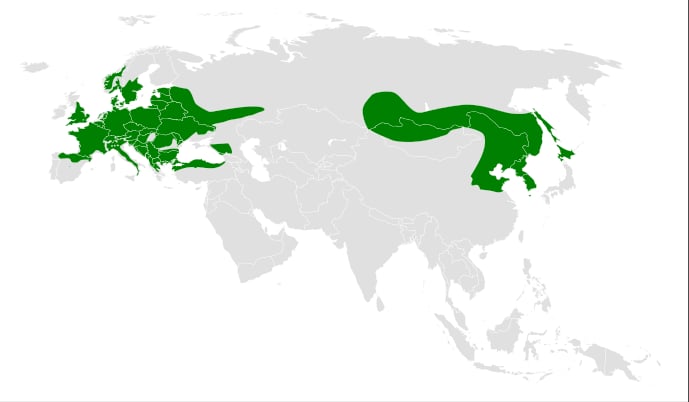
Data retrieved on October 15, 2025 at 6:06 AM