 Bird App
Bird of the day
Long-winged harrier
Circus buffoni
The long-winged harrier (Circus buffoni) is a common bird of prey species endemic to South America. They are members of the family Accipitridae, under the genus Circus which encompasses other harrier species. Its range encompasses most of South America, in grassland and wetland all across the continent. The long-winged harrier is a carnivorous bird, and will feed on many different animals found in its habitat.
Like owls and other harrier species, the long-winged harrier has a distinctive facial disc, which is used to triangulate the bird's hearing while it is hunting.
The long-winged harrier is classified as a species of least concern by the IUCN Red List, however their population has been observed to decline due to habitat degradation by human activity.
The long-winged is mid-sized bird of prey, and like most birds of prey species, the females are larger than the males. Males will weigh from 390 to 464 g (13.8 to 16.4 oz) and females will be slightly heavier, ranging from 400 to 645 g (14.1 to 22.8 oz). Their length can range between 46 and 60 cm (18 and 23.5 in) and their wingspan ranges between 120 and 155 cm (47 and 61 in). As other harrier species, the lon-winged harrier can be identified by its long and narrow tail and its especially long wings. Their wings and their back are mostly grey, with the primary feathers on the wings being much darker than the rest of the wing feathers, which are streaked with variants of white, grey and brown.
The long-winged harrier can harbor 2 different morphs, a dark morph and a light morph. In dark morph individuals, the belly is all black with females having more of a brown undertone. The light morph individuals can be identified by their white underparts, which contrasts heavily with their dark morph counterpart. Juvenile long-winged harriers usually have the same colour patterns as females, but they have a more speckled chest. The long-winged harrier morphologically resembles its close relative, the cinereous harrier (Circus cinereus), which can also be found in South America, but their range rarely overlaps.
As all other birds of prey species, the long-winged harrier possesses sharp talons used to catch their prey on the ground or in the air, and their legs are bright orange. The species also shares the large hooked beak of other birds of prey, which it uses to tear apart meat once it catches its prey.
The long-winged harrier is part of the only diurnal bird of prey group to possess a facial disc. The facial disc is formed by a group of easily recognizable group of feathers that form a disc shape around the bird's face. These feathers can be raised in response to sounds and can improve the bird's hearing when it is hunting by triangulating sounds in its ear holes.
Little is known of the long-winged harrier's vocalization, as is not a very vocal bird. It will call mostly when in flight and some variation of the bird's call include a fast succession of "klee-klee-klee", and a more quiet "thrill" with a quickly descending pitch.
Aliases
Circus buffoni, Long-winged harrier
Range
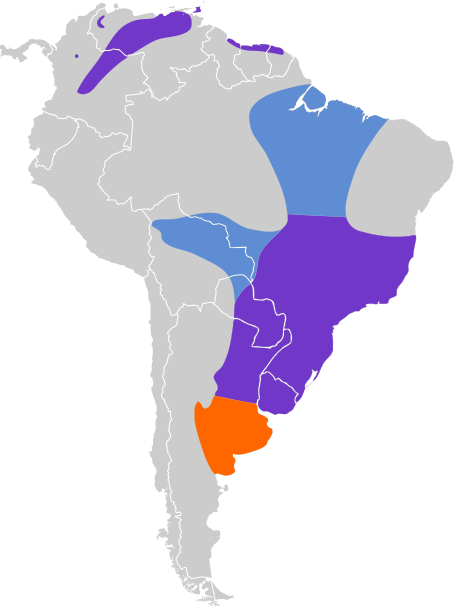
Data retrieved on October 15, 2025 at 5:58 AM