 Bird App
Bird of the day
Snow bunting
Plectrophenax nivalis
The snow bunting (Plectrophenax nivalis) is a passerine bird in the family Calcariidae. It is an Arctic specialist, with a circumpolar Arctic breeding range throughout the northern hemisphere. There are small isolated populations on a few high mountain tops south of the Arctic region, including the Cairngorms in central Scotland and the Saint Elias Mountains on the southern Alaska-Yukon border, as well as the Cape Breton Highlands. The snow bunting is the most northerly recorded passerine in the world.
The snow bunting is a sexually dimorphic, medium-sized passerine bird. It is ground-dwelling, and walks, runs and can hop if needed. It is fairly large and long-winged for a bunting. It measures 15 cm with a wingspan of 32–38 cm (13–15 in) and weights 30 to 40 grams. The bill is normally yellow with a black tip, however in males, the bill is all black in the summer. The plumage is white underneath and the wings and back have black and white on them. The female and male have different plumage; during the breeding season, the male is white with black wingtips and a black back, while the female has black wingtips and the black feathers on the back fringed with brown. During the winter, they both have broad orangey-brown fringes on the back feathers. In the spring, the buntings do not moult as many other passerines do; instead the breeding colours come with the wearing and abrasion of the brown fringes to show just the black centres of the feathers. Unlike most passerines, it has feathered tarsi, an adaptation to its harsh cold environment. No other passerine can winter as far north as this species, apart from the common raven.
This species is easily confused with McKay's bunting due to the similarity of their plumage and the occurrence of hybrids. It can also be confused with the Lapland longspur, which differs mainly in having minimal white in the wing; their calls are similar, but the snow bunting has more 'liquid' rippling tone, while Lapland longspur has a drier, more rattling tone. Another species that it may occur with is the horned lark, although that has a conspicuous black-and-yellow head pattern, a longer, partly black tail and no white on the wings.
The call is a distinctive rippling whistle, per,r,r,rit, and the song is a brief but loud warble hudidi feet feet feew hudidi.
Snow buntings use vocalizations to communicate among each other and males will have a song to attract the female. The communication calls are done by both the male and the female and they tend to be emitted in flight or in the ground, while the males will often emit the song from a perching position or in a flight display. The males will start singing as soon as they will reach the breeding grounds, and will stop once they find a mate. Studies have shown that the quality and the rate at which a song is emitted affect the reproductive success of a male. The rate of a song measured by the number of strophes per minute is limited by the foraging needs of the male; therefore, a male that is able to sing more frequently shows that he is more successful and effective in his foraging behaviour. The song becomes an indicator of the parental care qualities of the male, since having an effective foraging behaviour will provide a better probability of survival of the nestlings. Females will then choose their mates based on their song rate.
Within snow buntings, vocalizations in males are unique to each individual, although there is certain syllable sharing between one another. The uniqueness of each song reveals a capacity of recognition between individuals and has an effect in the individual fitness and reproductive success. The songs have duration of 2 seconds and have a frequency of 2 to 6 kHz. Each song is composed of similar and dissimilar figures that create different motifs that will alternate and repeat, resulting in a unique pattern for every male individual.
Aliases
Plectrophenax nivalis, snow bunting
Range
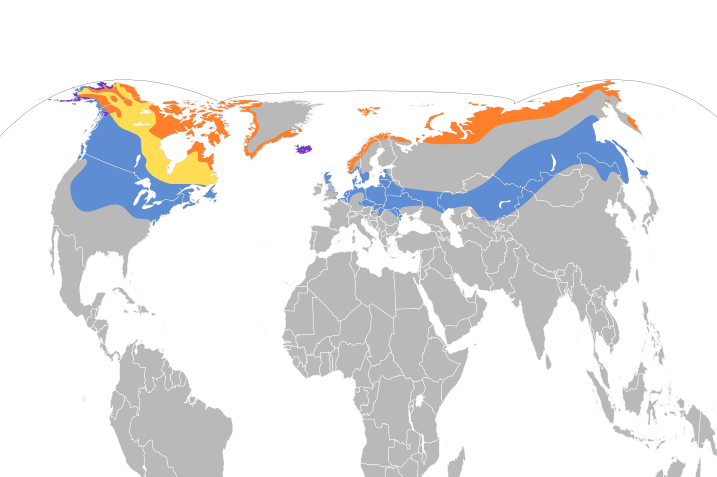
Data retrieved on October 15, 2025 at 5:56 AM