 Bird App
Bird of the day
Masked shrike
Lanius nubicus
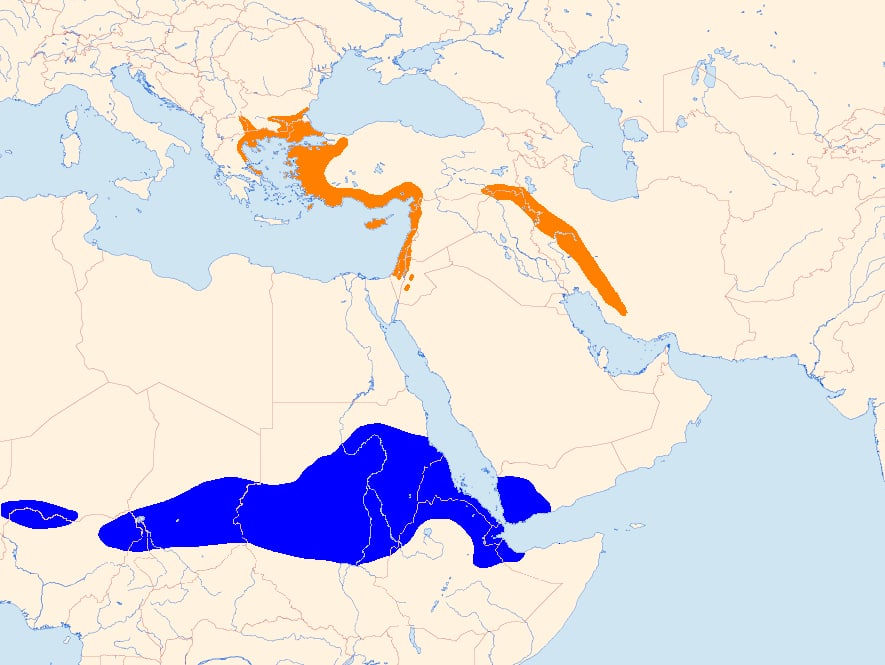
The masked shrike (Lanius nubicus) is a species of bird in the shrike family, Laniidae. It breeds in southeastern Europe and at the eastern end of the Mediterranean, with a separate population in eastern Iraq and western Iran. It is migratory, wintering mainly in northeast Africa. Although it is a short-range migrant, vagrants have occurred widely elsewhere, including northern and western Europe. It is the smallest member of its genus, long-tailed and with a hooked bill. The male has mainly black upperparts, with white on its crown, forehead and supercilium and large white patches on the shoulders and wings. The throat, neck sides and underparts are white, with orange flanks and breast. The female is a duller version of the male, with brownish black upperparts and a grey or buff tone to the shoulders and underparts. The juvenile has grey-brown upperparts with a paler forehead and barring from the head to rump, barred off-white underparts and brown wings аpart from the white primary patches. The species' calls are short and grating, but the song has melodic warbler-like components.
The masked shrike's preferred habitat is open woodland with bushes and some large trees. It is less conspicuous than its relatives, avoiding very open country and often perching in less exposed locations. The nest is a neat cup built in a tree by both adults, and the clutch is normally 4–6 eggs, which are incubated by the female for 14–16 days until hatching. The chicks are fed by both parents until they fledge 18–20 days later, and remain dependent on the adults for about 3–4 weeks after leaving the nest. The masked shrike eats mainly large insects, occasionally small vertebrates; it sometimes impales its prey on thorns or barbed wire. Populations are decreasing in parts of the European range, but not rapidly enough to raise serious conservation concerns, and the species is therefore classified by the International Union for Conservation of Nature as being of least concern.
The masked shrike is the smallest of its genus, a slender bird which usually weighs 20–23 g (0.71–0.81 oz), measuring 17–18.5 cm (6.7–7.3 in) long with a 24–26.5 cm (9.4–10.4 in) wingspan. It has a long tail and relatively small bill, on each side of which is a tomial tooth; the upper mandible bears a triangular ridge which fits a corresponding notch in the lower mandible. This adaptation is otherwise only found in falcons.
The male has mainly black upperparts, a white crown, forehead and supercilium. There are large white patches on the shoulders and primaries, and the outermost tail feathers are also white. The throat, neck sides and underparts are white, with orange on the flanks and breast. The iris is brown, the bill is black and the legs are dark brown or black. The female is a duller version of the male, with brownish-black upperparts and a grey or buff tinge to the white shoulder patches and underparts. The juvenile has grey-brown upperparts with darker bars from the head to rump, a paler grey forehead, barred off-white underparts and brown wings with white primary patches.
Masked shrikes are most similar in appearance to woodchat shrikes, but are smaller, more slender and longer-tailed. Adults of the two species are easily distinguished, since the masked shrike has white on its head and a dark rump, whereas the woodchat shrike has a black crown, rusty nape and white rump. Juveniles are more similar, but the masked shrike has a longer tail, paler face, and grey back and rump, whereas the woodchat shrike has a sandy back and pale grey rump.
Juveniles moult their head, body and some wing feathers a few weeks after fledging, and adults have a complete moult after breeding. In both cases, if the process is not complete by the time of migration it is suspended and completed on the wintering grounds.
The masked shrike gives the harsh calls typical of this family, with repeated tsr, tzr or shek notes and some whistles, and when alarmed produces a rattling krrrr. The bill may be snapped when the bird is agitated. The song, up to a minute long, is soft for a shrike, with chattering sounds interspersed with rich warbles. It resembles the songs of Hippolais species, particularly the olive-tree warbler. On rare occasions, males may sing in flight.
In the film the Great Escape, the POWs were taught how to mimic the masked shrike's call.
Aliases
Lanius nubicus
Range
Data retrieved on October 15, 2025 at 5:56 AM