 Bird App
Bird of the day
Short-eared owl
Asio flammeus
The short-eared owl (Asio flammeus) is a widespread grassland species in the family Strigidae. Owls belonging to genus Asio are known as the eared owls, as they have tufts of feathers resembling mammalian ears. These "ear" tufts may or may not be visible. The short-eared owl will display its tufts when in a defensive pose, although its very short tufts are usually not visible. The short-eared owl is found in open country and grasslands.
The short-eared owl is a medium-sized owl measuring 34–43 cm (13–17 in) in length and weighing 206–475 g (7.3–16.8 oz). It has large eyes, a big head, a short neck, and broad wings. Its bill is short, strong, hooked and black. Its plumage is mottled tawny to brown with a barred tail and wings. The upper breast is significantly streaked. Its flight is characteristically floppy due to its irregular wingbeats. The short-eared owl may also be described as "moth or bat-like" in flight. Wingspans range from 85 to 110 cm (33 to 43 in). Females are slightly larger than males. The yellow-orange eyes of A. flammeus are exaggerated by black rings encircling each eye, giving the appearance of them wearing mascara, and large, whitish disks of plumage surrounding the eyes like a mask.
Short-eared owls have a scratchy bark-like call. Raspy waowk, waowk, waowk or toot-toot-toot-toot-toot sounds are common. A loud eeee-yerp is also heard on breeding grounds. However, short-eared owls are silent on the wintering grounds.
Through much of its range, short-eared owls occurs with the similar-looking long-eared owl. At rest, the ear-tufts of the long-eared owl serve to easily distinguish the two (although long-eared owls can sometimes hold their ear-tufts flat). The iris-colour differs: yellow in the short-eared, and (often, though not always) orange in the long-eared, and the black surrounding the eyes is vertical on the long-eared, and horizontal on the short-eared. Overall the short-eared tends to be a paler, sandier bird than the long-eared. There are a number of other ways in which the two species the differ which are best seen when they are flying: a) the short-eared often has a broad white band along the rear edge of the wing, which is not shown by the long-eared; b) on the upperwing, short-eared owls' primary-patches are usually paler and more obvious; c) the band on the upper side of the short-eared owl's tail are usually bolder than those of the long-eared; d) the short-eared's innermost secondaries are often dark-marked, contrasting with the rest of the underwing; e) the long-eared owl has streaking throughout its underparts, whereas on the short-eared the streaking ends at the breast; f) the dark markings on the underside of the tips of the longest primaries are bolder on the short-eared owl; g) the upper parts are coarsely blotched, whereas on the long-eared they are more finely marked. The short-eared owl also differs structurally from the long-eared, having longer, slimmer wings: the long-eared owl has wings shaped more like those of a tawny owl. The long-eared owl generally has different habitat preferences from the short-eared, most often being found concealed in areas with dense wooded thickets. The short-eared owl is often most regularly seen flying about in early morning or late day as it hunts over open habitats.
Aliases
Asio flammeus
Range
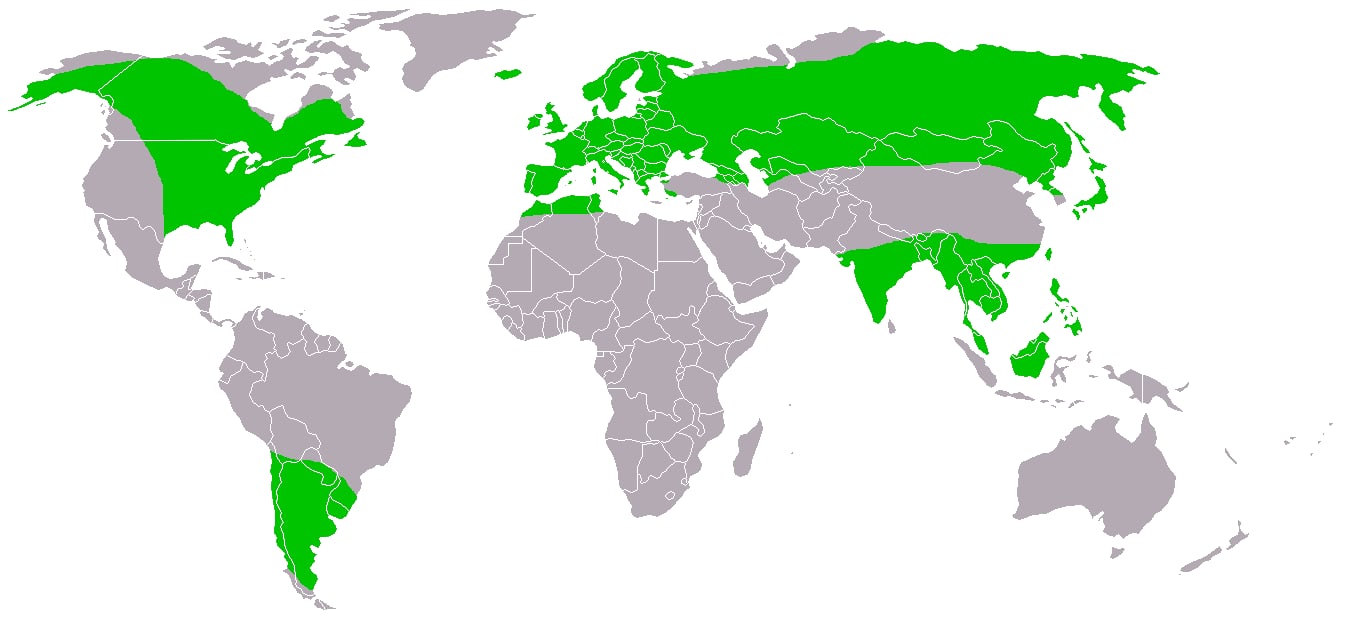
Data retrieved on September 27, 2026 at 4:12 PM