 Bird App
Bird of the day
Fork-tailed flycatcher
Tyrannus savana
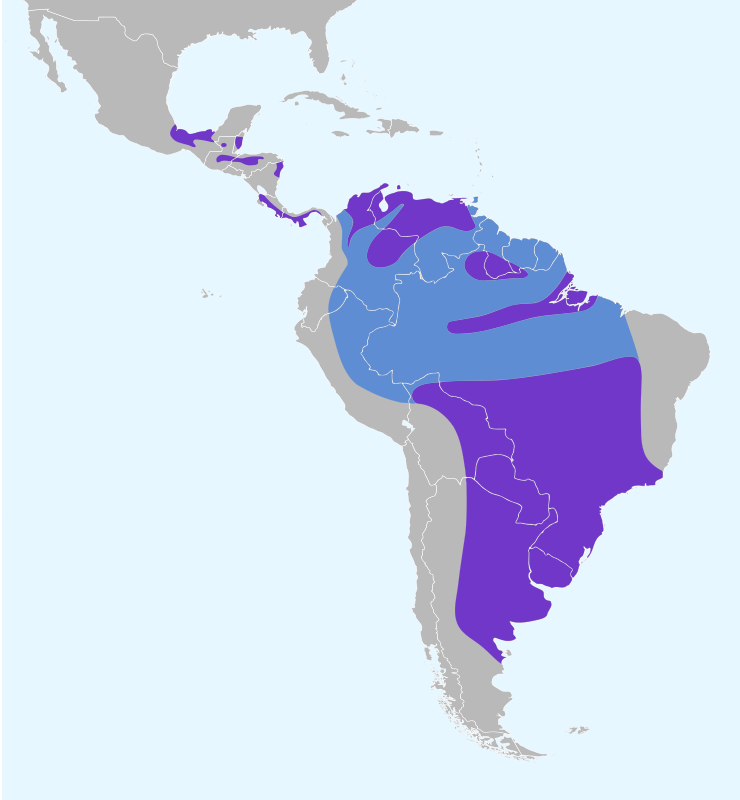
The fork-tailed flycatcher (Tyrannus savana) is a passerine bird of the tyrant flycatcher family and is a member of a genus typically referred to as kingbirds. Named for the long, forked tail, particularly in males, fork-tailed flycatchers are seen in shrubland, savanna, lightly forested and grassland areas, from southern Mexico to Argentina. They are frequently observed on conspicuous perches whence they sally after insect prey. Northern populations near southern Mexico tend to be permanent residents, while fork-tailed flycatchers that live further south are migrants with a reputation for wandering as far north as New Brunswick, Canada.
The fork-tailed flycatcher is white below, gray above, and has a black cap. Males sometimes show a yellow crown stripe. Males also have an extremely long, forked tail, of even greater length than that of the related scissor-tailed flycatcher. Females have a somewhat shorter tail, and it is significantly shorter in juveniles.
Males are 37–41 cm (15–16 in) in length; females, 28–30 cm (11–12 in), including tail. They weigh only 28–32 g (0.99–1.13 oz), much less than closely related kingbirds, which are half the total length of this species. The tail in adult males is two to three times longer than the length of the bird from the bill to the base of the tail. Generally, males and females of the species look quite similar, but can be distinguished by the longer tail in males.
The nominate subspecies T. s. savana has a darker grey back compared to T. s. monachus and T. s. sanctaemartae, which have notable light backs that contrast greatly with their black heads. Discrete notches on the primary feathers are also quite handy in identifying subspecies.
Most fork-tailed flycatchers are migratory, but some stay year-round, especially in southern Mexico. Migratory fork-tailed flycatchers tend to have more pointed wings than nonmigratory flycatchers.
Fork-tailed flycatchers produce both vocal and nonvocal sounds. In general, they have a dry, buzzy call, and a weak "tic-note" while in flight.
Their wings have been observed to make a distinct whistling note while flying overhead. Research has uncovered differences in the pitch of whistling noises by different subspecies of T. savana. This has supported a hypothesis that fork-tailed flycatchers are splitting into two species, as the nonmigratory birds have a much-lower-pitched whistling note than the migrators. This becomes another observed difference amongst others (e.g. wing shape) pointing to the two-species conclusion.
During mating displays, the males' wings may also make dry, crackling sounds; further research has investigated the use of these wing noises in potentially startling predators or would-be nest parasites (e.g. shiny cowbird).
Aliases
Tyrannus savana
Range
Data retrieved on October 15, 2025 at 5:52 AM