 Bird App
Bird of the day
Line-cheeked spinetail
Cranioleuca antisiensis
The line-cheeked spinetail (Cranioleuca antisiensis) is an arboreal species of bird in the ovenbird family Furnariidae. It is a common species in the Andes in Ecuador and Peru. Its natural habitat is subtropical or tropical moist montane forests, woodland and scrub. It is distinguished from other species by its distribution, behaviour and white supercilium. There are two recognized subspecies, which are in reality a gradient in morphology and plumage from one extreme to the other.
The IUCN Red List conservation status is rated as Least Concern, as the line-cheeked spinetail is common along its range and is presumably stable. However, since it is arboreal, the line-cheeked spinetail is vulnerable to deforestation. Yet, it is relatively tolerant to human disturbance and does well in successional vegetation.
The line-cheeked spinetail is a mid-sized spinetail, weighing 15–18 g and reaching 14.5 cm long. Like other spinetails in the genus Cranioleuca, it has a long graduated tail and a relatively long bill that curves downward slightly. It has a rufous crown; with a well-defined white supercilium; a pale throat; and some streaking on its ear coverts. It is brown to olive-grey above; with a greyish brown breast and belly; and rufous tail and wings.
The line-cheeked spinetail is a diurnal species and vocalizes most actively at dawn and dusk to maintain their breeding territory boundaries. It is often seen singing alone in branches near the top of trees. Its calls are a variation of chippering and scolding, including a "tsi-chik". The song is a series of loud shrills, usually ending in a trill before fading. Both adults and juveniles respond strongly to playback of songs, suggesting aggression between individuals within the species.
Although the distribution of the line-cheeked spinetail does not overlap with other Cranioleuca, it may be found in the same areas as the ash-browed spinetail (C. curtata) in montane valleys. However, the ash-browed spinetail has a less visible grey supercilium and tends to forage higher up in the canopy. The line-cheeked spinetail may also be confused with the red-faced spinetail (C. erythrops), especially the juveniles, which have a buff supercilium. The adult red-faced spinetail does not have a supercilium and occurs more on the east slopes of the Andes, whereas line-cheeked spinetails occupy the west slopes.
Aliases
Cranioleuca antisiensis
Range
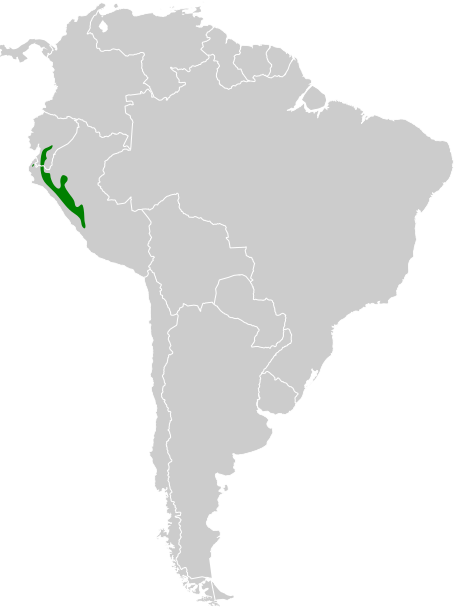
Data retrieved on September 27, 2026 at 4:44 PM