 Bird App
Bird of the day
Black-and-red broadbill
Cymbirhynchus macrorhynchos
The black-and-red broadbill (Cymbirhynchus macrorhynchos) is a species of bird in the typical broadbill family, Eurylaimidae. It is the only species in the genus Cymbirhynchus. A large, distinctive bird, it has maroon underparts, black upperparts, a maroon neck-band, and white bars on the wings. It also has a large, two-colored, blue-and-yellow bill. The species shows slight sexual dimorphism, with females being smaller than males. No other bird in its range resembles it, though the black-and-yellow broadbill has a similar call.
The species is found in Brunei, Cambodia, Indonesia, Laos, Malaysia, Myanmar, Singapore, Thailand, and Vietnam. Inhabiting lowland riparian forest throughout its range, it can also adapt quite well to disturbed habitat, such as secondary forest growth and degraded habitat near rivers. The black-and-red broadbill is mainly insectivorous, supplementing its diet with aquatic creatures such as mollusks, snails, fish, and crustaceans. It also takes leaves and seeds incidentally.
Breeding takes place during the dry season throughout its range, with the nest being a large, conspicuous structure that usually hangs over water. Nests are built by both sexes, out of creepers, fungal hyphae, moss, and other plant matter. Eggs are laid in clutches of two or three, occasionally with a fourth runt egg, and incubated by both parents. The black-and-red broadbill is evaluated as a least-concern species by the International Union for Conservation of Nature due to its large range and the lack of a severe decrease in its global population. However, the species has experienced declines in several parts of its range, and may face threats due to deforestation, trapping for the songbird trade, and hunting.
A large broadbill, the black-and-red broadbill has distinctive plumage and is unlikely to be mistaken for any other species within its range. The average adult is around 21–24 cm (8.3–9.4 in) in length, with wing lengths of 9.7–10.8 cm (3.8–4.3 in) and weighs 51–65 g (1.8–2.3 oz). Both sexes are similar in appearance, but the species shows slight sexual dimorphism, with the females being smaller in size. Adults have black heads and breastbands, greenish-black upperparts, with a maroon half-collar and bright maroon rumps and uppertail coverts (flight feathers on the tail and wing). The scapulars (feathers on the outside of the shoulder bone) have pure white edges, forming a white line on the closed wing. The bend of the wing has a narrow orange line. The tail is black, with variable amounts of white. The bill is dichromatic, with a bright turquoise-blue maxilla, and a yellow-orange mandible with a blue tip and edges. The irises are bright emerald green. The feet are bright blue, and sometimes tinged violet.
Immature birds are similar to adults, but have browner upperwings, and have white spots at the tips of the median coverts (second row of coverts on the wing), along with purple irises. Juveniles have much duller plumages, with sooty brown upper parts, maroon patches on the rump and uppertail coverts, brown underparts and wings, and white patches on the outer webs of the scapulars. They also have blackish to brownish-blue bills and bronze irises. Their feet are dull blue-grey.
The brilliant red plumage of the species is caused by the biological pigment 2,3-didehydro-papilioerythrinone, which is also present in birds with red plumage in the genera Sarcophanops and Eurylaimus.
One of the most striking features of the black-and-red broadbill is its large, boat-like bill. It is thought that the wide bill and gape first evolved in the common ancestor of all broadbills, as an adaptation to an insectivorous diet. Its tongue is also large and fleshy to help manipulate objects inside its beak.
The black-and-red broadbill is much less vocal than other species of typical broadbills, often remaining silent, and with quieter calls than most other broadbills. They also make ascending 'weeet' sounds, similar to those of the black-and-yellow broadbill, but shorter, slower, softer, and quieter. Its advertising call may be a rising cicada-like trill. The alarm call is a series of rapid 'pip' notes. A repeated soft 'wiark' has been reported as a contact call between a pair building a nest. Other calls include a monotonous and repetitive 'tyook', a hoarse 'ka-ka-kraar-kraar', a sharp 'peek-peek-peek', churring calls, melodious whistles, a hoarse twanging 'cow', and puma-like snarls. The most frequently heard call in Laos was a series of accelerating 'parnk' notes, similar to the noise made by the wingbeats of a wreathed hornbill.
Aliases
Cymbirhynchus macrorhynchos
Range
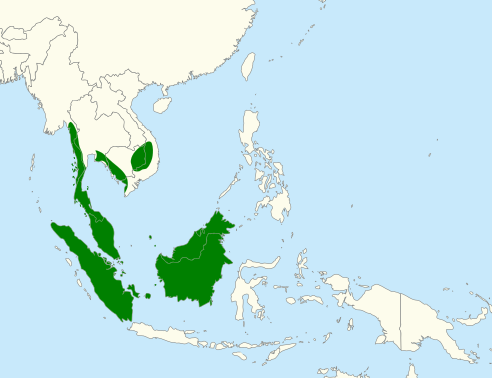
Data retrieved on October 15, 2025 at 5:49 AM