 Bird App
Bird of the day
Spix's macaw
Cyanopsitta spixii
Spix's macaw (Cyanopsitta spixii), also known as the little blue macaw, or just blue macaw, is a macaw species that was endemic to Brazil. It is a member of tribe Arini in the subfamily Arinae (Neotropical parrots), part of the family Psittacidae (the true parrots). It was first described by German naturalist Georg Marcgrave, when he was working in the State of Pernambuco, Brazil in 1638 and it is named for German naturalist Johann Baptist von Spix, who collected a specimen in 1819 on the bank of the Rio São Francisco in northeast Bahia in Brazil. This bird has been completely extirpated from its natural range, and following a several-year survey, the IUCN officially declared it extinct in the wild in 2019. However, after over 20 years of conservation efforts, 200 macaws have been bred from just two parent birds, and 52 individual birds have since been reintroduced into their natural environment in June 2022.
The bird is a medium-size parrot weighing about 300 grams (11 oz), smaller than most of the large macaws. Its appearance is various shades of blue, with a grey-blue head, light blue underparts, and vivid blue upperparts. Males and females are almost identical in appearance; however, the females are slightly smaller.
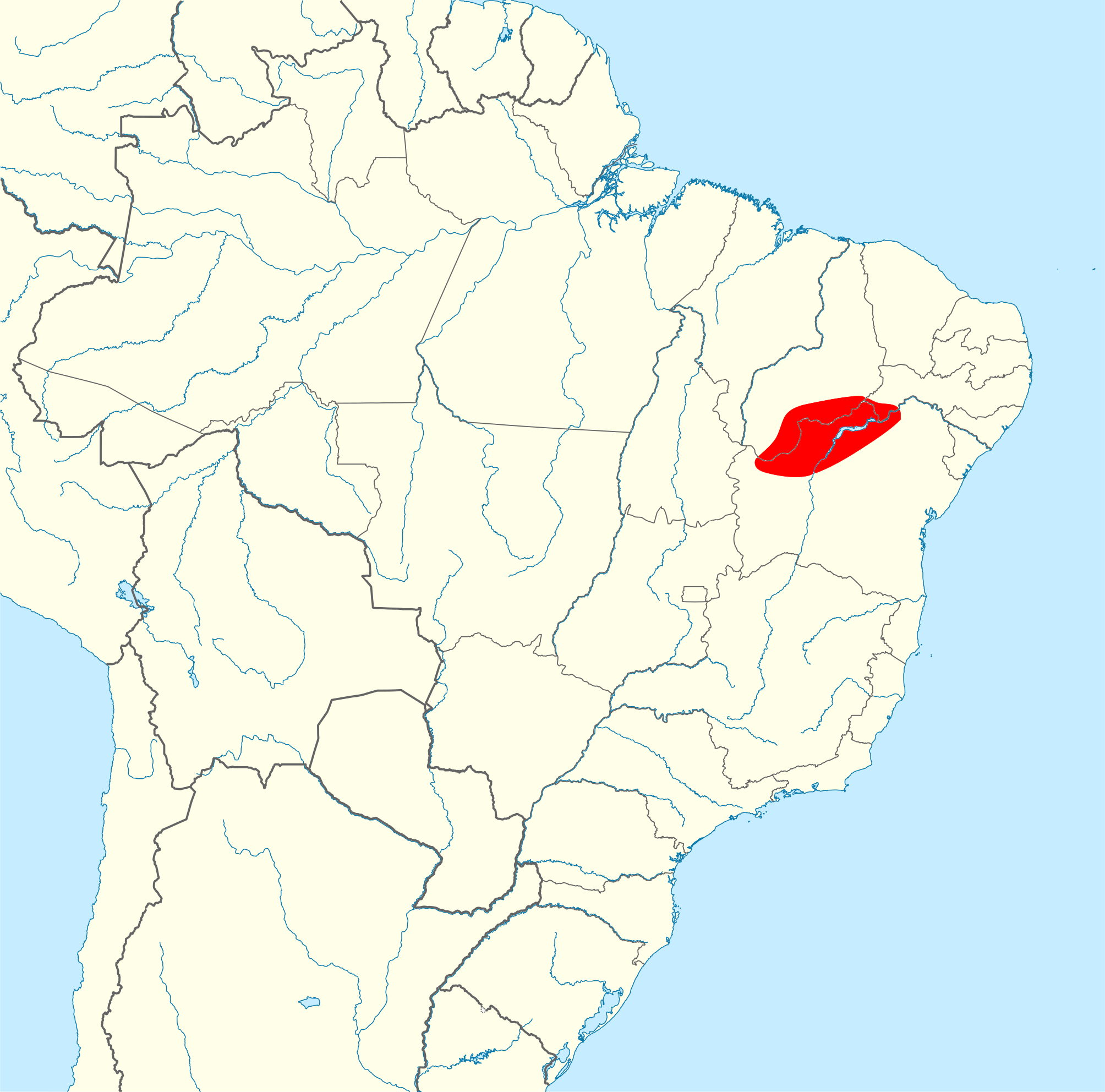
The species inhabited riparian Caraibeira (Tabebuia aurea) woodland galleries in the drainage basin of the Rio São Francisco within the Caatinga dry forest climate of interior northeastern Brazil. It had a very restricted natural habitat due to its dependence on the tree for nesting, feeding and roosting. It feeds primarily on seeds and nuts of Caraiba and various Euphorbiaceae (spurge) shrubs, the dominant vegetation of the Caatinga. Due to deforestation in its limited range and specialized habitat, the bird was rare in the wild throughout the twentieth century. It has always been very rare in captivity, partly due to the remoteness of its natural range.
It is listed on CITES Appendix I, which makes international trade prohibited except for legitimate conservation, scientific or educational purposes. The IUCN regard the Spix's macaw as extinct in the wild. Its last known stronghold in the wild was in northeastern Bahia, Brazil and sightings were very rare. After a 2000 sighting of a male bird, the next and last sighting was in 2016.
The species is now maintained through a captive breeding program at several conservation organizations under the aegis of the Brazilian government. One of these organizations, the Association for the Conservation of Threatened Parrots (ACTP), moved birds back from Germany to Brazil in 2020 as part of their plan to release Spix's macaws back into the wild. The Brazilian Chico Mendes Institute for Biodiversity Conservation (ICMBio) is conducting a project Ararinha-Azul with an associated plan to restore the species to the wild as soon as sufficient breeding birds and restored habitat are available.
Spix's macaw is easy to identify being the only small blue macaw and also by the bare grey facial skin of its lores and eyerings. It is about 56 cm (22 in) long including tail length of 26–38 cm (10–15 in). It has a wing length of 24.7–30.0 cm (9.7–11.8 in). The external appearance of adult male and female are identical; however, the average weight of captive males is about 318 g (11.2 oz) and captive females average about 288 g (10.2 oz). Its plumage is grey-blue on the head, pale blue on the underparts, and vivid blue on the upperparts, wings and tail. The legs and feet are brownish-black. In adults the bare facial skin is grey, the beak is entirely dark grey, and the irises are yellow. Juveniles are similar to adults, but they have pale grey bare facial skin, brown irises, and a white stripe along the top-center of their beaks (along the culmen).
Aliases
Cyanopsitta spixii, Little Blue Macaw, Spixís macaw, Spixis macaw
Range
Data retrieved on October 15, 2025 at 5:48 AM