 Bird App
Bird of the day
Crescent honeyeater
Phylidonyris pyrrhopterus
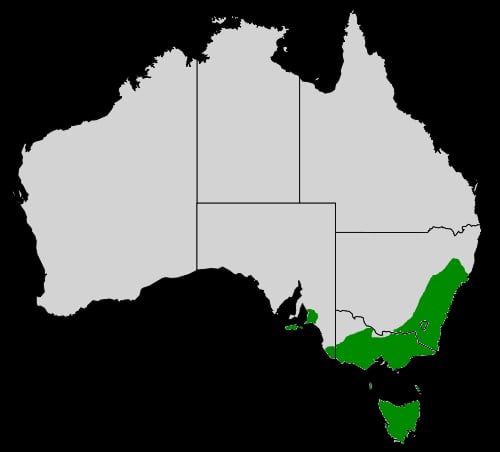
The crescent honeyeater (Phylidonyris pyrrhopterus) is a passerine bird of the honeyeater family Meliphagidae native to southeastern Australia. A member of the genus Phylidonyris, it is most closely related to the common New Holland honeyeater (P. novaehollandiae) and the white-cheeked honeyeater (P. niger). Two subspecies are recognized, with P. p. halmaturinus restricted in range to Kangaroo Island and the Mount Lofty Ranges in South Australia.
It has dark grey plumage and paler underparts, highlighted by yellow wing-patches and a broad, black crescent, outlined in white, down the sides of its breast. The species exhibits slight sexual dimorphism, with the female being duller in colour than the male. Juvenile birds are similar to the female, though the yellow wing-patches of male nestlings can be easily distinguished.
The male has a complex and variable song, which is heard throughout the year. It sings from an exposed perch, and during the breeding season performs song flights. The crescent honeyeater is found in areas of dense vegetation including sclerophyll forest and alpine habitats, as well as heathland, and parks and gardens, where its diet is made up of nectar and invertebrates. It forms long-term pairs, and often stays committed to one breeding site for several years. The female builds the nest and does most of the caring for the two to three young, which become independent within 40 days of laying its egg.
The parent birds use a range of anti-predator strategies, but nestlings can be taken by snakes, kookaburras, currawongs, or cats. While the crescent honeyeater faces a number of threats, its population numbers and distribution are sufficient for it to be listed as of Least Concern for conservation.
The crescent honeyeater measures 14–17 centimetres (5.5–6.7 in) in length with a wingspan of 16–23 centimetres (6.3–9.1 in), and it weighs about 16 grams (0.56 oz). It is sexually dimorphic with the female a paler version of the male. The male is mostly dark grey, with clear yellow wing-patches; a broad black crescent, outlined in white, down the sides of the breast; and a white streak above the eye. The top of the tail is black with yellow edges to the feathers forming distinctive yellow panels on the sides of the tail. White tips on the undertail are usually only visible in flight. The underparts are pale brownish-grey fading to white. The female is duller, more olive-brown than grey, with duller yellow wing-patches and faded crescent-shaped markings. Both sexes have dark grey legs and feet, deep ruby eyes and a long, downcurved black bill. The gape is also black. Young birds are similar to the adults, though not as strongly marked, and have dark grey bills, duller brown eyes, and yellow gapes. Male nestlings can be distinguished by their more extensive yellow wing-patches from seven days old. Moulting patterns of the species are poorly known; crescent honeyeaters appear to replace their primary flight feathers between October and January.
While both subspecies have the same general appearance, the female of halmaturinus has paler plumage than the nominate race, and both male and female have a smaller wing and tail and longer bill. The halmaturinus population on Kangaroo Island has a significantly shorter wing and longer bill than the Mount Lofty population, although this size variation of an insular form is at odds with Allen's and Bergmann's rules.
The crescent honeyeater has a range of musical calls and songs. One study recorded chatter alarm calls similar to the New Holland honeyeater, a number of harsh monosyllabic or tri-syllabic contact calls, and complex and diverse songs. The most common contact call is a loud, carrying "e-gypt", while the alarm call is a sharp and rapid "chip-chip-chip". The male also has a melodic song which is heard throughout the year, at any time of the day. The structure of the song is complex and diverse, and includes both a descending whistle and a musical two-note call. The male's song is performed from an exposed perch or within the tree canopy, and it engages in mating displays (song flights) during the breeding season. When the female is on the nest and the male nearby, they utter low soft notes identified as "whisper song".
Aliases
Phylidonyris pyrrhopterus, Certhia pyrrhoptera, Certhia australasiana, Melithreptus melanoleucus, Meliphaga inornata, Phylidonyris pyrrhoptera, Phylidonyris (Phylidonyris) pyrrhopterus
Range
Data retrieved on September 27, 2026 at 5:45 PM