 Bird App
Bird of the day
Alagoas curassow
Mitu mitu
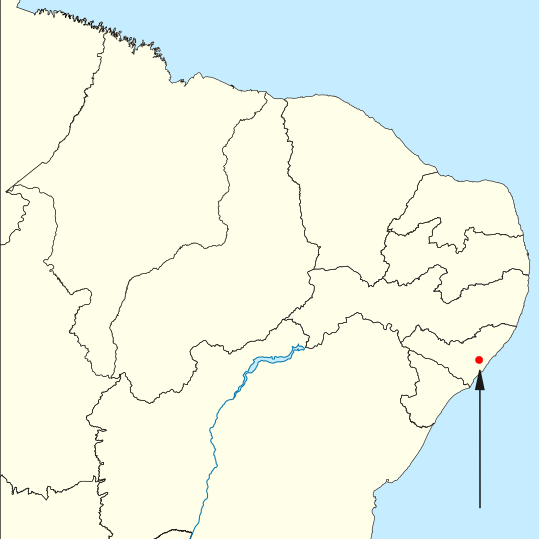
The Alagoas curassow (Mitu mitu) is a glossy-black, pheasant-like bird. It was formerly found in forests in Northeastern Brazil in what is now the states of Pernambuco and Alagoas, which is the origin of its common name. It is now extinct in the wild; there are about 200 individuals in captivity.
German naturalist Georg Marcgrave first identified the Alagoas curassow in 1648 in its native range. Subsequently, the origin and legitimacy of the bird began to be questioned due to the lack of specimens. An adult female curassow was rediscovered in 1951, in the coastal forests of Alagoas. The Pauxi mitu was then accepted as a separate species. At that time fewer than 60 birds were left in the wild, in the forests around São Miguel dos Campos. Several authors in the 1970s brought to light the growing destruction of its habitat and the rarity of the species. Even with these concerns, the last large forest remnants which contained native Alagoas curassow were demolished for sugarcane agriculture.
The Alagoas curassow measures approximately 83–89 centimetres (33–35 in) in length. Feathers covering its body are black and glossy, with a blue-purple hue. Specimens of Pauxi mitu also has a large, bright red beak, flattened at its sides, with a white tip. The same red coloration found on its legs and feet. The tips of its tail feathers are light brown in color, with chestnut colored feathers under the tail. It has a unique grey colored, crescent-shaped patch of bare skin covering its ears, a character not found in other curassows. The distinct coloration separates P. mitu as its own species distinct from other curassow species. Sexual dimorphism is not pronounced: females tend to be lighter in color and slightly smaller in size. In captivity, the birds can live to at least 24 years of age. Video recording in captivity show that this cracid sporadically makes a high-pitched chirping sound.
Aliases
Mitu mitu
Range
Data retrieved on September 27, 2026 at 3:56 PM