 Bird App
Bird of the day
Northern hawk-owl
Surnia ulula
The northern hawk-owl (Surnia ulula), or northern hawk owl, is a medium-sized true owl of the northern latitudes. It is non-migratory and usually stays within its breeding range, though it sometimes irrupts southward. It is one of the few owls that is neither nocturnal nor crepuscular, being active only during the day. This is the only living species in the genus Surnia of the family Strigidae, the "typical" owls (as opposed to barn owls, Tytonidae). The species is sometimes called simply the hawk owl; however, many species of owls in the genus Ninox are also called "hawk owls".
Male northern hawk-owls are generally 36–42.5 cm (14.2–16.7 in) long and weigh about 300 g (11 oz). Females are slightly bigger with a length of 37.2–44.7 cm (14.6–17.6 in) and a mass of about 340 g (12 oz). Both male and female have similar wingspans of about 45 cm (18 in). The northern hawk-owl plumage is relatively dark brown with an off-white spotting pattern on all dorsal parts of the body with the exception of the back of the neck which boasts a black v-shaped pattern. The underbelly is generally white or off-white which continues to the toes with brown bands on the breast and stomach. It also has a long tail with brown banding. The northern hawk-owl has a smokey white face with a black border, a flat head, yellow eyes and a yellow curved beak.
The northern hawk-owl has been said to resemble a hawk in appearance and in behavior. In North America, its appearance in flight is often considered similar to a Cooper's hawk (Accipiter cooperii). It has been suggested that this may be because the hawk-owl may partially fill an important diurnal niche similar to that of day hunters such as hawks.
Various calls are used by the different sexes in different situations. When attracting a mate the male usually lets out a rolled whistle of ulululululululul and a sound similar to tu-wita-wit, tiwita-tu-wita, wita, when perching at a potential nest site. The female's call is usually less constant and more shrill.
When alerting to danger, the northern hawk-owl lets out a sound similar to rike, rike, rike, rike. It also releases a high-pitched scream followed by a yip when an intruder is near to the nest. To warn of impending dangers to a fledgling, the hawk-owl will let out a noise similar to ki ki kikikikiki. Calls can vary in length from 15 seconds to 2 minutes.
Aliases
Northern Hawk-Owl, Surnia ulula
Range
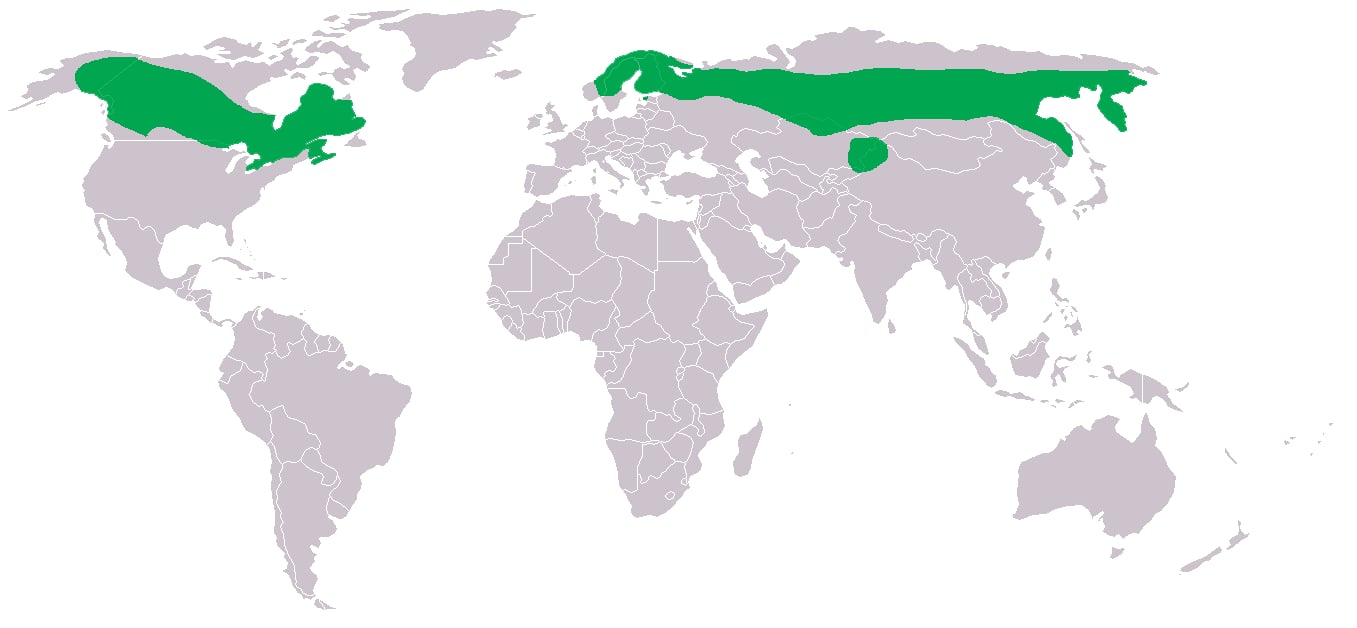
Data retrieved on October 15, 2025 at 5:43 AM