 Bird App
Bird of the day
Western grebe
Aechmophorus occidentalis
The western grebe (Aechmophorus occidentalis) is a species in the grebe family of water birds. Folk names include "dabchick", "swan grebe" and "swan-necked grebe".
Western grebe fossils from the Late Pleistocene of southwest North America were described as a distinct species, but later ranked as a paleosubspecies Aechmophorus occidentalis lucasi. More recent study found them to fall within the variation now known to exist in today's birds.
The western grebe is the largest North American grebe. It is 55–75 cm (22–30 in) long, weighs 795–2,000 g (1.753–4.409 lb) and measures 79–102 cm (31–40 in) across the wings. It is black-and-white, with a long, slender, swan-like neck and red eyes. It is easily confused with Clark's grebe, which shares similar features, body size, behavior and habitat, and hybrids are known. Western grebes nest in colonies on lakes that are mixed with marsh vegetation and open water. Western Grebe nests are made of plant debris and sodden materials, and the nest-building begins roughly around late April through June. The construction is done by both sexes and is continued on throughout laying and incubation. This species of waterbirds is widespread in western North America, so there is no specific place of abundance. Its subspecies, Clark's grebe generally populate more of the southern part of North America Other differences are whiter flanks and paler gray backs when comparing A.o.clarkii to A.o.occidentalis.
The western grebe has black around the eyes and a straight greenish-yellow bill whereas the Clark's grebe has white around the eyes and an up-turned bright yellow bill. The downy young of Western are grey; Clark's downy young are white.
In 1858 George Newbold Lawrence recognised Podiceps occidentalis based on darker coloured specimens, and P. clarkii based on three paler coloured specimens -two from California and one from Chihuahua. These two colour morphs were found to occur, roost and even interbreed together, and were long regarded to be synonyms (although it is unclear why P. clarkii was regarded as the junior synonym, coming alphabetically first). Deignan designated the Mexican specimen as the holotype of the taxon P. clarkii in 1961. In 1963 Dickerman reinstated the taxon as Aechmophorus clarkii, which he defined as the smaller birds, both dark and pale coloured, from Mexico. In 1979 a comprehensive study by Ratti demonstrated the apparent existence of reproductive barriers between different phases of the grebes. In 1986 Dickerman recognised the taxonomic significance of the distinctions between the dark and pale phase, and classified these phases as different subspecies:
A. occidentalis ssp. occidentalis, (Lawrence, 1858), large, dark morph, from western Canada & United States (California, Utah)
A. occidentalis ssp. ephemeralis, Dickerman, 1986 - Smaller than the western grebe, dark morph, from north & central Mexico.
A. clarkii ssp. clarkii, (Lawrence, 1858) Dickerman, 1963 - Small, pale morph, from north & central Mexico
A. clarkii ssp. transitionalis, Dickerman, 1986, large, pale morph, from western Canada & United States (California, Utah)
Multiple lines of evidence suggest that the differently colored western grebes (darker and lighter) are different taxa -in a single population in which sympatric speciation somehow persists. These forms were reported to mate according to their own colors and the mixing between dark and light-faced individuals is rare. This type of assortative mating derives from possible isolating mechanisms such as differential responses to advertising calls and spatial distribution. Each of the forms tended to stay closer to their own type, thus making their colony nesting be non-randomly distributed.
By 1992 Storer & Nuechterlein were promoting another concept to the taxon A. clarkii, now regarding the pale morphs from the US and Canada to be this taxon (Dickerman's A. occidentalis ssp. ephemeralis).
Aliases
Aechmophorus occidentalis
Range
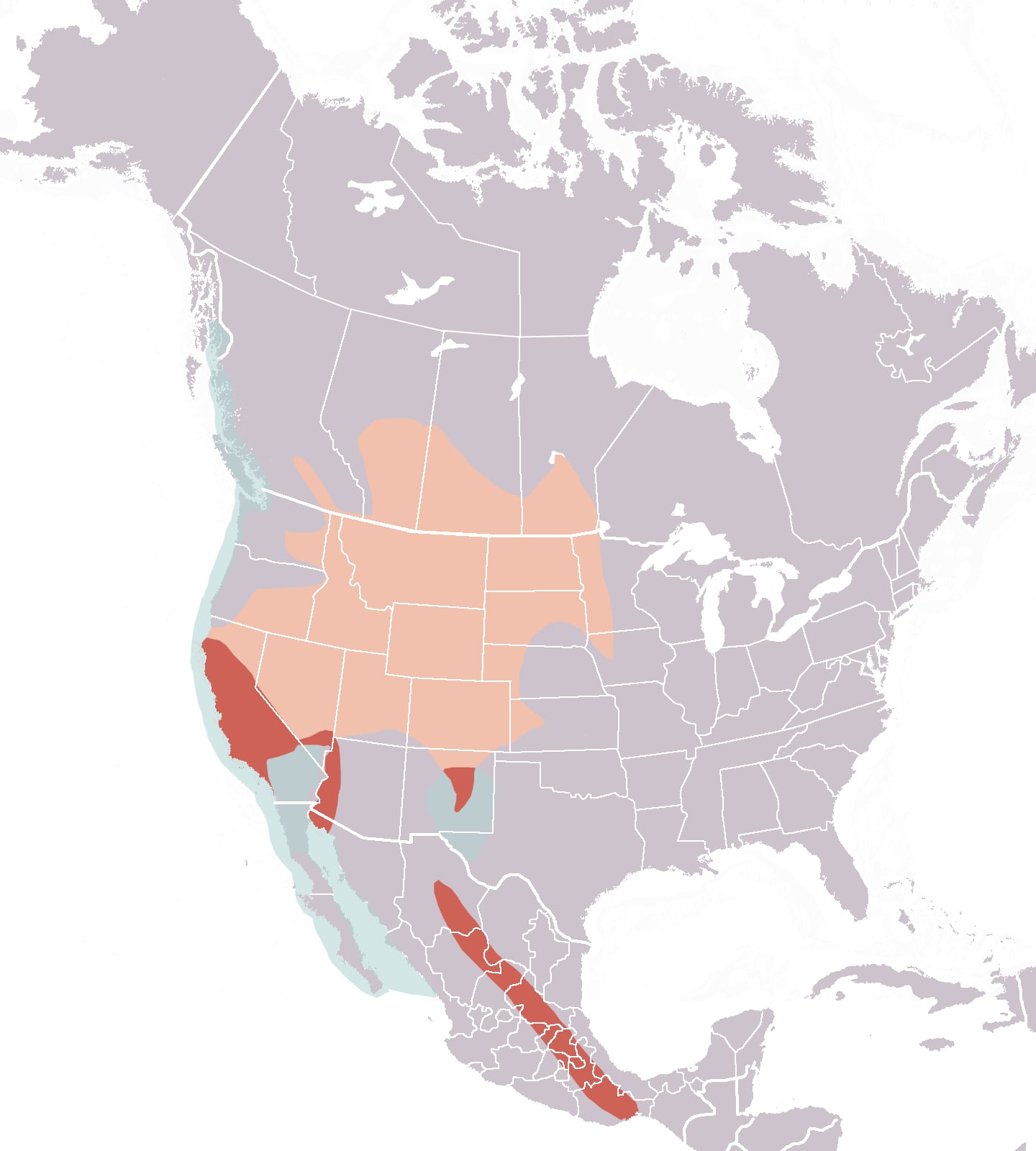
Data retrieved on October 15, 2025 at 5:37 AM