 Bird App
Bird of the day
Greater adjutant
Leptoptilos dubius
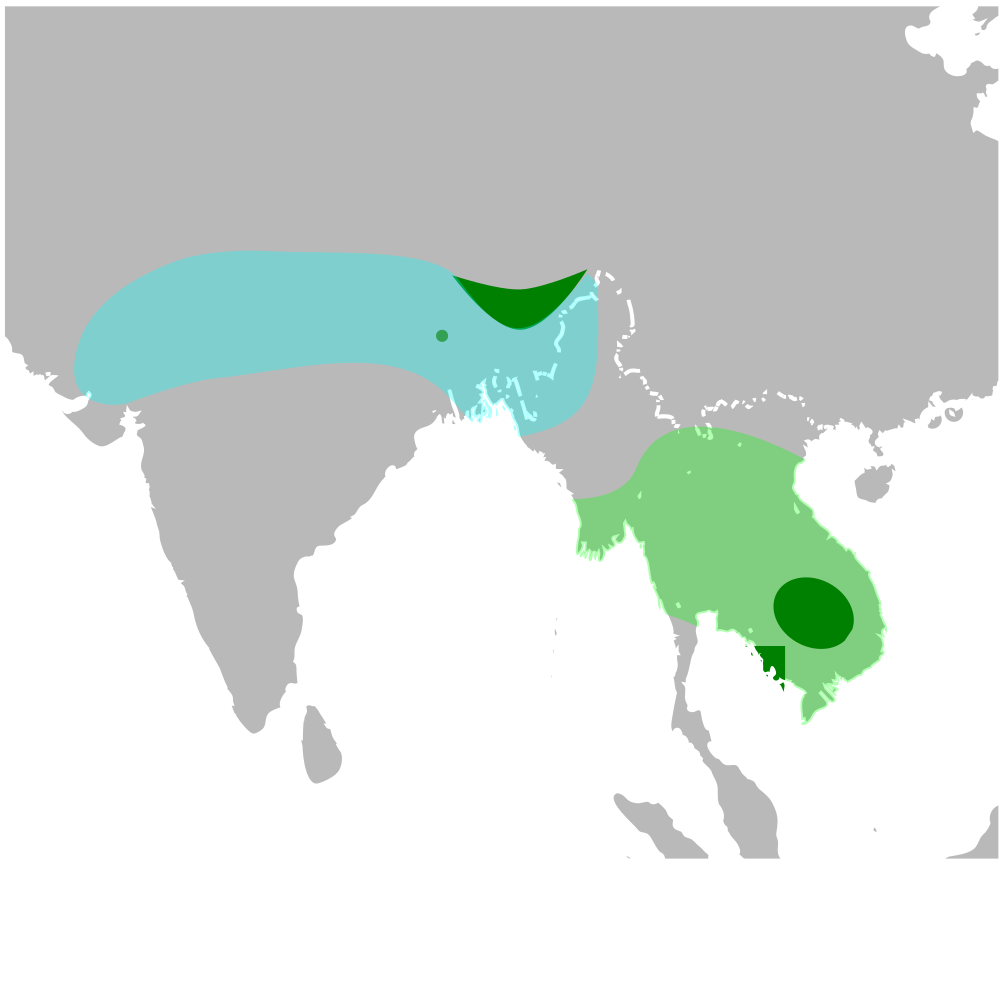
The greater adjutant (Leptoptilos dubius) is a member of the stork family, Ciconiidae. Its genus includes the lesser adjutant of Asia and the marabou stork of Africa. Once found widely across southern Asia and mainland southeast Asia, the greater adjutant is now restricted to a much smaller range with only three breeding populations; two in India, one in the north-eastern state of Assam and a smaller one around Bhagalpur; and another breeding population in Cambodia. They disperse widely after the breeding season. This large stork has a massive wedge-shaped bill, a bare head and a distinctive neck pouch. During the day, it soars in thermals along with vultures with whom it shares the habit of scavenging. They feed mainly on carrion and offal; however, they are opportunistic and will sometimes prey on vertebrates. The English name is derived from their stiff "military" gait when walking on the ground (see adjutant). Large numbers once lived in Asia, but they have declined (possibly due to improved sanitation) to the point of endangerment. The total population in 2008 was estimated at around a thousand individuals. In the 19th century, they were especially common in the city of Calcutta, where they were referred to as the "Calcutta adjutant" and included in the coat of arms for the city. Known locally as hargila (derived from the Assamese words har, 'bone', and gila, 'swallower', thus 'bone-swallower') and considered to be unclean birds, they were largely left undisturbed but sometimes hunted for the use of their meat in folk medicine. Valued as scavengers, they were once depicted in the logo of the Calcutta Municipal Corporation.
The greater adjutant is a huge bird, standing tall at 145–150 cm (4 ft 9 in – 4 ft 11 in). The average length is 136 cm (4 ft 6 in) and average wingspan is 250 cm (8 ft 2 in), it may rival its cousin the marabou stork (Leptoptilos crumeniferus) as the largest winged extant stork. While no weights have been published for wild birds, the greater adjutant is among the largest of living storks, with published measurements overlapping with those of the jabiru (Jabiru mycteria), saddle-billed stork (Ephippiorhynchus senegalensis) and marabou stork (Leptoptilos crumeniferus). Juvenile greater adjutant storks in captivity weighed from 8 to 11 kg (18 to 24 lb). A greater adjutant after recuperating in captivity from after injury during nest collapse was found to weigh 4.71 kg (10.4 lb) as a nestling and to weigh 8 kg (18 lb) after reaching maturity and ready for re-release. For comparison, the heaviest known wild stork was a marabou stork scaling 8.9 kg (20 lb), with adult marabou ranging from 4–6.8 kg (8.8–15.0 lb) (females) and 5.6–8.9 kg (12–20 lb) (males). The huge bill, which averages 32.2 cm (12.7 in) long, is wedge-like and is pale grey with a darker base. The wing chord averages 80.5 cm (31.7 in), the tail 31.8 cm (12.5 in) and the tarsus 32.4 cm (12.8 in) in length. With the exception of the tarsus length, the standard measurements of the greater adjutant are on average greater than that of other stork species. A white collar ruff at the base of its bare yellow to red-skinned neck gives it a vulture-like appearance. In the breeding season, the pouch and neck become bright orange and the upper thighs of the grey legs turn reddish. Adults have a dark wing that contrasts with light grey secondary coverts. The underside of the body is whitish and the sexes are indistinguishable in the field. Juveniles are a duller version of the adult. The pendant inflatable pouch connects to the air passages and is not connected to the digestive tract. The exact function is unknown, but it is not involved in food storage as was sometimes believed. This was established in 1825 by Dr. John Adam, a student of Professor Robert Jameson, who dissected a specimen and found the two-layered pouch filled mainly with air. The only possible confusable species in the region is the smaller lesser adjutant (Leptoptilos javanicus), which lacks a pouch, prefers wetland habitats, has a lighter grey skull cap, a straighter edge to the upper mandible, and lacks the contrast between the grey secondary coverts and the dark wings.
Like other storks, it lacks intrinsic muscles in the syrinx and produces sound mainly by bill-clattering, although low grunting, mooing or roaring sounds are made especially when nesting. The bill-clattering display is made with the bill raised high and differs from that of the closely related African marabou which holds the bill pointed downwards.
Aliases
Leptoptilos dubius, Adjutant
Range
Data retrieved on October 15, 2025 at 5:35 AM