 Bird App
Bird of the day
White-necked rockfowl
Picathartes gymnocephalus
The white-necked rockfowl (Picathartes gymnocephalus) is a medium-sized bird in the family Picathartidae, with a long neck and tail. Also known as the white-necked picathartes, this passerine is mainly found in rocky forested areas at higher altitudes in West Africa from Guinea to Ghana. Its distribution is patchy, with populations often being isolated from each other. The rockfowl typically chooses to live near streams and inselbergs. It has no recognized subspecies, though some believe that it forms a superspecies with the grey-necked rockfowl. The white-necked rockfowl has greyish-black upperparts and white underparts. Its unusually long, dark brown tail is used for balance, and its thighs are muscular. The head is nearly featherless, with the exposed skin being bright yellow except for two large, circular black patches located just behind the eyes. Though the bird is usually silent, some calls are known.
These rockfowl feed primarily on insects, though parents feed small frogs to their young. One feeding strategy involves following Dorylus army ant swarms, feeding on insects flushed by the ants. Rockfowl move through the forest primarily through a series of hops and bounds or short flights in low vegetation. This species rarely flies for long distances. The white-necked rockfowl is monogamous and pairs nest either alone or in the vicinity of other pairs, sometimes in colonies with as many as eight nests. These nests are constructed out of mud formed into a deep cup and are built on rock surfaces, typically in caves. Two eggs are laid twice a year. Though the birds breed in colonies, infanticide is fairly common in this species, with rockfowl attempting to kill the young of other pairs. Nestlings mature in about a month. This bird is long-lived.
This species is classified as Vulnerable as its dwindling and fragmented populations are threatened by habitat destruction. Conservation efforts are underway in parts of its range in the form of habitat protection, education efforts, and new laws. Some of the indigenous peoples of Sierra Leone considered the species to be a protector of the home of their ancestral spirits. This rockfowl is considered one of Africa's most desirable birds by birders and is a symbol of ecotourism across its range.
This rockfowl measures around 38 to 41 cm (15 to 16 in) in length, with its notably long tail contributing about 18 cm (7.1 in). Adult rockfowl show little sexual dimorphism in plumage and the sexes cannot be told apart by appearance. On the adult, the head, excluding the chin and throat, is completely bare of feathers except for a thin layer of fuzz on the forehead. The head's skin is bright yellow except for two large, circular patches of black skin located just behind the eye and containing the ear; only a thin, 2 mm (0.079 in) wide patch of yellow skin on the crown prevents the two black patches from connecting. The black patch has a raised edge and appears to be a distinct part of the face. The eyelid and eyering are a thin line of black surrounding the bird's large, dark brown eyes. The beak is robust, disproportionately large, and black. This beak can be considered crow-like, is noticeably decurved in the upper mandible, and is about 30 mm (1.2 in) long. The bird's chin and throat are covered in a thin layer of white feathers, and the neck is long and slender. The nape is also covered in white feathers, while the hindneck is nearly bare, revealing the orange-yellow skin. The upper mantle is a solid black, merging into a greyish-black lower mantle. The rockfowl's thighs are very muscular and aid its partially terrestrial lifestyle. The back, rump, and undertail are a bluish grey, while the tail is a dark brown and tented in shape. The moderately-sized wings are also a dark brown. The underparts are a creamy white and appear their creamiest in the upper breast. In dim light the white-necked rockfowl can appear to be solely black above and white below. The legs are blue and relatively long. Overall the plumage appears to be smooth with long feathers. The adult weighs 200 to 250 g (7.1 to 8.8 oz).
The nestling is born naked with dark-brown skin above and translucent pink skin below, blind, and with an orange-red gape. After a few days, the gape changes to a bright yellow-orange. After hatching, the head's skin is all yellow without the black patches of the adult; these are gained about a week before leaving the nest. An immature rockfowl after its fourth week is very similar to the adult, but its underparts are creamier and silkier than those of the adult, its neck possesses fewer feathers, and the yellow on the head is paler. Most noticeably, its tail is significantly shorter than that of the adult.
Although numerous calls have been recorded, the white-necked rockfowl is normally a silent bird. Its call has been compared to the clucks of a chicken, with clucks of "chuk-chuk-chuk" or "choop-choop-choop" being made at a constant rate of eight notes every five seconds. This call typically lasts for at least a minute. It has been suggested that this call may be a proper song, but more research is required to determine if this is accurate. The rockfowl's alarm call, one of its more frequent sounds, has been described as a continuous, low-pitched, guttural chatter similar to "ow, ow, ow". Adults and juveniles have also been known to produce a long-drawn "owooh" call note. Additionally, fledglings can give a loud, quavering second-long whistle as a contact call.
Aliases
Picathartes gymnocephalus, white-necked picathartes, Bare-headed rockfowl
Range
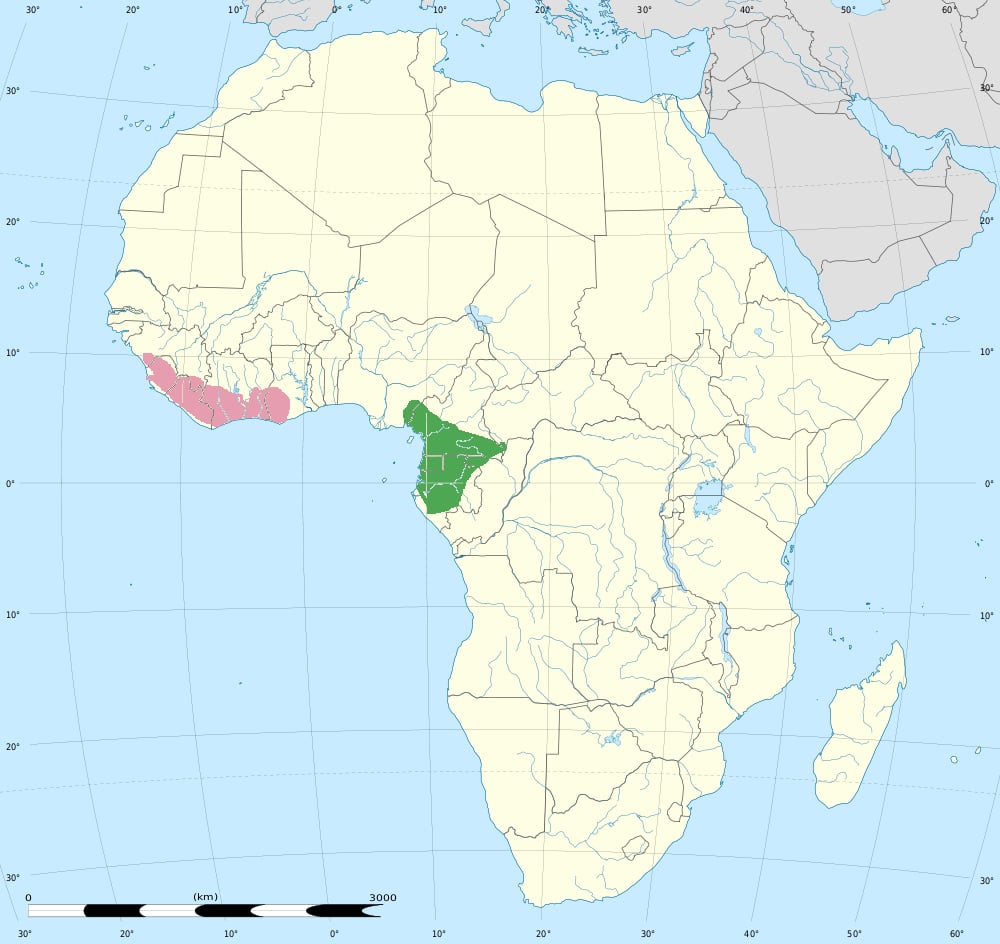
Data retrieved on October 15, 2025 at 5:31 AM