 Bird App
Bird of the day
Chestnut-hooded laughingthrush
Pterorhinus treacheri
The chestnut-hooded laughingthrush (Pterorhinus treacheri) is a species of bird in the laughingthrush family Leiothrichidae endemic to Borneo. Described by the British ornithologist Richard Bowdler Sharpe as a distinct species in 1879, it was subsequently considered a subspecies of the chestnut-capped laughingthrush until 2007, when it was again raised to species status by the ornithologists Nigel Collar and Craig Robson. It is 22–24 cm (8.7–9.4 in) long, with a chestnut brown head and chin, with grey feathering on the top of the head. The upperparts and the side of the neck are slaty-grey, with a long white wing patch. The throat, breast, and upper belly are dull yellowish-brown, with purer grey flanks and a reddish-brown vent, lower belly, and thighs. It has a yellow half eye-ring behind and below the eye, while the tail has a blackish tip. Both sexes look similar, while juveniles are duller than adults.
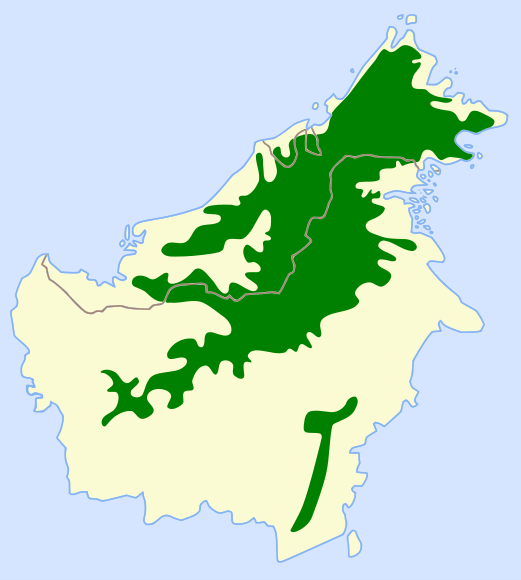
The species inhabits montane and hill forest, forest edge, disturbed vegetation, and cultivated areas in mountains in the north-central and southeastern parts of Borneo. It is mainly found at elevations of 600–2,800 m (2,000–9,200 ft), but can be found down to 200 m (660 ft) and as high as 3,350 m (10,990 ft). It is omnivorous, feeding on arthropods, fruit, and flowers. Breeding occurs from February to April and in October, with the species building cup nests and laying clutches of two bright blue to greenish-blue eggs. It is classified as being of least concern by the International Union for Conservation of Nature due to its very large range, fairly large population, and a lack of significant population decline, but its numbers are thought to be decreasing and it is threatened by habitat destruction and habitat fragmentation.
The chestnut-hooded laughingthrush is 22–24 cm (8.7–9.4 in) long, with both sexes having similar appearances. In the nominate subspecies, the chin, lores (area between the eyes and nostrils), supercilium (line above the eye), feathers around the nostrils, and the area around the base of the bill are chestnut brown. The forehead, front of the crown (top of the head), and the area from the eyes down to the chin are darker, with some greyish-white feathering on the crown. The throat, breast, and upper belly are dull yellowish-brown with a greyish tinge and dull yellowish-brown streaking. The flanks are purer grey, while the lower belly, thighs, and vent are reddish-brown. The side of the neck and the upperparts are slaty-grey with a slight yellowish-brown tinge, with a long white patch on the primaries. The tail is darker grey and has a blackish tip. The iris is red to reddish-brown, with a yellow half eye-ring behind and below the eye. The bill is dull orange to yellowish-brown, while the legs are yellowish.
Juveniles are duller than adults. P. t. damnatus has a duller breast with less streaking, while P. t. griswoldi has more intense chestnut on the vent. The species differs from the chestnut-capped laughingthrush by the feathering on the nostrils, its yellow (instead of white) eye-ring that is only present behind and below the eye, chestnut brown chin, greyer upperparts, paler underparts, and greyer feathers on the crown. The undescribed subspecies from western and southeastern Borneo differs from the three known subspecies in the colour of its underparts (peachy-buff instead of buff-grey), the presence of white markings below the eye, and the absence of streaking on the chest.
The song of the chestnut-hooded laughingthrush is a fluty, high-pitched chu-wu, chwi-wi-wi-wi-wiee-wiu-wu with rather clicky starting notes or a rising and falling wiu-wu-wu-wi-wi-wee-wu. It also makes an even-pitched series of up to 12 wi notes, a wu-tuwu-tuwu, or a ri'-ri'-ri, all of which are punctuated with a to-we-oh to-we-oh. Its call is a harsh, hoarse churr, while the contact call is a soft, descending ah-ah-ah-ah, with the latter notes also given singly.
Range
Links
Data retrieved on October 15, 2025 at 5:24 AM