 Bird App
Bird of the day
Pale crag martin
Ptyonoprogne obsoleta
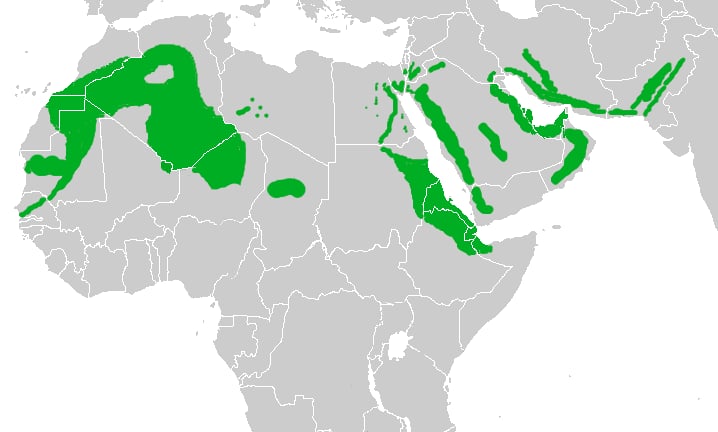
The pale crag martin (Ptyonoprogne obsoleta) is a small passerine bird in the swallow family that is resident in Northern Africa and in Southwestern Asia, east to Pakistan. It breeds mainly in the mountains, but also at lower altitudes, especially in rocky areas and around towns. Unlike most swallows, it is often found far from water. It is 12–13 cm (4+1⁄2–5 in) long, with mainly brown plumage, paler-toned on the upper breast and underwing coverts, and with white "windows" on the spread tail in flight. The sexes are similar in appearance, but juveniles have pale fringes to the upperparts and flight feathers. It was formerly considered to be the northern subspecies of the rock martin of southern Africa, although it is smaller, paler, and whiter-throated than that species. The pale crag martin hunts along cliff faces for flying insects using a slow flight with much gliding. Its call is a soft twitter.
This martin builds a deep bowl nest on a sheltered horizontal surface, or a neat quarter-sphere against a vertical rock face or wall. The nest is constructed with mud pellets and lined with grass or feathers, and may be built on natural sites under cliff overhangs or on man-made structures such as buildings and bridges. It is often reused for subsequent broods or in later years. This species is often a solitary breeder, but small groups may breed close together in suitable locations. The two or three eggs of a typical clutch are white with brown and grey blotches, and are incubated by both adults for 16–19 days prior to hatching. Both parents then feed the chicks. Fledging takes another 22–24 days, although the young birds will return to the nest to roost for a few days after their first flight.
The pale crag martin is caught in flight by several fast, agile falcon species, such as hobbies, and it sometimes carries parasites, but it faces no major threats. Because of its range of nearly 20 million square kilometres (7,700,000 sq mi) and a large and apparently increasing population, it is not seen as vulnerable and is assessed as Least Concern on the IUCN Red List.
The pale crag martin of the nominate subspecies P. o. obsoleta is 12–13 centimetres (4+1⁄2–5 inches) long with light brown upperparts, becoming paler on the lower back, and a short square tail that has small white patches near the tips of all but the central and outermost pairs of feathers. It has a pale grey throat, upper breast and underwing coverts, and the rest of the underparts are a dirty white. The eyes are brown, the small bill is mainly black, and the legs are brownish-pink. The wing length averages 13 cm (5 in) and the tail averages 4.8 cm (1+7⁄8 in). The sexes are similar in appearance, but juveniles have pale edges to the upperparts and flight feathers. The other subspecies differ from the nominate form as detailed in the table above.
This martin moults early, with adults having completely replaced their feathers by late August. Juveniles moult somewhat later, and their old primary feathers are retained even when the body has mainly adult plumage.
The pale crag martin's flight is slow, with rapid wing beats interspersed with flat-winged glides, and it is more acrobatic than the larger Eurasian crag martin. It is a quiet bird; the song is a muffled twitter, and other calls include a trrt resembling the call of the common house martin, a nasal vick, and a high-pitched twee contact call.
The pale crag martin is much drabber than most African swallows, and confusion is unlikely except with other crag martins or with sand martins of the genus Riparia. It is 15% smaller, paler and greyer than the Eurasian crag martin, and has smaller tail spots. It is smaller, paler, and has a more contrasting throat than the rock martin. In the far east of its range, the pale crag martin always has lighter underparts than the dusky crag martin. Although only slightly larger than the sand martin and brown-throated sand martin, the pale crag martin is more robust, has white tail spots, and lacks a breast band. Separation of similar species in flight may be complicated by the difficulty of judging colours accurately in strong desert light, particularly with juveniles. The fast flight of the brown-throated sand martin also makes identification more difficult.
Aliases
Ptyonoprogne obsoleta
Range
Links
Data retrieved on October 15, 2025 at 5:21 AM