 Bird App
Bird of the day
Markham's storm petrel
Oceanodroma markhami
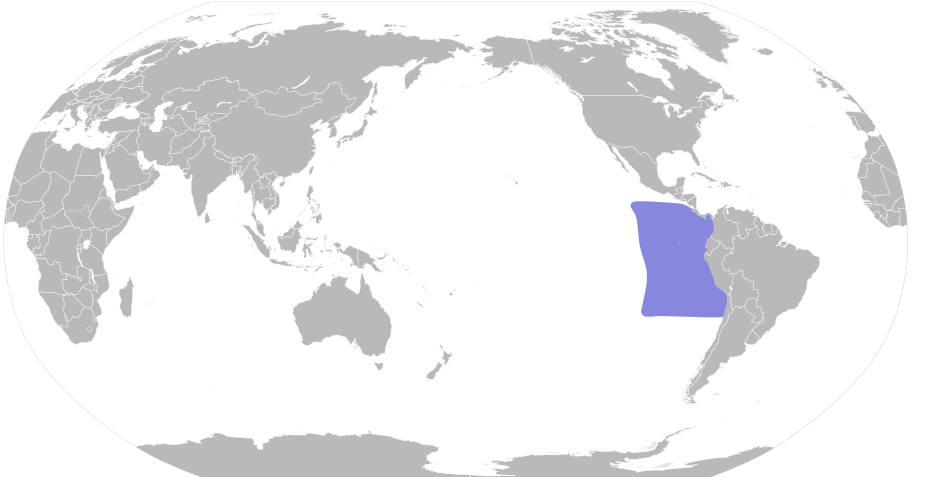
Markham's storm petrel (Hydrobates markhami) is a seabird native to the Pacific Ocean around Peru, Chile, and Ecuador. The species is named after British explorer Albert Hastings Markham, who collected the specimen on which the scientific description was based. It is a large and slender storm petrel, with a wingspan between 49 and 54 cm (19 and 21 in). Its plumage is black to sooty brown with a grayish bar that runs diagonally across the upper side of the wings. A member of the family Hydrobatidae, the northern storm petrels, the species is similar to the black storm petrel (Hydrobates melania), from which it can be hard to distinguish.
A colonial breeder, this storm petrel nests in natural cavities in salt crusts in northern Chile and Peru; ninety-five percent of the known colonies are found in the Atacama Desert. The first colony was only reported in 1993, and it is expected that more colonies are yet to be discovered. Pairs produce one egg per season, which is laid on bare ground without any nesting material. Parents will attend their brood only at night, returning to the sea before dawn. The timing of the breeding season significantly varies both within and in between colonies, for unknown reasons. The diet of Markham's storm petrel consists of fish, cephalopods such as octopuses, and crustaceans; about ten percent of stomach contents is traceable to scavenging.
The species is listed as near threatened by the International Union for Conservation of Nature (IUCN). Despite their relatively large population, which was estimated at between 150,000 and 180,000 individuals in 2019, the species is in decline. Primary threats are habitat destruction due to mining of the salt crusts the birds rely on for breeding, and light pollution by mines and cities near the colonies. Light pollution can attract or disorient fledglings that make their first flight to the sea, and has been estimated to be responsible for the death of around 20,000 fledglings each year, which might amount to one third of all fledglings.
Markham's storm petrel is a large and slender storm petrel. As in other species of its genus, the wings are slender with tapering tips and a distinct wing bend at the carpus (wrist). The tail is deeply forked. The fresh plumage is black to sooty brown with a dull lead-gray gloss on its head, neck, and mantle. With wear, the plumage becomes browner overall. A distinct crescent-shaped, grayish bar runs diagonally over the upper side of the inner wing. The covert feathers above this bar are often brownish, while the primaries below it are often blackish, resulting in a characteristic three-colored wing pattern. The iris is brown and the bill, legs, and feet are black. The bill is shorter than in most related species, whereas the nasal tube on top of the bill is long, reaching to the mid-length of the beak. Adults have a wingspan between 49 and 54 cm (19 and 21 in) and measure between 21 and 23 cm (8.3 and 9.1 in) from the tip of the bill to the tip of the tail. Body weight is 53 g (1.9 oz) on average. Sexes are alike without morphological differences.
Similar birds within its range include the black storm petrel (Hydrobates melania) and the dark variety of Leach's storm petrel (Hydrobates leucorhous). It is especially difficult to distinguish from the similar-sized black storm petrel, from which it differs in having a tarsus that is much shorter than the foot, and in that the gray bar on the upper side of the wing is more distinct and reaches closer to the leading edge of the wing. Markham's storm petrel also differs in its shorter neck and more angular head, and in the more pronounced forking of the tail. From Leach's storm petrel, it differs in its more pronounced tail forking, its longer wings, and larger size. Differences in flight patterns also aid in separating these species. Markham's storm petrel typically flies leisurely and often glides with intermittent shallow wingbeats, whereas the black storm petrel glides less often and tends to use deep wingbeats. Markham's storm petrel also typically flies greater than 1 m (3.3 ft) over the ocean surface, in contrast to the black storm-petrel, which usually flies at less than one meter. Leach's storm petrel generally uses deeper wingbeats and its flight is more bouncing.
The calls of Markham's storm petrel have been described as series of "purrs", "wheezes", and "chatters". Adults in nests were found to vocalize when a recording of Markham's storm petrel vocalizations was played at the entrance of the nest cavity.
Aliases
Oceanodroma markhami, Markhamís storm-petrel, Markhamis storm-petrel, Hydrobates markhami
Range
Data retrieved on October 15, 2025 at 5:19 AM