 Bird App
Bird of the day
Great tit
Parus major
The great tit (Parus major) is a small passerine bird in the tit family Paridae. It is a widespread and common species throughout Europe, the Middle East, Central Asia and east across the Palearctic to the Amur River, south to parts of North Africa where it is generally resident in any sort of woodland; most great tits do not migrate except in extremely harsh winters. Until 2005 this species was lumped with numerous other subspecies. DNA studies have shown these other subspecies to be distinct from the great tit and these have now been separated as two distinct species, the cinereous tit (Parus cinereus) of southern Asia, and the Japanese tit (Parus minor) of East Asia. The great tit remains the most widespread species in the genus Parus.
The great tit is a distinctive bird with a black head and neck, prominent white cheeks, olive upperparts and yellow underparts, with some variation amongst the numerous subspecies. It is predominantly insectivorous in the summer, but will consume a wider range of food items in the winter months, including small hibernating bats. Like all tits it is a cavity nester, usually nesting in a hole in a tree. The female lays around 12 eggs and incubates them alone, although both parents raise the chicks. In most years the pair will raise two broods. The nests may be raided by woodpeckers, squirrels and weasels and infested with fleas, and adults may be hunted by sparrowhawks. The great tit has adapted well to human changes in the environment and is a common and familiar bird in urban parks and gardens. The great tit is also an important study species in ornithology.
The great tit is large for a tit at 12.5 to 14 cm (4+7⁄8–5+1⁄2 in) in length, and has a distinctive appearance that makes it easy to recognise. The nominate race P. major major has a bluish-black crown, black neck, throat, bib and head, and white cheeks and ear coverts. The breast is bright lemon-yellow and there is a broad black mid-line stripe running from the bib to vent. There is a dull white spot on the neck turning to greenish yellow on the upper nape. The rest of the nape and back are green tinged with olive. The wing-coverts are green, the rest of the wing is bluish-grey with a white wing-bar. The tail is bluish grey with white outer tips. The plumage of the female is similar to that of the male except that the colours are overall duller; the bib is less intensely black, as is the line running down the belly, which is also narrower and sometimes broken. Young birds are like the female, except that they have dull olive-brown napes and necks, greyish rumps, and greyer tails, with less defined white tips.
There is some variation in the subspecies. P. m. newtoni is like the nominate race but has a slightly longer bill, the mantle is slightly deeper green, there is less white on the tail tips, and the ventral mid-line stripe is broader on the belly. P. m. corsus also resembles the nominate form but has duller upperparts, less white in the tail and less yellow in the nape. P. m. mallorcae is like the nominate subspecies, but has a larger bill, greyer-blue upperparts and slightly paler underparts. P. m. ecki is like P. m. mallorcae except with bluer upperparts and paler underparts. P. m. excelsus is similar to the nominate race but has much brighter green upperparts, bright yellow underparts and no (or very little) white on the tail. P. m. aphrodite has darker, more olive-grey upperparts, and the underparts are more yellow to pale cream. P. m. niethammeri is similar to P. m. aphrodite but the upperparts are duller and less green, and the underparts are pale yellow. P. m. terrasanctae resembles the previous two subspecies but has slightly paler upperparts. P. m. blandfordi is like the nominate but with a greyer mantle and scapulars and pale yellow underparts, and P. m. karelini is intermediate between the nominate and P. m. blandfordi, and lacks white on the tail. The plumage of P. m. bokharensis is much greyer, pale creamy white to washed out grey underparts, a larger white cheep patch, a grey tail, wings, back and nape. It is also slightly smaller, with a smaller bill but longer tail. The situation is similar for the two related subspecies in the Turkestan tit group. P. m. turkestanicus is like P. m. bokharensis but with a larger bill and darker upperparts. P. m. ferghanensis is like P. m. bokharensis but with a smaller bill, darker grey on the flanks and a more yellow wash on the juvenile birds.
The colour of the male bird's breast has been shown to correlate with stronger sperm, and is one way that the male demonstrates his reproductive superiority to females. Higher levels of carotenoid increase the intensity of the yellow of the breast its colour, and also enable the sperm to better withstand the onslaught of free radicals. Carotenoids cannot be synthesized by the bird and have to be obtained from food, so a bright colour in a male demonstrates his ability to obtain good nutrition. However, the saturation of the yellow colour is also influenced by environmental factors, such as weather conditions. The width of the male's ventral stripe, which varies with individual, is selected for by females, with higher quality females apparently selecting males with wider stripes.
The great tit is, like other tits, a vocal bird, and has up to 40 types of calls and songs. The calls are generally the same between the sexes, but the male is much more vocal and the female rarely calls. Soft single notes such as "pit", "spick", or "chit" are used as contact calls. A loud "tink" is used by adult males as an alarm or in territorial disputes. One of the most familiar is a "teacher, teacher", often likened to a squeaky wheelbarrow wheel, which is used in proclaiming ownership of a territory. In former times, English folk considered the "saw-sharpening" call to be a foretelling of rain. Tit calls from different geographic regions show some variation, and tits from the two south Asian groups recently split from the great tit do not recognise or react to the calls of the temperate great tits.
One explanation for the great tit's wide repertoire is the Beau Geste hypothesis. The eponymous hero of the novel propped dead soldiers against the battlements to give the impression that his fort was better defended than was really the case. Similarly, the multiplicity of calls gives the impression that the tit's territory is more densely occupied than it actually is. Whether the theory is correct or not, those birds with large vocabularies are socially dominant and breed more successfully.
Aliases
Parus major
Range
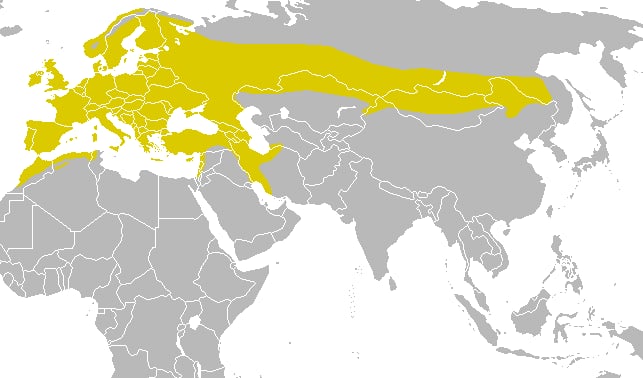
Data retrieved on October 15, 2025 at 5:17 AM