 Bird App
Bird of the day
Spruce grouse
Canachites canadensis
The spruce grouse (Canachites canadensis), also known as Canada grouse, spruce hen or fool hen, is a medium-sized grouse closely associated with the coniferous boreal forests or taiga of North America. It is the only member of the genus Canachites.
It is one of the most arboreal grouse species, fairly well adapted to perching and moving about in trees. When approached by a predator, it relies on camouflage and immobility to an amazing degree; for example, letting people approach within a few feet before finally taking flight.
Spruce grouse are 38–43 cm (15–17 in) long; males weigh 550–650 g (19–23 oz) and females 450–550 g (16–19 oz). The spruce grouse has a wingspan range of 21.5–22.6 in (55–57 cm). Races vary slightly in plumage, especially in the tail pattern and in the extent of white on the underparts, but in general adult males are mainly grey above and black below, with white spots along the side, and a red patch of bare skin over the eye called the "eyebrow comb". This red eyebrow comb, should not be confused by a similar yellow marking found on other species of grouse including, but not limited to, sharp-tailed and dusky grouse. Adult females are mottled brown (red morph) or mottled grey (grey morph) with dark and white bars on the underparts. Juveniles resemble females. Females may be confused with ruffed grouse but they have a dark tail with a pale band at the end (while the reverse is true in ruffed grouse) and they do not erect their crown feathers when alarmed the way ruffed grouse do.
Spruce grouse are among the most silent of all grouse, but they nevertheless have a number of calls used to warn of predators, to repel territorial intruders, to maintain brood cohesion, or to elicit brooding. In the subspecies franklinii, territorial males are notable for their wing-clap display. At the end of a short flight through the trees, the wings are brought together over the back so as to produce two sharp claps, about half a second apart, loud enough to be heard by the human ear 150 m (490 ft) away. These territorial displays can sometimes be elicited by similar hand clapping, and can be used to detect male territories and estimate their density. Other non-vocal sounds include soft drumming by territorial males (a sound produced by the beating wings) and a tail-swish and a whoosh produced by the tail feathers in flight.
Aliases
Canachites canadensis, Falcipennis canadensis
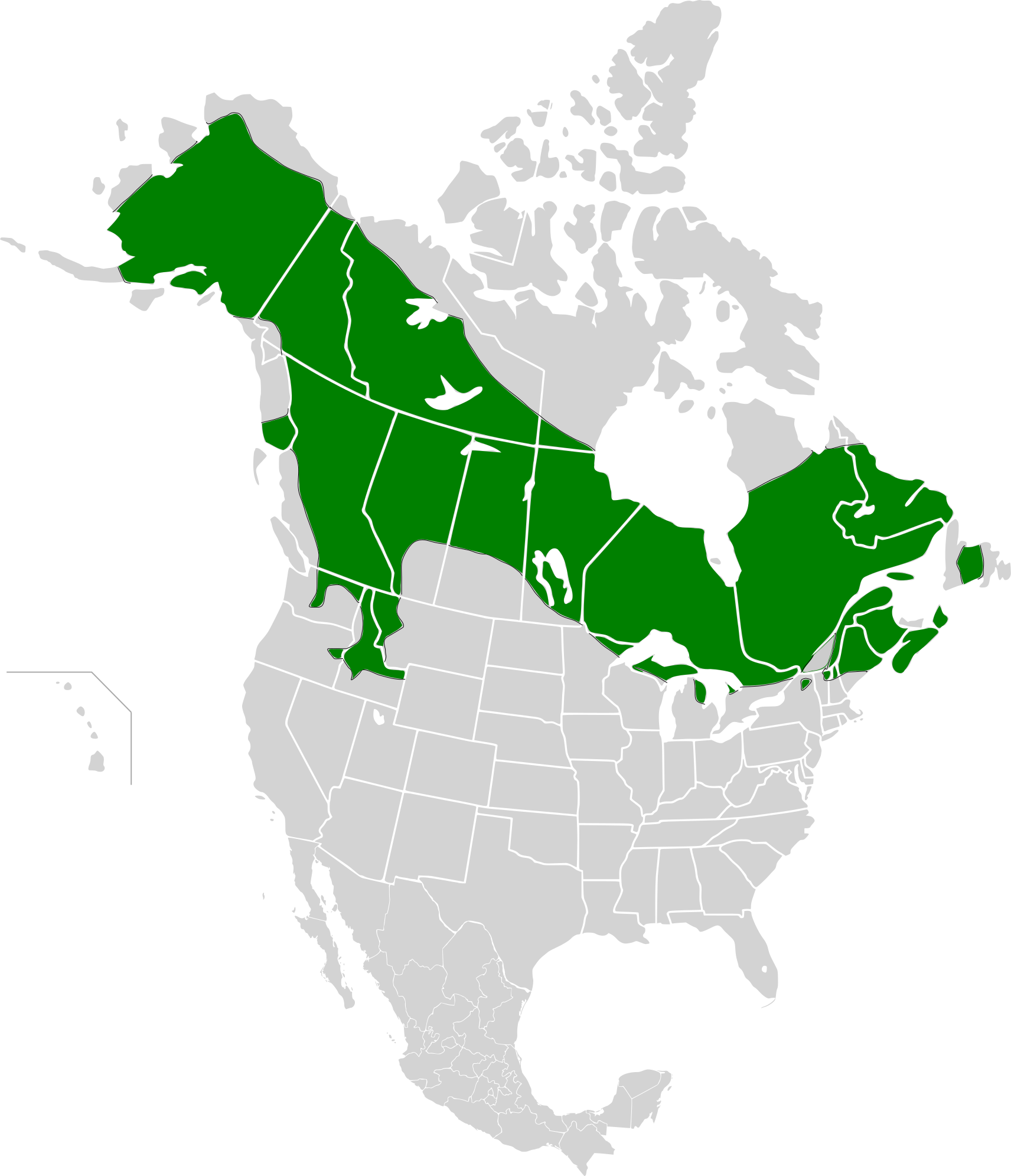
Range
Links
Data retrieved on September 27, 2026 at 5:42 PM