 Bird App
Bird of the day
Dalmatian pelican
Pelecanus crispus
The Dalmatian pelican (Pelecanus crispus), also known as the curly-headed pelican, is the largest member of the pelican family and among the heaviest flying birds in the world. With a wingspan typically ranging between 2.7 and 3.2 metres (8 ft 10 in and 10 ft 6 in), it ranks among the largest soaring birds. These pelicans are known for their graceful flight and often travel in synchronised flocks. With a range spanning across much of Central Eurasia, from the eastern Mediterranean in the west to the Taiwan Strait in the east, and from the Persian Gulf in the south to Siberia in the north, it is a short-to-medium-distance migrant between breeding and overwintering areas.
As with other pelicans, its diet is mainly fish, and the males are larger than the females. Its curly nape feathers, grey legs and silvery-white plumage are distinguishing features, and the wings appear solid grey in flight. The adults acquire a drabber plumage in winter, however, making them look more similar to the great white pelican. Its harsh vocalizations become more pronounced during the mating season. It breeds across the Palearctic from southeastern Europe to Russia, India and China in swamps and shallow lakes. It usually returns to traditional breeding sites, where it is less social than other pelican species. Its nests are crude heaps of vegetation, which are placed on islands or dense mats of vegetation.
The species' numbers dramatically declined during the 20th century, partly due to land use, disturbance and poaching activities. The core population survives in Russia, but in its Mongolian range, it is critically endangered. Removal of power lines to prevent bird strike or electrocution and constructing nesting platforms or rafts have reversed declines locally.
The Dalmatian pelican is the largest of all pelican species and one of the heaviest flying birds in the world, with a body length of 1.6–1.8 m (5 ft 3 in – 5 ft 11 in), a wingspan typically ranging between 2.7–3.2 m (8 ft 10 in – 10 ft 6 in)., and an average weight of about 11 kg (24 lb).
The species is most easily recognised by its enormous bill, which typically measures between 37 and 45 cm (15 and 18 in) long and includes a large pouch used for catching fish. This makes it the bird species with the second longest bill, only surpassed by the Australian pelican (Pelecanus conspicillatus), whose bill length ranges from 34.6 to 50 cm (13.6 to 19.7 in). During the breeding season, this pouch becomes a vivid orange-red, contrasting with the more subdued yellow or grey tones observed during the rest of the year. The upper mandible remains greyish throughout, often with a slight orange tip.
The Dalmatian pelican has silvery-white plumage, which may appear more grey or creamy, especially in winter. A distinguishing feature is the presence of a shaggy crest of curly feathers on the nape and back of the head, giving the bird a notably unkempt appearance compared to the smooth-headed great white pelican (Pelecanus onocrotalus). The legs are dark grey, another feature that helps separate it from related species with pinkish legs.
While generally a quiet species, the Dalmatian pelican may produce deep, guttural grunts, hisses, or barking sounds during the breeding season. Juveniles are overall greyer and duller in appearance, with less distinctive crests and darker plumage, but gradually acquire the characteristic silvery-white plumage as they mature.
Aliases
Pelecanus crispus, Dalmatian pelican
Range
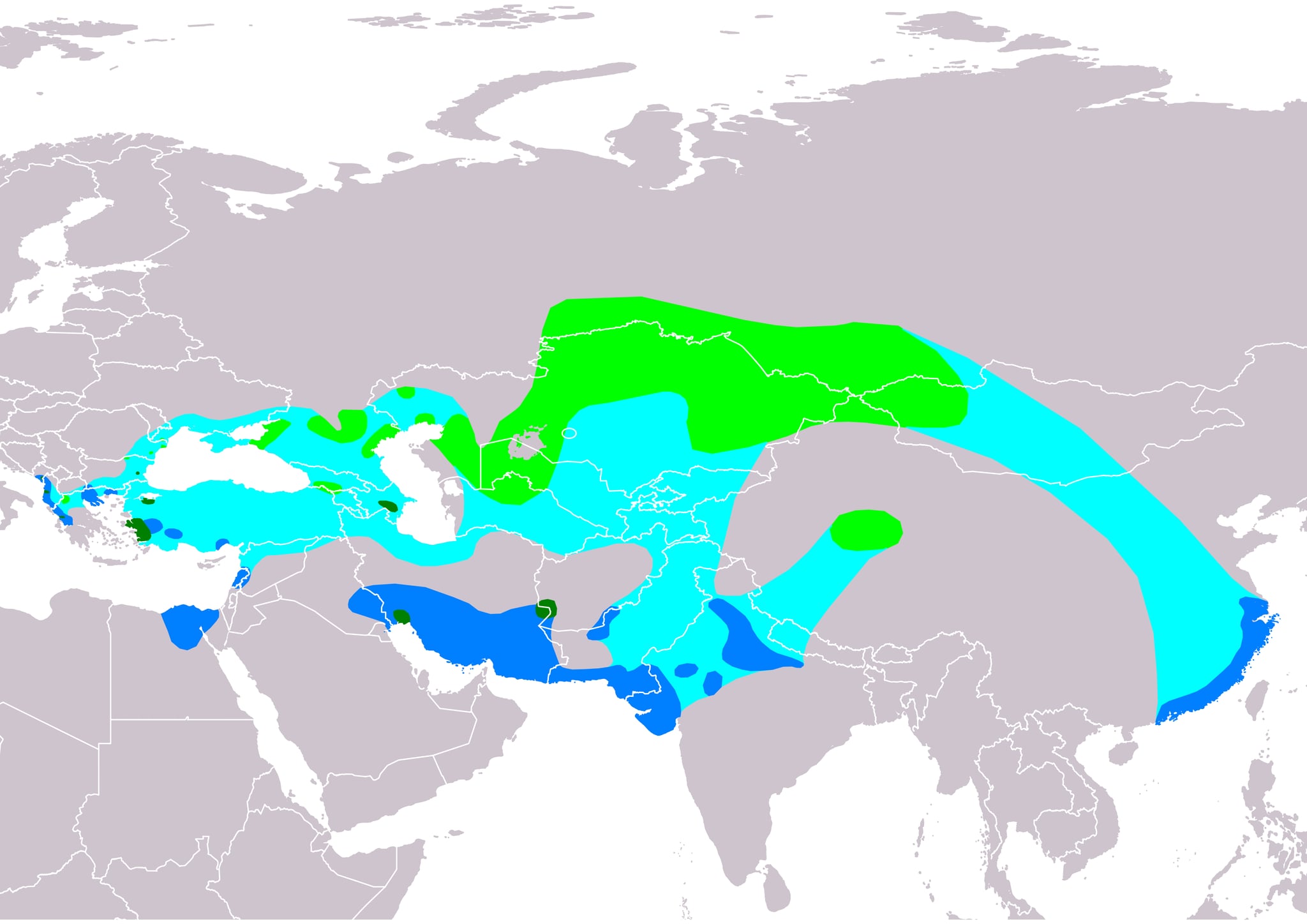
Data retrieved on October 15, 2025 at 5:16 AM